

Stoma travel certificate & airport security: the honest UK guide
Quick answer: A stoma travel certificate is a small multilingual card or letter confirming you wear a stoma pouch and need to carry your supplies in your hand luggage. It isn't a legal document and no airport can demand one, but it makes the conversation at security shorter and calmer — especially abroad. In the UK you can usually get one from your stoma care nurse, from stoma charities and support organisations, or from your pouch manufacturer or delivery company, and many are available as a PDF you can save to your phone. At the checkpoint, mention the pouch before you step into the scanner and ask for a private search if you'd rather not do it in front of the queue.
The certificate isn't really about the piece of paper. It's about the ninety seconds at security when you're standing there in socks, holding a tray, wondering whether you're about to have a very public conversation about your abdomen. Almost every ostomate remembers their first flight after surgery — the low-level dread on the drive to the airport, the mental rehearsal of what you'd say. Here's the honest version: it's nearly always a non-event. And a certificate, plus knowing exactly what happens and what to say, turns it into an even smaller one.
Key takeaways
- A travel certificate is optional, but it makes explaining yourself faster — particularly on flights where English isn't the first language.
- Save it as a PDF and carry a paper copy. Phones die; laminated cards don't.
- Body scanners don't harm your pouch. They may flag it, which usually means a swab or a quick pat-down.
- Everything you genuinely need goes in hand luggage. Hold bags go missing; your supplies shouldn't be in one.
What a stoma travel certificate actually is — and what it isn't
 Stoma BeltHernia support & leak prevention. Trusted by 50,000+ ostomates worldwide.Discover →
It's a card or a single sheet, typically wallet-sized or A5, that says something along the lines of: the bearer wears a stoma pouch and must carry supplies in hand luggage, including scissors where required. The useful ones repeat that sentence in several languages — French, Spanish, German, Italian, Arabic, Turkish and Greek are common — so you can simply point at the relevant paragraph rather than mime anything.
What it isn't: it isn't a fast-track pass, it isn't a legal exemption, and it won't stop a security officer from screening you. No UK airport requires one, and nobody is going to turn you away for not having it. Think of it as a translation tool with a bit of official-looking weight behind it. Where it genuinely earns its place is abroad — a checkpoint in a country where you don't share a language, being asked to explain the flat rectangular thing under your waistband. That's when a printed line in the local language does more for your blood pressure than any amount of confident gesturing.
Worth being fair here: plenty of ostomates fly for years without one and never miss it. If you mainly do short hops within the UK and Ireland, a clear sentence — "I have a stoma, I'm wearing a pouch" — does the same job. The certificate is insurance for the trips where words might fail.
Where to get one in the UK (and how to get the PDF)
There's no single national issuer, which is why searching for it feels oddly confusing. In practice you have four routes, and there's no harm in having more than one.
| Where to ask | What you usually get | Best for |
|---|---|---|
| Your stoma care nurse (NHS or your delivery service's nurse team) | A signed letter on headed paper, sometimes with a card | Anyone who wants something personalised and signed |
| UK stoma charities and support organisations | Multilingual travel card, often posted out or downloadable | The classic wallet card most people mean by "travel certificate" |
| Your pouch manufacturer or delivery company | A travel card or certificate where they offer one, usually via customer care or their website | Quick turnaround if you already order through them |
| Your own printed note | A short paragraph you've written and translated yourself | Last-minute trips, or as a backup copy |
On the PDF question, since that's what half the people reading this actually came for: most of the above can be sent or downloaded digitally. The practical setup that works is belt-and-braces — save the PDF to your phone's wallet or favourites so it opens without signal, email a copy to yourself, and print one on paper that lives permanently in your passport wallet. Roaming data at 6am in a foreign terminal is not a plan. A folded sheet in with your boarding pass is.
Ask for it a couple of weeks before you travel if you can. Posted cards take time, and the week before a holiday is already busy enough.
What actually happens at a UK security checkpoint
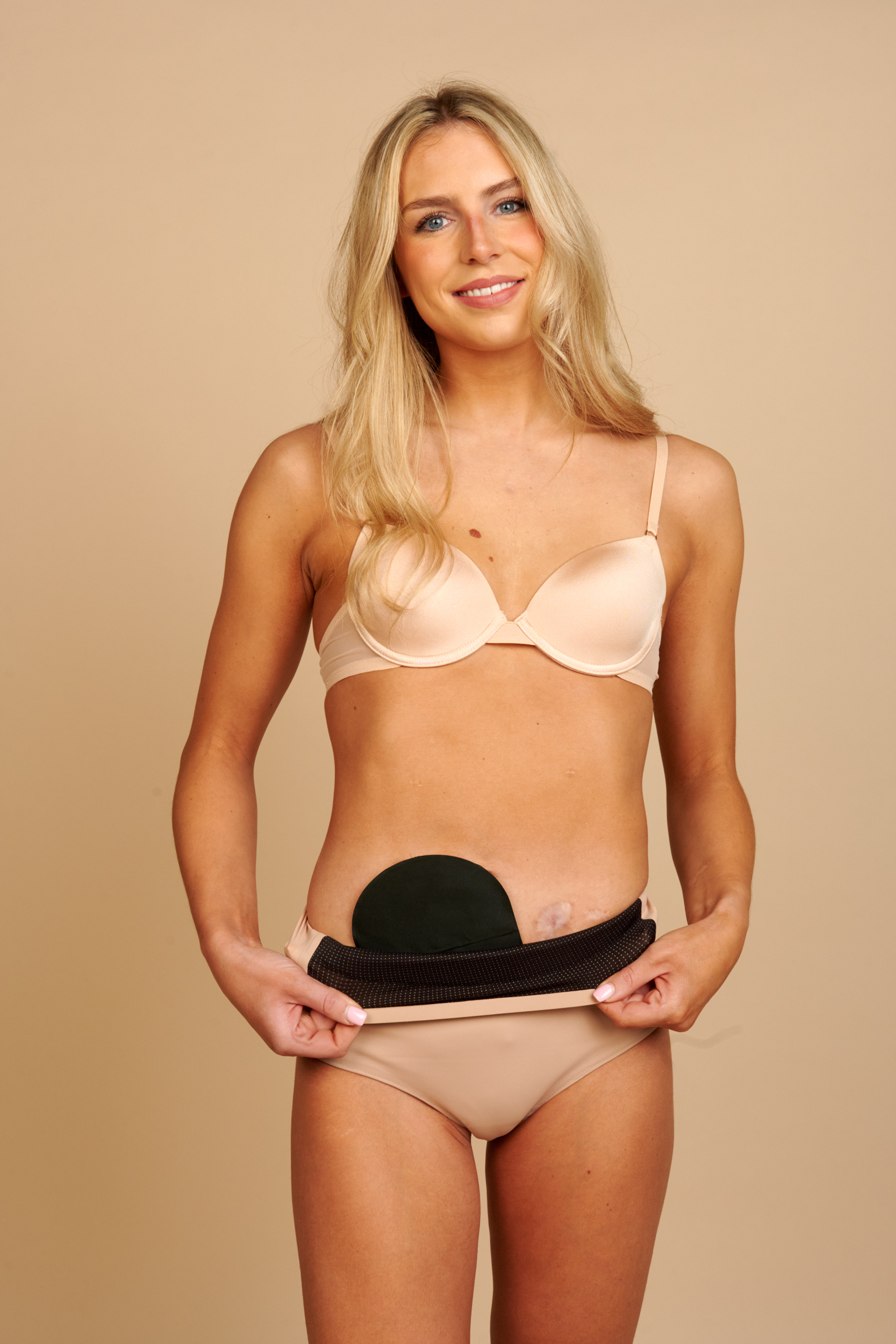
You walk up, you put your things in the tray, and you go through either an archway metal detector or a full-body scanner. The pouch itself doesn't set off a metal detector — there's no metal in it. Body scanners are a different mechanism: they look for anything that isn't skin, so a pouch, a support belt or a wrap can show as an anomaly on the officer's outline diagram. That's normal, it happens to people with all sorts of things under their clothes, and it doesn't mean anything has gone wrong.
If it flags, one of three things follows. Most often, a targeted pat-down of that area — over your clothes, done by an officer of the same sex. Sometimes a swab of your hands or clothing, which is checked for traces in a machine (some people call it "the gunpowder swab"). Occasionally, if the officer needs to see more, they'll ask to check the area more closely. You can request a private search room at any point, for any reason, and you don't have to justify it. In the UK that request is routine and nobody blinks.
What genuinely helps: say it first. Volunteering "I have a stoma, there's a pouch on my abdomen" before you step into the scanner reframes the whole interaction — you're informing them, not being caught out. And no, you don't have to show anyone your stoma. Being checked over clothing on that area is the standard, and if an officer suggests otherwise, ask for a supervisor and the private room.
The thirty-second script
Having the words ready is half the calm. Something like:
- Approaching the scanner: "Just so you know, I have a stoma — I wear a pouch on my abdomen. It may show on the scanner."
- If they want a closer look: "Happy for you to check over my clothing. Could we do that in the private room, please?"
- If there's a language barrier: hand over the certificate, open at the right language, and point. Then let them lead.
- About your bag of supplies: "These are my stoma supplies — scissors for cutting the flange, and adhesive remover spray. Here's my certificate."
On the liquids question: the standard cabin allowance applies to the everyday bits, but essential liquids and gels you need for your stoma can usually be carried in larger quantities if you declare them at the checkpoint and can support them with documentation — this is exactly the moment the certificate earns its keep. Rules and screening equipment vary between UK airports and are still changing at some, so have a quick look at your departure airport's own security page a few days before you fly rather than relying on what worked last summer.
Packing supplies: the hand luggage maths

The single rule that matters: everything you'd be stuck without goes in your hand luggage. Hold bags get delayed, rerouted and occasionally lost, and no resort chemist is going to have your exact flange size on a Sunday. Split the rest across a second bag if you're travelling with someone.
A sensible cabin kit, based on what most ostomates end up carrying:
- Double what you'd normally use for the length of the trip — heat, different food and long travel days all change your pattern.
- Pre-cut a few flanges at home so you're not doing that on a tray table.
- Disposal bags, wipes, dry wipes and a roll of kitchen paper flattened into the bag — that last one is the tip that keeps coming up in support groups, and it's genuinely better than airport hand towels.
- Adhesive remover, barrier spray, and any powder or paste you use.
- A full change of clothes, or at minimum spare underwear, sealed in a bag.
- Your certificate, plus a note of your product codes — far more useful than the box if you need to buy locally.
- A spare kit kept in the car for the drive to the airport and the drive home. Small habit, enormous relief the one time you need it.
Somewhere between packing and boarding is where the wardrobe decision quietly matters. A soft high-waisted brief or a light support wrap holds everything flat and steady while you're hauling cases and sitting for hours, and it makes the security pat-down a non-event because there's nothing bulky or crinkly to explain. Have a look at the stoma wraps and support pieces if you want that held-in feeling for a long-haul day.
Beyond the checkpoint: assistance, lanyards and airport loos
Security is one small part of the airport. The rest is worth planning too.
- Special assistance can be booked through your airline, usually at least 48 hours before departure. You don't need to be a wheelchair user — it covers help getting through the terminal, priority at security queues and support at connections. Long walks between gates with a full pouch and a heavy bag are exactly the situation it exists for.
- The Hidden Disabilities Sunflower lanyard is recognised at many UK airports and by a growing number of shops and transport operators. It signals "I may need a little more time or patience" without a single word of explanation. Many airports have them at the information desk. If you're wondering where a stoma sits in all this, our piece on whether having a stoma counts as a disability in the UK covers the honest version.
- Accessible toilets — the ones with a shelf, a sink inside the cubicle and space to actually move are worth walking an extra terminal for. Larger terminals sometimes have a hook and a proper mirror too; if you find a good one, note it for the return leg. Do your change before boarding, not in an aeroplane loo at cruising altitude.
- Radar key for the UK leg of your journey — motorway services, stations, and plenty of airport landside toilets.
The part nobody warns you about: it gets boring, in the best way
By the third or fourth trip, the certificate lives in your passport wallet and you stop thinking about it. You say your sentence, you get swabbed or you don't, and you're at the gate buying an overpriced coffee like everyone else. Ostomates go camping in the middle of nowhere, do theme parks in ridiculous heat, swim in the sea, and fly long-haul for work interviews. The pouch comes along; it just isn't the main character.
The confidence comes from small preparations rather than a big mindset shift. Certificate printed. Supplies doubled. A change of clothes sealed in a bag. Something comfortable and flattering to wear that holds everything where it should be. And, for the far end of the trip, a swimming costume you actually like — because the whole point of getting through security is what's waiting on the other side. If you're new to all this, our guide for new stoma patients is a gentler starting point, and comparing pouch options can help if travel keeps exposing the same weak spot in your routine.
Travel light. Feel like yourself.
High-waisted swimwear designed around a pouch — cut to hold, shaped to flatter, and nothing about it announces why. Pack it and forget about it until the pool.
Frequently asked questions
Can I take stoma scissors in my hand luggage?
Small scissors used for cutting flanges are generally permitted in the cabin when they're part of your stoma supplies, which is precisely why the certificate mentions them. Keep them with the rest of your kit rather than loose in a pocket, declare them at the tray, and have a spare pair in your hold bag as a fallback. If an officer decides otherwise on the day, pre-cutting your flanges before you travel means it costs you nothing.
Does a stoma travel certificate work outside the UK?
The multilingual ones are designed for exactly that — the point of the translated paragraphs is that a security officer in Málaga, Marrakesh or Munich can read the same sentence you can. It carries no legal authority anywhere, including here, but it removes the language barrier, which is usually the actual problem. For long-haul destinations where the languages on your card aren't covered, a translation saved on your phone as a screenshot works fine.
How long after surgery can I fly?
This varies enormously between people and it's a conversation for your own stoma care team, not a blog. What we can say from experience: the first flight is easier when you've already had a few practice runs — a train journey, a day out, a night away — so that changing in an unfamiliar loo isn't brand new on the day you're also managing check-in, security and a departure board.
Will the cabin pressure make my pouch inflate?
Many ostomates notice a bit more ballooning on flights than they do on the ground. It's manageable rather than dramatic: use a filter or a vented pouch if you get on with them, go easy on fizzy drinks and anything that reliably produces gas for you, and empty before boarding and again before descent. A support wrap over the top keeps everything flat and stops the outline showing through your clothes.
Is a stoma card the same thing as a travel certificate?
People use the terms interchangeably, but there's a slight difference in emphasis. A stoma card is usually the small wallet card you carry day to day — useful in any situation where someone needs to know quickly. A travel certificate is the version aimed at airports, with the wording about hand luggage, supplies and scissors, and the multiple languages. If you're offered both, carry both; together they weigh less than a boarding pass.
What should I actually wear through the airport?
Something with a soft high waistband that sits above the flange, no hard buttons or belts pressing on the pouch, and layers you can add when the cabin gets cold. Avoid low-rise anything for travel days. A wrap or support belt under a loose top makes long sitting far more comfortable and means a pat-down is over in seconds. Our stoma clothing range is built around exactly this kind of day.