

Stoma Supplies & Stoma Bags
Stoma supplies come from many makers, and choosing the right stoma bag, wafer and extras can be confusing. This catalogue lines up the UK options side by side: colostomy, ileostomy and urostomy bags, one-piece and two-piece systems, the main brands, how to get supplies on NHS prescription or by home delivery, and the accessories that make daily life easier. Use the quick chooser to find your starting point, tick off the monthly checklist, then ask your stoma care nurse to confirm the fit. One honest note before you scroll: SIIL doesn't sell pouches or wafers; we make the accessories and clothing to wear with them.



Stoma supplies reach people in the UK in several ways: on NHS prescription written by your GP or, in some areas, a nurse prescriber and filled by a home delivery service or a high-street pharmacy, or as free samples from the maker. The catalogue below brings together stoma bags for colostomy, ileostomy and urostomy, flanges and wafers, seals, wipes and the extras that ease a change. It is a guide to third-party products, for people newly home from hospital and for long-term stoma users alike. For a shortlist of favourites, read our reviews of the best stoma supplies in the UK and the best stoma bags.
Stoma Supplies

Choosing stoma supplies is far easier when the leading brands sit side by side in one catalogue. Here you can compare stoma supplies from Coloplast, Hollister, ConvaTec, Salts, Dansac, B. Braun, Welland and Pelican, and see which stoma bags, flange sizes and skin barriers suit which stoma. Whether you have a colostomy, an ileostomy or a urostomy, the right stoma supplies start with knowing what to ask your stoma nurse for, and the sections below take you through it in plain English.
Knowing your stoma supplies helps you avoid the classic mistakes: a flange that is the wrong size in millimetres, a pre-cut opening that is too tight, a drainable bag where a closed one would do. You will see how stoma supplies reach you on NHS prescription, whether through a home delivery service or a pharmacy, how to ask for free samples and how to plan a month of stoma supplies without running short. The main brands, pouch types and accessories are all explained, so your next order is one you can place with confidence.
| Benefit | Included |
|---|---|
| The main brands of stoma supplies compared in one place | ✓ |
| One-piece, two-piece, closed, drainable and urostomy bags explained | ✓ |
| Colostomy, ileostomy and urostomy bags matched to each type of stoma | ✓ |
| Flange sizes in millimetres, cut-to-fit versus pre-cut, made simple | ✓ |
| Skin-care accessories: rings, paste, powder, wipes and film | ✓ |
| How to get stoma supplies on NHS prescription, including home delivery | ✓ |
| Questions to take to your stoma care nurse | ✓ |
| A monthly checklist of stoma supplies so you avoid running short | ✓ |
| Links to the UK sites of Coloplast, Hollister and ConvaTec for samples | ✓ |
What Is Included in Stoma Supplies: Pouches, Wafers, Seals, Wipes and More
Stoma supplies cover the items you use to collect output and look after the skin around a stoma. The core is the pouching system: a pouch (the bag) and a skin barrier, also called a wafer, baseplate or flange, which sticks to your skin. Around that sit barrier rings or seals, stoma paste, powder, adhesive remover wipes, barrier film, deodorising lubricants, disposal bags and a measuring guide. Our guide to stoma skin barriers, rings and powders explains what each extra is for.
Stoma Supplies Checklist for Your First Weeks After Surgery
You normally leave hospital with a starter supply, anything from about a week to four weeks depending on the trust, plus a plan from your stoma care nurse for ordering more. In the first weeks the stoma shrinks, so expect to change often and to re-measure. Keep spare pouches, a measuring guide, curved scissors, wipes and disposal bags. Ask who orders your first prescription, and when the first delivery lands, before the hospital supply runs low; in some areas a contractor needs about two weeks to receive the prescription from the GP before the first order ships. The new stoma patient guide and our equipment list for changing a stoma bag walk through it.
How Much Do You Need? Working Out a Month of Stoma Supplies
The number of bags and wafers you use depends on your output, your skin and how long each product holds. The table gives typical figures only; your stoma nurse advises on the numbers and your prescriber puts them on the prescription. Heavy output, sweat and hot weather shorten wear time. Keep a one-week spare at home so a late delivery does not leave you short. Our monthly supplies checklist lists the extras to reorder alongside the bags.
| Bag type | Usual change | Bags or wafers a month |
|---|---|---|
| One-piece closed (colostomy) | Once or twice a day | 30 to 60 bags |
| One-piece drainable | Every 2 to 4 days | 8 to 15 bags |
| Two-piece drainable | Wafer every 3 to 5 days | 6 to 10 wafers, plus pouches |
| Urostomy bag with tap | Every 2 to 4 days | 8 to 15 bags, plus night bags as the maker advises |
Stoma Bags
Stoma bags are best chosen by type, size and fit first, and by brand second. Get those three right and most makers' ranges can work well; get one wrong and leaks and sore skin become far more likely. Below: how the bag attaches, how it empties and how the opening is cut, with a table that pairs each type of stoma with a typical bag. See our stoma bag guide and the overview of stoma bag types.
Stoma Bag Types: One-Piece, Two-Piece, Closed, Drainable and Urostomy Bags
Stoma bags fall into a small number of types. Attachment is either one-piece (bag and adhesive barrier joined) or two-piece (a separate baseplate with a bag that clips or sticks on). Emptying is either closed (you change the whole bag when full) or drainable (an outlet you open and clip). Urostomy bags are drainable, usually with a tap. Within each type you then choose a size and, depending on the range, a fabric backing, a filter and a colour. The full list of stoma bag types shows examples of each.
One-Piece vs Two-Piece Stoma Bags: Which Suits Your Skin and Routine
A one-piece stoma bag is slim, quick to apply and often feels the most discreet, but each change means peeling the adhesive off your skin. A two-piece system leaves the wafer in place for around three to five days (some people get longer) while you swap the pouch, which can be kinder to sore or sensitive skin and is handy if you change often. Some people find clipping the pouch on harder with limited dexterity; others prefer being able to rotate it. Try both, ask for samples and decide with your nurse. Our comparison of one-piece and two-piece colostomy bags goes into detail.
Closed vs Drainable Stoma Bags: Matching the Bag to Your Output
Output decides the outlet. A closed bag suits the firmer, formed stool of a colostomy: you remove it, bin it and fit a fresh one. A drainable bag suits the looser output of an ileostomy, or a colostomy that is often loose, because you can empty it without changing it. As a rule, empty a drainable bag when it is one-third to half full, since a heavy bag pulls on the adhesive. Closed bags are lighter and flatter, drainable bags save adhesive changes. Read about drainable one-piece pouches and closed one-piece pouches.
Cut-to-Fit vs Pre-Cut Stoma Bags and Flange Sizes in Millimetres
Cut-to-fit wafers let you trim the opening to your stoma; pre-cut wafers come ready-shaped in set sizes. Cut the opening about 2 to 3 mm larger than the stoma, or as the maker's guide says, so the skin is covered but the stoma is not squeezed. In two-piece systems the pouch must match the flange size, which in most ranges falls between 38 mm and 70 mm, so check each maker's chart. Measure at the widest point with the guide supplied, and again every few weeks while the stoma settles. Pre-cut can suit a stable, round stoma; cut-to-fit gives more flexibility for an oval or changing one.
| Stoma | Usual output | Typical bag | Ask your nurse about |
|---|---|---|---|
| Colostomy | Formed stool | Closed or drainable, with a filter | Filter type, mini bags |
| Ileostomy | Liquid to porridge-like | Drainable, one- or two-piece | Wafer wear time, outlet size |
| Urostomy | Urine, with mucus | Drainable with a tap and anti-reflux valve | Night drainage bag |
| Flush or retracted stoma | Any | Convex wafer | Degree of convexity |
| Sore or sensitive skin | Any | Soft wafer, often two-piece | Barrier film, rings |
Colostomy Bags
Colostomy bags collect the firmer, more predictable output of a stoma formed from the large bowel. Most people use a closed or a lightly drainable bag with a charcoal filter for wind, and many change once or twice a day. Output tends to settle into a pattern, so a descending colostomy can feel manageable quickly, while a transverse one is usually looser. Our colostomy guide for the UK covers the surgery and the first months in detail.
Closed, Drainable and Mini Colostomy Bags and Stoma Caps: Which Suits Your Output
A closed colostomy bag is the usual choice for formed stool because a fresh bag sits flat against the body and its film holds odour in. If your output is looser, or you want to empty without a full change, a drainable colostomy bag keeps the outlet handy. Mini bags are shorter and discreet, popular for sport, swimming and intimate moments, and a tiny stoma cap can do the same job for a well-controlled colostomy if your nurse agrees. Compare colostomy bag types and where to buy colostomy bags in the UK; stoma swimwear and stoma panties hold a small bag neatly.
Colostomy Bags with Filters for Wind, Ballooning and Odour
Wind is normal after colostomy surgery, and a charcoal filter in the bag lets wind out through a small vent while helping to reduce smell. A filter can block with moisture or thick output, which can make the bag balloon; filter covers, replacement stickers and cutting back on foods that cause wind can all help. If the bag inflates often, ask your nurse to check the fit and the filter type. See our guides on stoma bag ballooning and managing stoma bag odour.
Ostomy Bags
Ostomy bags and stoma bags are the same product. In the UK most people say stoma bag, while manufacturers and international websites often write ostomy bag or ostomy pouch. The choices are identical whichever word is used: attachment, emptying, size, filter and fit, so what you learn about one applies to the other. Our ostomy bag guide and the practical advice on how to choose your ostomy bags help you narrow the options before you ask for samples.
Ostomy Bags Explained: Why Brands Use Different Names for the Same Types
Makers name their ranges differently, which makes comparing ostomy bags harder than it should be. One brand's midi may be the length another calls standard, and the two-piece connection may be called a click, snap or coupling. Look instead at four specifications: attachment, outlet, size and wafer shape. Note them for the bag that works for you, and your nurse or home delivery service can match like for like if a product goes out of stock.
Convex Ostomy Bags for Flush or Retracted Stomas
If your stoma sits level with the skin, or below it, output can creep under a flat wafer and cause leaks. A convex wafer has a gentle outward curve that presses around the stoma and helps it stand out so output drops straight into the bag. Convexity ranges from light to deep, in both one- and two-piece versions, and a belt can add a little extra support. Because the wrong grade can bruise skin, a stoma nurse should assess you first. Our guide to stopping a leaking stoma pouch explains when convexity helps.
Ileostomy Bags
Ileostomy bags deal with a stoma formed from the small bowel, where output is looser, more frequent and more irritating to the skin. That points to drainable bags with a secure outlet and a wafer that resists breakdown. Many people empty several times a day and change the whole system about every two to four days, though your nurse may suggest a different rhythm. A well-fitting ileostomy bag helps protect the skin and makes nights easier. Our ileostomy guide for the UK and the notes on ileostomy management add the day-to-day detail.
Drainable Ileostomy Bags for Liquid Output and Sensitive Skin
Liquid output sits against the wafer, so the barrier material matters as much as the bag. Look for a soft, moisture-absorbing wafer that resists breakdown and holds firm without tearing at the skin, and an outlet with a closure you can work with one hand: a roll-up clip, a hook-and-loop fold or an integrated tap. A filter is optional on many ileostomy bags, since there is often less wind, and thin liquid output can block it. A barrier ring fills gaps beside the stoma, and barrier film protects the skin. If the skin keeps breaking down, tell your nurse promptly.
High-Output Ileostomy Bags and Thicker Output: When to Change the Pouch
A high-output stoma, where output is more than about 1 to 1.5 litres a day, needs a larger-capacity bag and often a wider outlet, and your team may advise food or medicine changes to thicken it. Empty a high-output bag when it is about a third full, and change the whole pouch as soon as it leaks or the skin itches or burns. Pancaking, where output stays stuck at the top of the pouch instead of falling to the bottom, is a different problem and often eases with a lubricating gel inside the bag; your nurse can suggest other fixes. Our guide to stoma pancaking shows how to manage it. Call your nurse or GP if you feel dizzy or very thirsty.
Urostomy Bags
Urostomy bags are made for a stoma that passes urine, usually after bladder surgery. Because urine flows constantly, these bags are normally drainable with a tap at the base, and most have an anti-reflux valve inside to stop urine flowing back towards the stoma. Many people change the bag and wafer about every two to four days and empty it when it is about half full. For more on living with a urostomy, read our urostomy guide for the UK and urostomy care advice.
Urostomy Bags with a Tap and Anti-Reflux Valve: How They Work
The tap lets you drain urine into the toilet quickly, with no clip to fiddle with, and you close it again with a twist or a lever. The anti-reflux valve is a one-way barrier inside the bag that stops urine pooling back against the stoma, which helps protect the skin around it. Mucus from the bowel segment is normal and does not mean a problem. If the urine turns cloudy, smells strong or you feel unwell, call your nurse or GP.
Night Drainage Bags and Leg Bags for Urostomy
Overnight a urostomy bag can fill and pull on the wafer. A night drainage bag, usually about two litres, connects to the tap of your urostomy bag with a short tube so urine drains while you sleep. Keep it lower than your body, on a stand or in a bag by the bed, and rinse it as the maker instructs. Some makers offer leg bags for long days out. A night bag holder or a clip stops the tube dragging. Swimming is possible; read our guide to swimming with a urostomy.
Ostomy Pouch
An ostomy pouch is the bag attached to the wafer, and pouch is the word many makers use. A stoma has no valve or sphincter, so the pouch collects output as it leaves the body. Pouches are made of multi-layer film that holds in odour, and many come with a soft fabric backing so the plastic does not touch skin. Our guide on what an ostomy pouch is and our stoma pouch guide explain how the parts fit together.
Ostomy Pouch Sizes, Filters and Opaque or Transparent Fabrics
Many ranges offer mini, midi and maxi pouch lengths, so you can pick the capacity that suits your output and the way you dress. Opaque pouches hide the contents; transparent ones let you and your nurse see the stoma and the output, which is handy in the first weeks and for checking the fit. Filters are usually built into closed pouches and many colostomy pouches, and the soft fabric backing found on many pouches helps keep moisture off the skin. Our guide to signs it is time to replace your ostomy pouch shows what to watch for.
Stoma Supplies by Brand: Coloplast, Hollister, ConvaTec, Salts, Dansac and More
UK stoma supplies come from a handful of manufacturers, and between them they cover colostomy, ileostomy and urostomy bags in one-piece and two-piece versions. The differences are in the wafer, the feel of the fabric and, for two-piece systems, the way the coupling works, so the best way to choose is to try more than one with your nurse's help. The table below gives an overview; the following sections look at the best-known names. For a head-to-head look, read our Coloplast, Hollister and ConvaTec comparison and the brands recommended by stoma nurses.
| Brand | Examples of ranges | Worth knowing |
|---|---|---|
| Coloplast | SenSura Mio, Assura | Wide range of convex options and Brava accessories |
| Hollister | New Image, Moderma Flex, CeraPlus | Adapt rings, paste and powder are widely used |
| ConvaTec | Esteem+ (one-piece), Natura+ (two-piece) | Mouldable barriers and a customer support programme |
| Salts | Confidence Natural | British maker with one- and two-piece bags |
| Dansac | NovaLife | One- and two-piece systems, convex options |
| B. Braun, Welland, Pelican | Flexima (B. Braun), Aura (Welland) | Useful alternatives to try if another wafer irritates |
Coloplast Stoma Bags: SenSura Mio and Assura
Coloplast is among the best known stoma bag makers in the UK. SenSura Mio uses a flexible, body-shaped wafer that follows movement, available as one-piece and two-piece, flat and convex, while Assura is a long-standing range with a wide choice of sizes and outlets. Coloplast also makes the Brava accessories: seals, wipes, powder and adhesive remover. Samples can be ordered from the brand, and your stoma nurse or home delivery service can arrange a trial. See our Coloplast range guide and the maker's own UK website.
Hollister Stoma Supplies: New Image, Moderma Flex and Adapt Accessories
Hollister is another major maker in the UK. New Image is its long-established pouching range, with a click coupling on the two-piece system, Moderma Flex is its flexible one-piece range, and CeraPlus barriers are infused with ceramide, a natural component of skin. The Adapt range covers barrier rings, paste, powder and lubricating deodorant, which many people on other brands use too. Hollister also offers a wide choice of accessories. Our Hollister range guide goes through each line, and the maker's UK website is the place to ask about samples.
ConvaTec Stoma Bags: Esteem+ One-Piece and Natura+ Two-Piece Systems
ConvaTec makes both one-piece and two-piece systems. Esteem+ is its one-piece range, with a mouldable barrier and soft, quiet pouch materials, while Natura+ is its long-established two-piece range, with a choice of flange sizes, outlets and convex options. ConvaTec also makes its own accessories and offers a customer support programme. Natura+ is a good starting point if you like to swap the pouch while the wafer stays on. Read our ConvaTec supplies guide, then see the ConvaTec UK site.
Salts, Dansac, B. Braun, Welland and Pelican: Other Stoma Bag Makers Supplying the UK
Beyond these three, several other makers supply the UK. Salts Healthcare is a British manufacturer with a wide choice of one- and two-piece bags, Dansac offers one- and two-piece systems with convex options, B. Braun supplies one- and two-piece bags, and Welland and Pelican add two more UK-based choices. Switching brand can be worth trying if you leak, if your skin reacts or if your current supply is limited. Read our guide to Dansac stoma bags, then consider asking for samples of two or three alternatives.
Stoma Accessories and Skin-Care Supplies
Accessories fine-tune a pouching system and protect your skin. None is compulsory, and you should add one at a time so you know what works. The core group is barrier rings, paste and powder; the supporting group is wipes, film and tape; the comfort group is deodorants, disposal bags and covers. Our guide to stoma bag accessories and the complete guide to essential products explain what to buy first and what can wait.
Seals, Barrier Rings, Paste and Powder: Fixing Leaks Before They Start
A barrier ring or seal is a soft, mouldable ring that fills the gap between the stoma and the wafer, so output is less likely to creep under the edge. Paste fills small dips and creases, and powder soaks up moisture on sore, weeping skin, but should be dusted on lightly and brushed off before the wafer goes on. Together they handle most early leak problems, particularly with uneven skin, scars or hernia bulges. See stoma skin barriers, rings and powders explained and our advice on skin care around your stoma.
Adhesive Remover Wipes, Barrier Film and Medical Tape for Gentle Changes
Adhesive remover wipes or sprays dissolve the glue so you can lift the wafer with less pull on the skin. Barrier film is a thin, no-sting coating that shields the skin before a new wafer goes on. Hypoallergenic medical tape, the sort used as a plaster around the edge, adds security on hot or active days, often applied as a picture frame around the wafer. Added one at a time, as your skin needs them, they help keep it in better shape. Peel the wafer off slowly, from the top downwards, while pressing the skin with the other hand.
Stoma Products Worth Keeping in the Drawer and What You Can Skip
Not every stoma product earns a place in the drawer. Many people find a spare pouch, a measuring guide, wipes, disposal bags and a barrier ring useful. Deodorising drops, powders and extra tape usually earn their place only if you have a specific problem. If a product sits unused for a month, stop reordering it. Our shop sells accessories and clothing only, never pouches or wafers; browse stoma products and clothing and the full range of stoma clothing for everything that goes over the bag.
How to Get Stoma Supplies on NHS Prescription
On the NHS, stoma supplies are prescribed, not bought over the counter. Your stoma care nurse advises which products suit you, and your GP or a nurse prescriber writes the prescription, which you can take to a pharmacy or pass to a home delivery service. You are usually free to choose which one supplies you. The routes differ slightly in each UK nation, so confirm the details locally. Our NHS cost guide and our stoma care nursing guide give more.
Can You Get Stoma Bags on Prescription? Who Prescribes and How Often
Yes: in the UK, stoma bags and many accessories are available on NHS prescription, usually written by your GP on the advice of your stoma nurse. A repeat prescription lets you reorder regularly, often every month or two depending on your prescriber, with the quantity set to what you need. If your needs change, ask the nurse to update the list. Samples and trial products from the manufacturers are free of charge. Our guide to free stoma supplies, NHS samples and programmes lists what is on offer.
Appliance Contractors and Home Delivery Services for Stoma Supplies
Dispensing appliance contractors, often called DACs, specialise in stoma and continence supplies. Names such as Fittleworth, SecuriCare, Coloplast Charter and Respond Healthcare are well known. The contractor receives your prescription, contacts the surgery for repeats, packs the order discreetly and delivers to your door, often with a helpline and extras such as wipes and disposal bags. You can change contractor if the service is not working for you. See our guide to the best ostomy suppliers in the UK.
Prescription Charges and Medical Exemption for a Permanent Stoma
In Scotland, Wales and Northern Ireland NHS prescriptions are free. In England a prescription charge usually applies unless you are exempt, and people with a permanent stoma can normally apply for a medical exemption certificate by asking the GP surgery for the application form. The official list names colostomy and ileostomy as examples, so ask your GP if you have a urostomy, and a temporary stoma does not usually qualify. The certificate then makes all your NHS prescriptions free. Eligibility rules and forms change, so check the official NHS guidance on free prescriptions and ask your stoma nurse or GP. Until the certificate arrives, ask your pharmacy or contractor how to handle the charge.
Changing Brand or Supplier: Ask Your Stoma Nurse Before You Switch
Changing brand is common and often helps, but do it with support. Tell your stoma care nurse why you want to switch: leaks, itchy skin, a bag that is hard to open. They can arrange samples, check the fit and update the prescription so the new brand arrives without a gap. Moving supplier follows the same path; the new contractor will usually ask for your current order details. The stoma care nurses UK page explains how to reach yours.
Buying Stoma Supplies Privately and Travelling with Them
Sometimes the prescription route cannot help: a bag you need today, a holiday spare, a product your nurse has not yet prescribed. A private purchase fills the gap. Many retailers sell stoma bags online, and some confirm sizes by email before dispatch. Treat private buying as a back-up to your prescription, never a replacement for it, and check delivery times before you pay, especially before a holiday. Read our guide on where to buy colostomy bags in the UK.
Buying Stoma Bags Without a Prescription, VAT and Travel Spares
You can buy stoma bags without a prescription from specialist online shops. Ask the seller whether VAT relief is available: some products can be sold without VAT to people who are chronically sick or disabled, if the buyer signs a short eligibility declaration. Before a trip, pack double what you expect to use, split between hand luggage and the case, and bring pre-cut bags if you would rather not carry scissors. Charities such as Colostomy UK, the Ileostomy & Internal Pouch Association and the Urostomy Association offer peer support and travel advice. Read our travel certificate and airport security guide.
Accessories That Go Over Your Stoma Bag: SIIL Covers, Belts and Clothing
SIIL does not make or sell pouches or wafers. We make the soft accessories and clothing that go with them, designed to sit over any brand of pouch: over 12,000 ostomates wear SIIL pieces and the range is rated 4.8★ from 8,248 reviews. Covers soften the plastic, belts hold the bag flat, and underwear and swimwear give it a pocket. They sit alongside your prescription, adding comfort rather than replacing any of your supplies. Browse the full range in our stoma clothing collection.
Stoma Bag Covers That Soften the Plastic and Hide the Bag
A fabric stoma bag cover slips over your pouch so the plastic does not touch your skin, muffles the rustle and gives you a soft, plain surface under clothing. Covers fit one-piece and two-piece pouches, and can be machine-washed on a gentle cold cycle and air-dried. They are popular in the first weeks after surgery, for work and for anyone who dislikes the look of the bag. Our stoma bag covers come in several colours; the sizing guide helps you choose the right one for your bag, and the guide to covers for work shows them in use.
Stoma Belts, Wraps, Panties, Swimwear and Stoma Guards
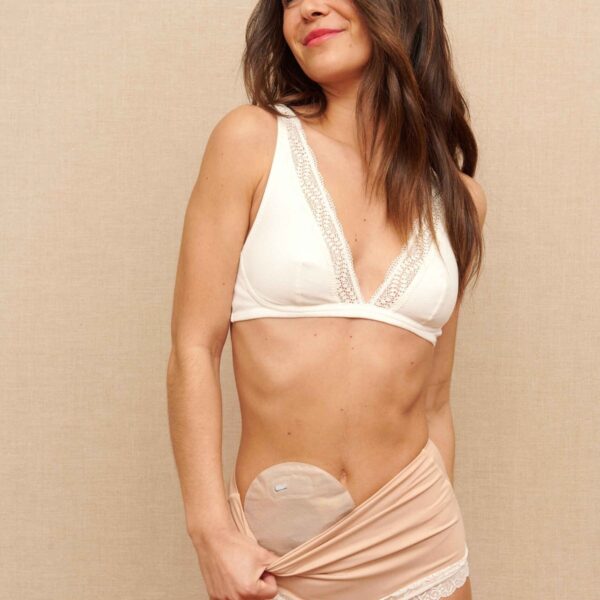
A stoma belt holds the bag flat and adds gentle support round the stoma, which stoma nurses often discuss with people at risk of a parastomal hernia. A wrap is a stretch band worn over your clothes that holds the bag flat, while panties carry it in a soft inner pocket for fitted clothes. Swimwear leaves room for a mini or standard pouch, and the stoma guard protects the area from knocks. Each one sits over your usual pouch without changing how it attaches. See the stoma belt, stoma wraps, stoma panties, stoma swimwear and stoma guard.
Stoma Supplies and Stoma Bag Questions Answered
These are the questions people ask most about stoma supplies, stoma bags and how to get them in the UK. Each answer is general: your stoma care nurse knows your stoma, your skin and your output, and has the last word on what suits you. If a product is leaking, burning or hurting, do not wait for the next appointment; call the nurse or your hospital stoma department the same day.
How Often Should You Change a Colostomy Bag?
It depends on the bag. A closed one-piece colostomy bag is usually changed once or twice a day, or whenever it is about a third full. In a two-piece system you change the pouch as often as you need and the wafer every three to five days or so, as your nurse advises. Change at once if there is itching, burning or leaking, because those are signs the barrier is failing. Your stoma nurse can set a pattern that suits your output and skin. See our guide to how to change a stoma bag.
Can You Get Stoma Bags on Prescription?
Yes. NHS stoma bags and many accessories are prescribed on the advice of your stoma nurse and usually supplied by a home delivery contractor or a pharmacy. A repeat prescription means you do not need to ask each month. In Scotland, Wales and Northern Ireland prescriptions are free, and in England people with a permanent stoma can normally apply for a medical exemption certificate. Ask your GP or nurse to confirm how it works in your area.
Can You Swim With a Stoma Bag?
Yes. Most stoma bags are waterproof and the wafer stays on in water, though you should check that it is fresh and well stuck before you swim. Empty the bag first, cover the filter with the sticker provided and consider a mini bag or a stoma cap. A swimsuit with a lining or a wrap over the bag keeps it discreet. Read our guide to swimming with a stoma and see colostomy bags and swimming.
Can You Shower With a Stoma Bag On?
Yes, you can shower with the bag on or off. Water and mild soap will not harm the stoma, which has no pain sensation. Skip oily soaps and creams on the skin where the wafer will stick, and pat the area dry before you fit a new one. If you shower with the bag on, a filter cover stops the vent getting wet. See how to protect your ostomy bag during showers.
What Is the Difference Between a Stoma Bag and an Ostomy Pouch?
None in practice. Stoma bag is the usual British expression, while ostomy pouch and ostomy bag are more common from manufacturers and in international writing. Both mean the pouch that collects output and attaches to a wafer on your skin. You may also hear appliance, a word used on prescriptions, and bag system. Whatever the name, specify attachment, outlet, size and wafer shape when you order, so your contractor or pharmacy can match it exactly.
How Many Stoma Bags Do You Get on Prescription?
Your stoma nurse advises on the number, which depends on how often you change, and your prescriber writes it on the prescription. Closed colostomy bags may be around thirty to sixty a month, and drainable bags eight to fifteen, but your prescription lists your own amounts. If you run out early because of leaks or a temporary change in output, ask your nurse to review the quantity instead of cutting back. Keep a note of the delivery date and the quantity received.
What Is the Best Stoma Bag for an Ileostomy?
For an ileostomy, a drainable bag, one-piece or two-piece, with a secure outlet and a soft wafer that resists breakdown is the usual choice. High output may need a larger capacity. Brands differ in feel, so ask for samples of two or three and test each for a week. Choose the bag that stays on, protects your skin and is easy to empty, and ask your nurse about a convex wafer if output leaks under a flat one. Read our best stoma bags reviews.
Do Stoma Bags Have Filters, and Do They Block?
Many do. A charcoal filter lets wind out and helps reduce odour, and it suits colostomy bags best. It can block with thick output or moisture, making the bag balloon, so sealing the filter for swimming is a short-term measure only. Filter covers and spare stickers help, and your nurse may suggest a lubricant inside a drainable bag. If the bag inflates regularly, ask your nurse to check the fit and the filter type. See our guide on stoma bag ballooning.
How Do You Measure Your Stoma for the Right Wafer Size?
Use the measuring guide supplied by the maker, holding it flat against the skin at the base of the stoma. Choose the hole that fits closely, then cut the wafer about 2 to 3 mm larger, or as the guide advises. Measure again every few weeks during the first two months while the stoma shrinks, and after weight change or surgery. A stoma nurse can check your measurement in minutes and tell you which wafer to ask for.
Can You Fly With Stoma Bags and Supplies?
Yes. Carry spares in hand luggage, at least twice what you would use, and keep the essentials with you rather than in the hold. Pre-cut bags avoid carrying scissors, and a travel certificate from a stoma charity such as Colostomy UK or the Ileostomy & Internal Pouch Association can ease security questions. You do not have to show your bag, but you may ask for a private screening. Read the stoma travel certificate guide and flying with a colostomy bag for the day itself.
Can You Use Different Brands of Pouch and Wafer Together?
Usually not for two-piece systems. A pouch and wafer must come from the same maker and share the same coupling, otherwise the seal may fail. One-piece bags avoid the issue. Accessories such as rings, paste, powder and wipes can be mixed across brands. If you are unsure, ask your stoma nurse or the supplier to confirm compatibility before you order a new combination, and never force parts that do not click together.
Where Can You Find Support When Your Stoma Supplies Are Not Working?
Start with your stoma care nurse, who can change products, reassess the fit and arrange samples. Your GP surgery and supplier helpline are the next steps. For peer support, Colostomy UK, the Ileostomy & Internal Pouch Association and the Urostomy Association run networks of people living with a stoma. Our stoma care nursing guide explains what a nurse can do, and when to ask for an urgent review. Keep a short note of what is going wrong and when, because your nurse can use it to choose the next product.
Which stoma bag fits your stoma?
A quick starting point, not a prescription. Your stoma care nurse has the final word on fit.
| Your situation | Typical bag | Helpful extras | Read next |
|---|---|---|---|
| Colostomy (firmer output) | Closed or drainable bag with a filter, one-piece or two-piece | Deodorising lubricant, adhesive remover wipes | Colostomy bag types → |
| Ileostomy (looser output) | Drainable bag with a secure outlet and a soft wafer | Barrier rings, barrier film | Ileostomy guide → |
| Urostomy | Drainable bag, usually with a tap and an anti-reflux valve, plus a night drainage bag | Night bag holder, barrier wipes | Urostomy guide → |
| Flush or retracted stoma | A convex wafer (ask your nurse first) | Barrier ring, a support belt | Stopping leaks → |
| Sore or sensitive skin | A gentle wafer, often in a two-piece system, removed slowly | Adhesive remover, barrier film | Skin care around a stoma → |
| Sport and busy days | A mini or midi bag, flat against the body | Support belt or stoma panties | Exercise with a stoma → |
Checklist
Your monthly stoma supplies, at a glance
Quantities depend on how often you change, so use this as a list to tick off before you reorder.
- Bags for your usual change routine, plus spares for a bad week
- Wafers or baseplates, if you use a two-piece system
- Barrier rings, paste or powder, if your stoma nurse recommends them
- Adhesive remover wipes or spray
- Barrier film or wipes to protect the skin
- Deodorising lubricant and disposal bags
- A measuring guide and curved scissors for cut-to-fit wafers
- Something soft to wear over it: bag covers or a belt
Everyday problems and what helps
The bag is only half of it. These are the moments people tell us about most, and the SIIL pieces made for them. Every piece works over any brand of bag.





Guides to choosing stoma supplies
Plain-English guides for the questions that come up most.