

Belt for stoma: how to wear one so it actually helps
Quick answer: A belt for stoma is a wide, high-waisted band you wear over your stoma bag to keep the pouch close, quiet and still. Put the bag on first, line the opening over the whole pouch (not halfway up it), and fasten it so you can slip two fingers underneath — a hug, not a squeeze. Used that way, it steadies the bag through sitting, walking and stretching without clamping your waist.
You have probably been handed a skinny elastic strap that clips onto the tabs of your stoma bag and thought, is that it? Or you have seen people in groups calling a proper belt a game changer, then tried one that rolled, dug in, or sat nowhere near the pouch. Honest version: a belt for stoma only earns its keep if it sits in the right place, at the right tension, for the day you are actually having. Get that right and the bag stops swinging, the waistband of your trousers stops catching it, and you stop checking it every five minutes.
- A belt holds the pouch still. It does not invent a better seal if the bag is already lifting.
- Line the opening over the whole bag and use the two-finger test — marks, pinching or a folded pouch means it is too tight.
- Clip-on appliance belts, wider support belts, wraps and bag covers do different jobs. Plenty of people mix them.
- You can still wear jeans, swimming costumes, gym kit and a white shirt. The belt is one layer, not the whole outfit.
What a belt for stoma actually does (and what it is not)
 Stoma BeltHernia support & leak prevention. Trusted by 50,000+ ostomates worldwide.Discover →

If you are still getting your head around what a stoma is — and what a stoma bag actually does — start there, then come back. Short version: the stoma is the opening on your tummy; the bag collects what comes through it. A belt for stoma is the layer over that bag so the pouch behaves like part of your body instead of a separate object. It is not another piece of hospital kit, and it will not magically stop a leak.
When the bag is already lifting or you are changing it far too often, a belt will not invent a better seal. Sort the pouch first. If you are comparing pouches, start with a straight look at stoma bags that people actually live in. The belt is a separate layer, for a separate job.
What the belt does well is stop the pouch wandering when you bend, reach, sit at a desk, or walk the dog. Less tug on the bag. Less “is it showing?”. Less of that hollow swing against your clothes. A heavier pouch — the kind you notice when you have left emptying a bit late — is exactly when a wider band earns its keep. Output still goes into the bag as usual. The belt just stops that bag from acting like a pendulum.
People use “stoma belt”, “colostomy belt” and “ostomy belt” as if they were different products. In real life they are the same idea: a supportive band at stoma height. Ileostomy, colostomy and urostomy all use one. The job does not change with the type of stoma — only the feel of the bag does. A more mobile or bulkier pouch usually wants more width so the band is not cutting across the middle of it.
Stoma guide
The first weeks with a stoma, without the leaflet voice
Bags, clothes and the small practical wins nobody prints on the leaflet — written like a friend who has already done this.
Clip-on strap, wide belt, wrap or cover — pick the job, not the label
Stoma bag accessories get lumped together in search results, and that is how you end up with the wrong thing on your waist. The skinny strap in the box, a wide support belt, a wrap and a bag cover are not four versions of the same product. They win in different places. Plenty of people use two at once. Honesty rule: the clip-on belts that come with most pouches genuinely win on light days and for travel — they weigh nothing, they live with the bag, and they do not add another clothing layer. They lose when you want the pouch held as a smooth shape under jeans or a white shirt. That is a wider band’s job.
| What you are holding | What it is actually for | Where it wins | Where it does not |
|---|---|---|---|
| Clip-on appliance belt | Hooks onto the tabs of the stoma bag | Light extra hold; lives in the same kit as the pouch | Narrow, can roll, not a clothes layer |
| Wider support belt | A high-waisted band over the whole pouch | Everyday stillness under real clothes | Not a swimming costume; not a fix for a lifting bag |
| Stoma wrap | Broader, softer coverage around the tummy | Smoothing a bigger area; gentler on a tender waist | Bulkier than a slim belt under very fitted shirts |
| Bag cover | Fabric over the pouch itself | Comfort against the skin; quieter rustle; a more finished look | Does not add much hold on its own |
If the day is a dog walk, a desk, and a supermarket run, a wide belt at stoma height is usually the layer that stops you checking. If the day is a swimming costume or trunks, the belt comes off and the clothes do the covering — look at stoma swimwear that actually sits at stoma height. If the bag fabric bothers you, a cover is the comfort piece; the belt can still go over the top. Mix them. That is normal, not overkill.
If you want a proper wide band rather than the skinny strap in the box, have a look at a stoma bag belt made to sit at stoma height under real clothes — fashion-first, not hospital kit.
How to put a belt for stoma on so it stays put
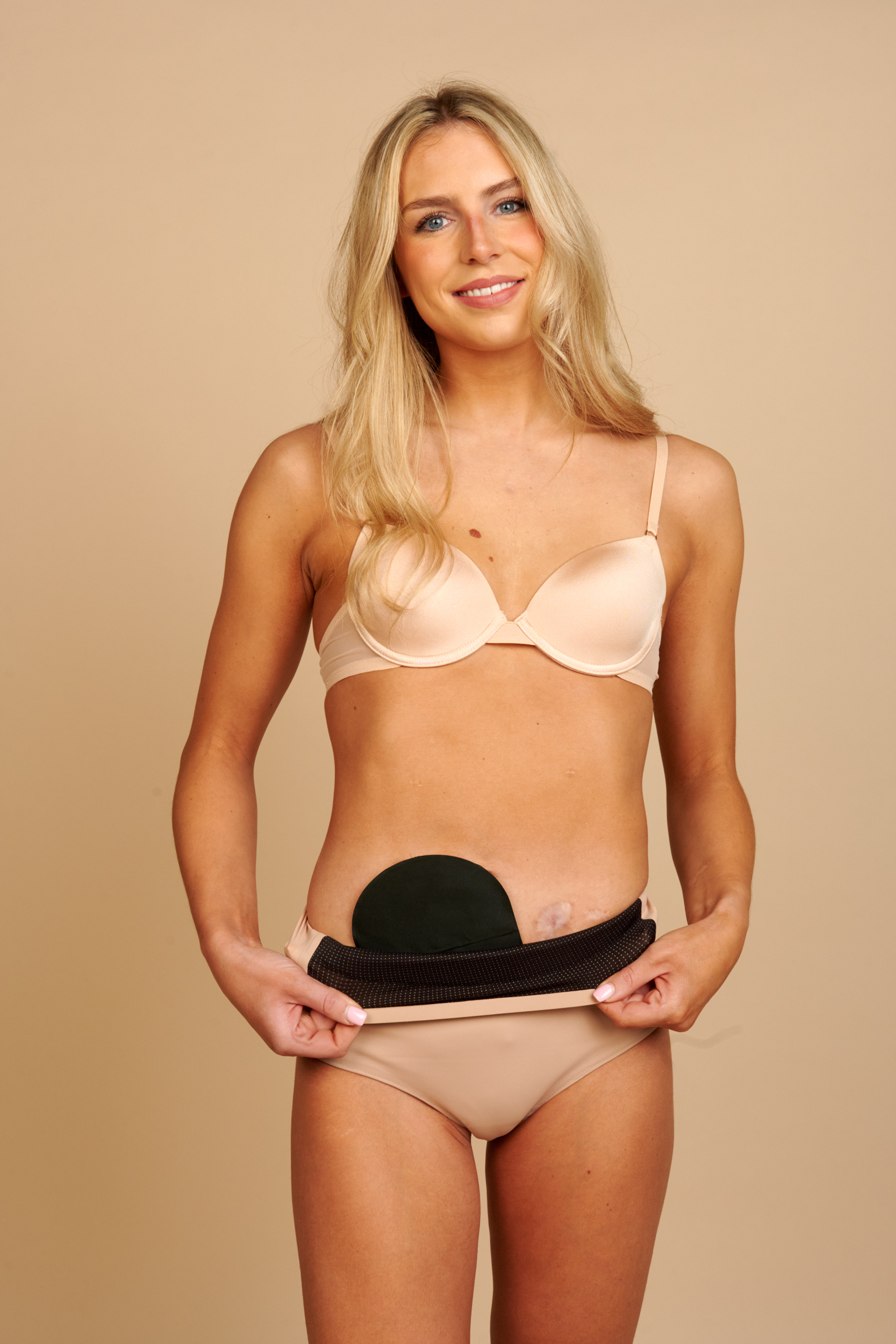
A wider band only works if the opening sits over the pouch, not across the middle of it. Put the stoma bag on first, the way you always do. The skin around it should be dry — a belt over damp skin just becomes a warm, slippy layer that rides up. Smooth the pouch so it is flat against you, outlet folded or clipped the way you wear it during the day. Then the belt goes on over the top, not underneath, not half-on-half-off.
Line the opening over the bag. This is the bit most people skip, and it is why a “game changer” turns into a rolled-up sausage by lunchtime. If the band sits across the middle of the pouch, it pinches the bag into a fold, output has nowhere even to sit, and you will feel it every time you lean forward. The opening should frame the pouch so the bag can fill downwards, the way it is designed to. Fasten it so you can slide two fingers between the band and you. That is the tension test. Red marks, pinching, or the pouch folding in on itself means it is too tight. A belt that is hanging off you will ride up the first time you sit down.
- Bag on first, skin dry, pouch smoothed flat.
- Belt over the top — never trapped under the bag.
- Opening frames the whole pouch, not the top third of it.
- Two fingers of space. A hug, not a squeeze.
- Stand, sit, reach for a high shelf. If it rolls, it is in the wrong place, not “broken”.
Re-check after the first hour, not at 9pm. Pouches shift as you eat, drink and move. A belt that felt perfect in the bathroom can sit differently after a commute. Adjust it the way you would a bra that has ridden up — no drama, just a quiet tug back to stoma height. If you empty more often, you will be undoing and refastening it anyway. Build that into the habit rather than treating the belt as something you put on once and forget.
Real clothes, real days: jeans, gym kit, swimming costumes and a white shirt
The point of a belt for stoma is not to look like you are wearing one. It is so the rest of the outfit can be ordinary. High-waisted jeans, a tucked-in shirt, gym leggings, a swimming costume, a blazer for work — those are all still on the table. The belt is the quiet layer that stops the pouch printing as a separate lump when the waistband of your trousers sits on it. For the rest of the wardrobe, start with stoma clothing that already thinks about waist height.
A white shirt is the classic worry. A skinny clip-on strap does almost nothing for that outline. A wider, smoother band plus a pouch that is not overfull is what actually helps. Empty before you leave, not “when I get there”. High-waisted briefs or a wrap under the shirt will often do more for the line of the clothes than another millimetre of squeeze from the belt. The bag is there. The outfit still has to work on a Tuesday.
Gym kit is the same logic in stretch fabric. Leggings with a high waist often hold the pouch as well as a belt, and some people skip the belt on studio days for that reason. Running and a heavier pouch is when the wide band earns its keep — less bounce, less checking. Swimming costumes and trunks are a different outfit, not a different person: take the everyday belt off, wear a costume that actually covers at stoma height, and put the belt back on when you are dry. You are not choosing between “a swimming life” and “a belt life”. You are changing layers, the way everyone else changes out of gym kit on the way home.
When the belt is not the fix — and what you can still do
If the bag is lifting by lunchtime, the belt is not the conversation. That is a pouch problem, and a band over the top will not talk it into lasting four days. Change the bag on a schedule that matches your actual output, not the optimistic one on the box. A belt over a leak just holds a leak against you.
What you can do is stack the layers that already work. A bag that stays put. A cover if the plastic bothers you. A wide belt or wrap when you want the pouch still under clothes. High-waisted underwear as the everyday base. That is a full outfit, not a drawer full of kit. Some days you will only want the clip-on strap from the box, and that is a perfectly good day. The win is having the option, not wearing every accessory at once.
Living with a stoma, in real life, is this unglamorous loop: empty, check the bag, get dressed, go out. A belt for stoma sits in the “get dressed” part. It will not change what comes through, and it will not make you grateful for a bag you did not ask for. It will make the bag quieter in a queue, stiller at a desk, and less of a thing you manage with your hand every time you stand up. That is a small win. It is also enough.
Want the pouch to sit like part of the outfit, not a separate object?
A wide, high-waisted stoma belt is the fashion layer — smooth under jeans, shirts and gym kit, not another piece of hospital elastic.
Questions people ask after they have tried one
Can I sleep in a belt for stoma?
Some people do, especially if the pouch feels restless when they turn over. Plenty take it off because a warm band all night is just another thing to notice. Honest version: try it on a night you are already awake anyway. If you wake up with marks, a folded pouch, or the belt up under your ribs, leave it on the chair. The two-finger rule still applies in bed. A belt is optional after dark, not a test you have to pass.
Is a hernia belt the same as a belt for stoma?
No. A hernia support is a firmer, often more structured garment some people use when there is a bulge to brace. A belt for stoma is a softer everyday band to keep the pouch still under clothes. They are not interchangeable, they do not replace each other, and plenty of people use one, the other, or neither. If someone has handed you a rigid support and called it a stoma belt, that is a labelling mix-up, not a reason to wear it over a full pouch all day.
Will a belt for stoma work with a two-piece bag as well as a one-piece?
Yes. The belt sits over the finished pouch, so it does not care whether the bag is a one-piece or a two-piece. What it cares about is the shape and the fill. A bulkier two-piece with a full bag wants the opening framed over the whole pouch, same as any other system. If the clip-on tabs on your particular bag sit in an awkward place, skip the skinny strap and use the wide band as a clothes layer instead — it does not need the tabs at all.
Does a belt change how output sits in the bag?
It should not trap output in the top of the pouch. If the band is cutting across the middle, the bag folds, and you get that tight, ballooned feeling even when you have just emptied. Move the opening so the bag can fill downwards, loosen to two fingers, and empty on your usual rhythm. The belt holds the bag against you; it does not reroute what comes through the stoma. A heavier pouch still needs emptying — the belt just stops it swinging while you get to a loo.
Can I wear a bag cover underneath a belt?
Yes, and a lot of people do. The cover is the fabric against your skin and the quieter rustle; the belt is the hold. Put the cover on the pouch first, then the belt over the top, still lining the opening over the whole bag. If the extra layer makes the band feel tighter, let the belt out rather than yanking the cover off. On hot days you may want only the cover. On jeans-and-a-shirt days you may want both. That is a clothes decision, not a rule.
What if my stoma sits very low, or right in a crease?
A narrow clip-on strap is usually the first thing to fail here — it has nowhere sensible to sit and it rolls into the crease. A wider, high-waisted band (or high-waisted briefs doing a similar job) can sit across a broader patch of tummy so the pouch is held without the elastic landing on the stoma itself. You may need to wear the band a fraction lower than a catalogue photo suggests. Stand, sit, and lean before you leave the bathroom. If every belt still rides into the crease, a wrap with more coverage is often the more honest tool than forcing a skinny strap to behave.