

 ES
ES EN
EN GB
GB DE
DE FR
FRNo products in the basket.
What is a stoma? Ostomy meaning: stoma, colostomy and ileostomy explained
Quick answer: Ostomy is the hospital word for a surgically made opening that lets waste leave through a stoma on the abdomen. In everyday UK speech most people just say “stoma”. The three types you will hear are colostomy, ileostomy and urostomy. Stoma is the bit you can see; ostomy is the wider setup — opening, surgery and kit.
You might have clocked the phrase on an NHS letter, a box of bags, or a conversation that moved faster than you did. Nobody hands you a glossary on the way out of hospital. Here is the version people actually use once they are home — not the textbook one.
What is a stoma? The short answer
 Stoma BeltHernia support & leak prevention. Trusted by 50,000+ ostomates worldwide.Discover →
What is a stoma? A stoma is an opening on your tummy that a surgeon makes so poo or wee can leave the body another way. It is made from the end of the bowel or from a tube of bowel for urine. A small bag, the stoma bag, sits over it. A stoma is pink or red, warm and moist, and has no nerve endings, so touching it does not hurt.
Why do people have a stoma?
Usually because part of the bowel or bladder needs to rest, heal or be removed. The most common reasons in the UK are:
- Bowel cancer, when part of the colon or rectum is taken out. There is more in our guide to bowel cancer and stoma surgery.
- Crohn’s disease and ulcerative colitis, when medicines are not enough. See Crohn’s, colitis, diverticulitis and a stoma.
- Diverticulitis or a bowel that has burst or become blocked, often as emergency surgery.
- Bladder cancer, which can lead to a urostomy.
- An injury, or a condition someone has had since birth.
Some stomas are temporary and are closed again months later. Others are permanent. Our guide to temporary vs permanent stomas explains the difference.
What does a stoma look like?
Most stomas are round or oval, between about 2 and 4 cm across, and look a bit like the inside of your mouth. A colostomy is usually on the left of the tummy, an ileostomy on the right. In the first weeks after surgery a stoma is swollen and then shrinks, so you will measure it again a few times. If you want to know what colour is normal, read what colour your stoma should be.
How many people in the UK have a stoma?
Between 176,000 and 205,000 people in the UK live with a stoma, according to NICE. Between 13,500 and 21,000 people have stoma surgery every year. That is more people than live in a city the size of Oxford, and most of them work, travel, swim and dress just as they did before (NICE resource impact report; NHS: colostomy).
What do you wear with a stoma?
Your usual clothes. A lot of people like high-waisted underwear or a soft wrap that holds the bag flat under fitted clothes. Our edit of stoma clothing is a good place to start, and the stoma bag covers are there for the days you want the bag fully covered.
Written by María G. · hola@siilostomy.com · Last updated: 20 October 2026
What ostomy actually means
Ostomy is a hospital word. It describes a surgically made opening that gives waste a new way out. You will see it on clinic letters, supply forms and product boxes. You will hear it less in kitchens, group chats and changing rooms, where “stoma” has quietly won.
A stoma is the visible opening on the abdomen. Ostomy is the broader label for having that opening and the kit that sits over it. Same life, two words. One sounds like a ward. One sounds like a person.
The ending -ostomy comes from Greek for “opening”, which is why colostomy, ileostomy and urostomy look like a family. You do not need that in a supermarket queue. You need it when a letter says “end ileostomy” and you would rather not guess. For a slower walk-through of living with one, our plain-English ostomy explainer sits next to this glossary rather than repeating it.
The term is a practical noun. It is not a personality, a limitation, or a script you owe every new person. Once you can pick it out of a sentence, the rest of the language gets easier to hold.
Ostomy, stoma or bag — which word is which?
These three get used as if they were the same thing. Mixing them up is how a simple chat becomes longer than you wanted.
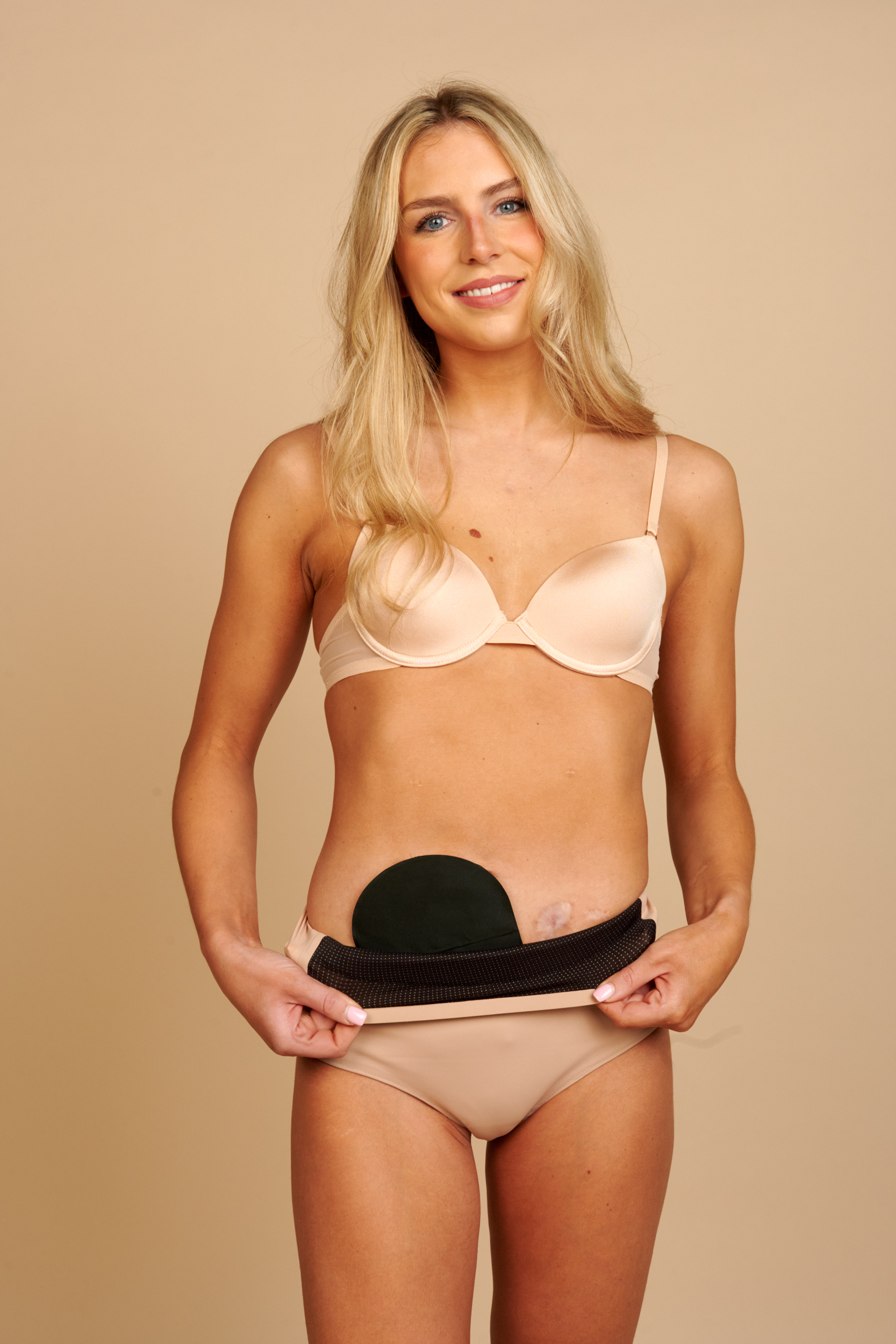
Ostomy is the medical term for the arrangement. Stoma is the opening you can see and feel. Bag — or pouch, on a box — is the appliance over it. In a café, “I’ve got a stoma” is the sentence that lands. On an NHS letter, “ostomy” is what they print. Both are correct. One is kinder out loud.
People also say “stoma bag” as a single idea, the way you say “phone charger”. Forum purists will tell you the bag is not the stoma. They are technically right, and also not the person you need to impress at a barbecue. Match the form in front of you. Talk like a person everywhere else.
- Ostomy — the whole setup: opening plus kit.
- Stoma — the opening on the abdomen. The word most UK ostomates actually say.
- Bag / pouch / appliance — what you wear over it. “Bag” wins in real life; “pouching system” wins on packaging.
- Flange / wafer / baseplate — the sticky part on the skin. Three names, one job.
Once those four are in your pocket, most clinic letters stop looking like another language. The rest is detail — useful, not urgent.
New stoma guide
New to a stoma? Take the calm version home with you.
A practical read for the first weeks — what people actually pack, wear and get used to, without the ward-speak.
The three types, in one place
Search results love a long list. Lived experience is simpler: almost everyone you meet is talking about one of three. The differences sit in output, emptying rhythm and which bags show up on the delivery — not in whether you can get dressed and leave the house.
| Term you will see | In plain English | What the bag is usually doing | What people notice day to day |
|---|---|---|---|
| Colostomy | A stoma formed from the large bowel | More formed output; many people use closed bags and change rather than empty | Routines can feel a bit more “once or twice and done” |
| Ileostomy | A stoma formed from the small bowel | Looser output; drainable bags you empty through the day | You get very good at knowing where the nearest loo is, then you stop thinking about it |
| Urostomy | A stoma for urine | Urine, with a tap or bung; often a night bag in the mix | Different kit, same idea: wear it, empty it, get on with the day |
Temporary and permanent are not extra types. They are a timescale written next to one of the three. Loop or end is a construction detail from theatre — useful with a stoma nurse, less useful in a dating profile. If reversal comes up later, that is its own chapter; we have a separate read on life after stoma reversal for when that language shows up.
Words you will actually see on boxes and letters
This is the vocabulary on boxes, NHS letters and the inside of a supply cupboard. You do not need all of it. You need the ones that stop you ordering the wrong thing, or nodding along in clinic when you did not follow.
- Pouching system — catalogue-speak for bag plus sticky base. If a box says this, it means the whole appliance.
- One-piece / two-piece — bag and base joined as one, or a bag you click onto a separate base. Preference, not a test.
- Closed bag — no emptying tap; you change it and bin it. Common with a colostomy.
- Drainable bag — a clip or Velcro tail you open over the loo. Common with an ileostomy.
- Output — the contents. The least glamorous, most useful word in the set.
- Stoma nurse — the person who translates all of the above into something you can do at the bathroom sink.
Brand names sit in this drawer too. Coloplast, Hollister and ConvaTec are the names you will see on a lot of UK kitchen counters. People get loyal to a shape the way they get loyal to a bra brand — because it stays put. If you are comparing actual pouches, start with a lived round-up of stoma bags people actually wear rather than a catalogue.
A firmer stoma belt or a soft stoma wrap is clothes-and-hold, not a pouch. It looks clinical in a search result; in the drawer it is just another layer some people like for sport or a fitted jumper.
What “ostomy medical supplies” really refers to
A lot of searches around this phrase are not asking for a definition. They are asking where the stuff lives. It usually means the clinical kit: pouches, bases, wipes, rings, night bags, adhesive remover. It does not mean underwear, swimming costumes or a bag cover you would be happy for someone to see on the back of a chair.
The big pouch companies genuinely win at the appliance itself. That is their whole job. High-street high-waisted briefs sometimes win on a quiet day if your bag is small and your outfit is loose. A fashion cut wins when you want the bag to sit in a pocket of fabric rather than announce itself through a waistband. Different drawers. Do not let a search page convince you they are the same shop.

In the UK the bags themselves usually arrive via the NHS, organised with your stoma nurse. Clothes, covers and swimwear do not. Keep supplies for the skin-and-seal job. Keep clothing for the getting-dressed job. Your morning is calmer when those are not fighting for the same shelf.
When you want the swimming costume to feel like a swimming costume again — not a workaround — stoma swimwear belongs in the second drawer: high-waisted, pocketed where it matters, and built for the pool rather than the clinic.
How the words show up in real life
The vocabulary is only useful if it works outside the hospital. That is the test: can you say what you need in a changing room, at security, or to a new partner without giving a lecture.

At work, “stoma” is usually enough. You do not owe anyone the full hospital term, the type, or a history. A trusted colleague might get “I wear a bag, I might need a minute after lunch.” That is a complete sentence. HR forms may still print ostomy because forms love hospital words. Match the form; keep the conversation human.
Travelling is the same pattern. Airport staff are used to stoma bags. You can say “stoma bag” and point. You do not need “end colostomy with a two-piece pouching system” while someone is holding a tray of laptops. Pack extras, keep a spare base in your hand luggage, and let the short word do the work. Swimming, gym, a wedding, a too-hot Tube in July — the language stays small. The kit can be as considered as you like.
Intimacy is where people over-explain because they are nervous, not because the other person asked for a glossary. “I have a stoma, the bag sits here, tell me if you want it covered” is plenty. A fabric stoma bag cover is a comfort choice, not a requirement. Some people never bother. Some people will not leave the bedroom without one. Both are allowed.
What you can still do, in the same breath: wear a fitted jumper, sit in a swimming costume on a Spanish lounger, eat the meal you actually want once you know your own output, walk the long way home, say no to explaining yourself. The term is a label for kit. It is not a forecast.
The bag is kit. The outfit is still yours.
High-waisted cuts and quiet coverage, designed to sit with a stoma rather than fight a waistband — fashion first, clinic never.
Questions people ask once they know the words
Is “ostomy” the same as “stoma” on NHS letters?
Almost. Letters prefer ostomy because it names the whole setup. Stoma is the opening itself, and it is the word most people say out loud. If a letter says ostomy and your nurse says stoma, they are talking about the same life. Use whichever matches the paperwork in front of you.
Is a urostomy still called an ostomy?
Yes. Urostomy sits with colostomy and ileostomy as one of the three everyday types. The output is urine rather than bowel contents, and the bags look a bit different — tap or bung, often a night bag — but in conversation “stoma” still works.
What does “pouching system” mean on a box if I just call it a bag?
Pouching system is catalogue language for the bag plus the sticky base, especially with two-piece kit. On the ward and in the kitchen, bag is the word that gets used. If you are ordering, match the box. If you are talking, bag is fine — nobody is marking you.
Does “end stoma” on my notes mean it cannot be reversed?
Not on its own. End and loop describe how the stoma was constructed, not a promise about next year. Temporary and permanent are the timescale words. If reversal is being discussed, it will be said plainly, and it is a separate conversation from this week’s letter.
What do I say at airport security — ostomy or stoma bag?
Stoma bag. Short, obvious, and what staff hear all day. You do not need the hospital term, the type, or a speech. A spare in your hand luggage and a calm “I wear a stoma bag” is the whole script most people ever need.
Are bag covers and high-waisted pants classed as medical supplies?
No. Ostomy supplies are the pouches, bases, wipes and rings — the skin-and-seal kit, usually the Coloplast, Hollister or ConvaTec drawer. Covers, high-waisted underwear and swimming costumes are clothes. Useful, sometimes essential for confidence, but they are not the same search and they do not come from the same place as your bags.
Keep reading
More from the SIIL journal

Living with an Ostomy
Stoma Travel Bag: What to Pack in Your Kit (UK)
What goes in a stoma travel bag: the UK kit checklist, how many bags to take, NHS supplies before you go, RADAR key, travel certif…
16 min read

Living with an Ostomy
Colostomy Irrigation UK: How It Works, Who It Suits and the Freedom It Can Give
Colostomy and stoma irrigation explained for the UK: who it suits, the kit on prescription, how to irrigate step by step, timings …
12 min read

Living with an Ostomy
Loop Ileostomy, Loop Colostomy and Defunctioning Stomas: A UK Guide
Loop ileostomy, loop colostomy and defunctioning stomas explained for the UK: what they look like, why they are often temporary, b…
14 min read
Welcome offer
Join the SIIL family.
Get 20% off your first order.
Stories, tips and exclusive drops — once a month, never spam. Your code lands in your inbox the moment you subscribe.
By subscribing you accept our privacy policy. Unsubscribe in one click, anytime.
Welcome — check your inbox for the code.
£122.99
£72.99
£52.99
£52.99
£39.99
£44.99
£92.99
£31.99
£39.99
£52.99
£52.99
£19.99