

 ES
ES EN
EN GB
GB DE
DE FR
FRNo products in the basket.
Can You Have Sex With a Stoma? A Real-Life UK Guide
Quick answer: Yes. You can have sex with a stoma. The bag stays on, you empty it first, and a cover or a pair of high-waisted knickers usually takes the sting out of feeling on show. The first time is often more awkward in your head than it is in the room — then it becomes an ordinary part of how you live.
If you have just typed this into Google, you are in familiar company. Maybe surgery is still ahead and you are trying to work out whether a stoma is “worth it”. Maybe you are a few weeks out, your partner is being carefully kind, and that carefulness is somehow worse. Here is the honest version from people who have already been through it: a stoma does not put your sex life on hold. It asks for a bit of planning, a bit of vanity, and a conversation you would rather skip. None of that is the same as being finished.
Key takeaways
- Yes — people with a stoma have sex, date, stay married, and have unremarkable Tuesday nights.
- Empty the bag, check the seal, and give your tummy time to feel like yours again before you rush it.
- A cover, wrap or high-waisted pair is not clinic kit. It is how you stop thinking about the bag.
- Most partners are far less bothered than the story you are telling yourself at 1am.
Yes, you can — and it is more ordinary than the search bar makes it sound
 Stoma BeltHernia support & leak prevention. Trusted by 50,000+ ostomates worldwide.Discover →
A stoma is simply the small opening on your tummy that a bag sits over. The bag collects what used to go to the loo. It does not close the rest of you down. People google “can you have sex with a stoma” as if the answer might be no, because the internet is full of diagrams and almost empty of anyone saying, calmly, that they did it last Saturday.
The quieter stories help more than the famous ones: someone mentioning they went back to intimacy before they went back to work, or that the first time was clumsy and the fourth time they forgot the bag was there. Not a miracle. Not a tragedy. A body that works differently, and a night that can still be a night. If you are still pre-op, this question is often sitting under a bigger one: will I still be myself. You will. The bag is an accessory you did not ask for. It is not a verdict on whether you are allowed to want someone.
What actually changes in bed (and what does not)
The mechanics of sex do not move to your abdomen. What changes is the scenery: a scar that is still pink, a bag that rustles if it is half full, a tummy that may feel tender or a bit numb for a while. Partners usually notice the hesitation long before they notice the pouch. The thing in the way is often the story, not the plastic. Different stomas behave differently, which is why a single tip list never quite fits — handle your own bag on the night, not a label.
| Stoma type | What you tend to notice | What usually helps |
|---|---|---|
| Ileostomy | Output is more liquid, so the bag can fill and gurgle sooner. Timing after a meal matters more. | Empty just before. Some people swap to a smaller closed bag for the evening. Avoid starting on a full stomach. |
| Colostomy | Output is often firmer and more predictable. If you already irrigate and wear a cap, the bag may barely feature. | Work with your usual pattern. A quiet window after a movement is a gift. A cap or mini pouch is a genuine win if that is already your routine. |
| Urostomy | The bag collects urine, so it can swell and make that soft trickle sound. Night-drain habits do not translate neatly to a sofa. | Empty fully. A well-stuck bag plus a snug wrap stops the swing. Keep a spare handy and do not overthink the sound. |
Whatever you have, the bedroom rules are the same: empty, secure, then stop staring at it.
There is no universal date when everything is “allowed” again. Most people wait until they are no longer sore, the bag is staying put, and they actually want to — weeks rather than days for many, longer if the head takes its time. That is not a failure. The same practical picture applies if your tummy has had more than one operation: keep the bag empty and out of the crush, start slower than your pride wants, and do not treat the first attempt as a performance review. There is a steady guide to the first stretch after surgery if you are still in that foggy early bit and intimacy is only one of the questions.
How people actually prepare (the unglamorous bit that works)
Confidence on the night is mostly logistics dressed up as mood. Do the boring things first so you can forget them.
- Change or empty first. A fresh bag, or a drainable one emptied and closed properly, is the single most useful move — whichever brand you are already on. Start clean. Start light.
- Do not start on a full stomach. A cup of tea and a biscuit is fine. A big dinner and two pints is how you spend the next hour listening to your own bag.
- Mornings are underrated. Many people find the bag is quieter before breakfast, and they have already done a change.
- Have a spare within reach. Not because disaster is likely. Because knowing it is on the chair stops you rehearsing disaster.
- A dark towel on the bed is not tragic. Same energy as a towel at the beach. If it lets you relax, use it.
- Check the wafer once, then leave it alone. Picking at the edges is how you talk yourself out of the evening.
A smaller evening bag is a real habit, not a special “sex product”. If your daytime drainable feels bulky, look at the slimmer closed options in the range you already trust — there is an honest run-through of how different stoma bags actually compare if you are still finding your setup. Some colostomates who irrigate simply wear a cap and forget the conversation entirely. That is a genuine advantage; it is all right to say so.
What to wear so you feel like yourself, not a patient
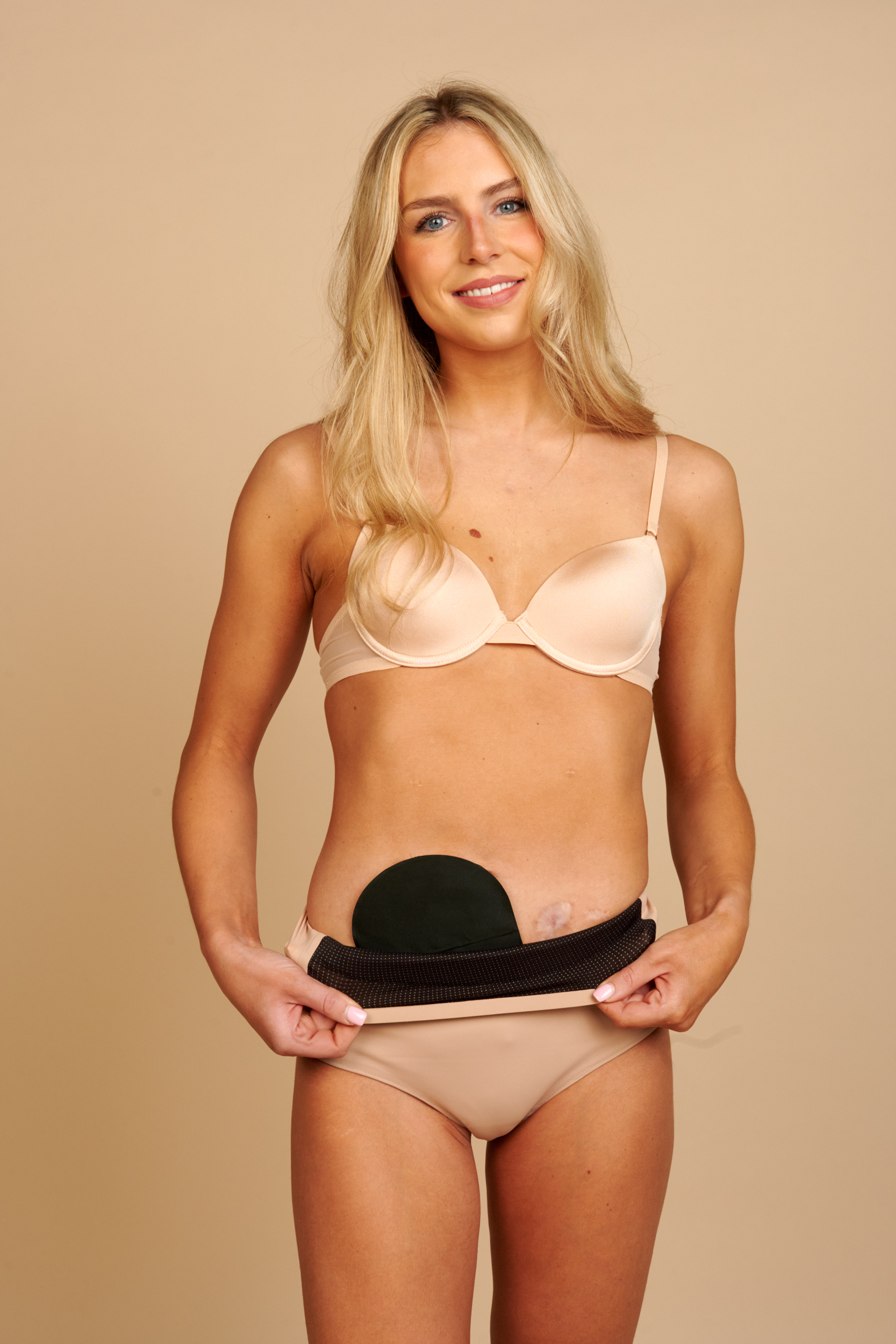
A lot of people have perfectly good sex in nothing but a well-stuck bag. A lot of others cannot get out of their own way until the bag is covered. Neither camp is doing it wrong. What you want is something that looks like you chose it — not a beige workaround from a clinic drawer.
High-waisted knickers that sit above the wafer keep the pouch from swinging and stop the silhouette you keep checking in the mirror. A soft stoma bag cover turns the appliance into fabric, which is a small thing and also the whole thing for some people. A wrap holds everything still if you move a lot. A support belt can do the same job on nights you want more hold and less awareness. Think the same way you would about good shapewear: smooth, quiet, chosen.
A tubular support bandage from the chemist holds a bag still for a couple of pounds. A silk scarf tied neatly works. An old pair of high-waisted M&S knickers with a hole you cut yourself has got a lot of people through the first month. Wear those if they are what you have. Purpose-made pieces exist for the night you want it to feel like proper underwear — the same standard as the rest of your drawer — rather than a craft project. If you want something that already looks like it belongs on a real body, start with SIIL bag covers and build from there.
Positions, pressure, and the “what if it leaks” thought
You do not need a diagrammed playbook. Stop anyone parking their full weight on the pouch, and keep an exit if something feels off. Side-lying is the unglamorous favourite: nobody is leaning on the bag, you can see each other’s faces, and you can reach the clip. You on top gives you control of where your tummy sits. Partner in front, rather than folding you in half, keeps the wafer happier. Sitting on the edge of the bed sounds unromantic until you try it and realise nobody is squashing anything.
Will they feel the bag? Sometimes, as a soft shape, the way you would feel a sports bra or a plaster. It is not a third person in the room unless you keep introducing it. The stoma is not made of glass, and it is not the point of the evening either. A bit of contact through a covered bag is ordinary. A knee driven into an uncovered, half-full pouch is just poor manners.
If a leak happens — and for most people, most nights, it does not — you stop, you go to the bathroom, you change, you come back or you do not. Treat it like knocking a glass of water over. Annoying. Cleanable. Not a metaphor for the relationship. Keep wipes and a spare where you can reach them without turning on the big light. Noise is the other private fear: bags rustle, urostomy pouches trickle, ileostomy bags gurgle after garlic bread. A snug cover or wrap dulls a lot of it. Music dulls the rest.
Partners, dating, and the long stretch after the first time

Long-term relationships and a new stoma bag are a particular kind of strange. The person who has seen you through hospital food and 3am bag changes is, on paper, the easiest audience you will ever have. In practice both of you can become overly polite. They wait to be invited. You wait to feel ready. Weeks slide. The kindest thing you can do is be plain: “I want to, I am nervous about the bag, can we go slowly and not make a speech about it.” That sentence has restarted more bedrooms than any technique. If they are the worried one, let them look on a Tuesday, when sex is not the point. Mystery feeds the fear.
Dating is a different nerve. You choose when to mention it. Some people say it before the first night because they cannot flirt while bracing. Some wait until it is clearly going somewhere, then say it in daylight, not in the dark with a shirt half off. What tends to go badly is springing it as a confession, as if you have done something. You have a stoma. You also have a sense of humour, a body, and a Saturday night. Lead with those.

A soft wrap or a support belt is simply how you keep the pouch from becoming the most interesting object in the room. And if wanting it has gone quiet, start smaller than a full performance: a bath, being held without it turning into a test, clothes you actually like — including by a pool in stoma swimwear that does not announce anything. Desire often comes back once your body stops feeling like a project.
Want the bag to disappear into the outfit, not the evening.
High-waisted knickers, covers and wraps made to sit over a stoma bag — the same standard you would expect from good everyday underwear, not from a hospital cupboard.
Questions people still ask once they know the answer is yes
Does the stoma bag have to come off for sex?
No. Leave it on. Empty it, check it is stuck, cover it if that helps you forget it, and get on with the evening. Taking it off is not a thing people do for intimacy, and it is not safer or sexier. The bag stays. You stay.
Do I need a special “intimacy” stoma bag?
No. A fresh version of whatever you already wear is enough. Some people like a smaller closed bag or a cap for an evening because it sits flatter. That is comfort, not a requirement. You do not need a product with intimacy on the box.
Can I wear ordinary high-street lingerie with a stoma bag?
Often, yes — especially high-waisted styles, bodysuits you can wear over a cover, and anything with stretch rather than a hard waistband across the wafer. Very low-rise sets will fight you. Try a favourite piece over a cover at home first. Keep what works; do not bin your whole drawer on principle.
How do people bring this up when they start dating?
Whenever you can say it without it sounding like an apology. Before the first night is kinder if you already know you will freeze otherwise. After a couple of proper dates is fine if you need to see whether they are worth the sentence. Say it in daylight, simply: you have a stoma, the bag stays on, it is not a big production.
When does it stop feeling like a project and start feeling like sex again?
For a lot of people the first time is the most self-conscious, and by the fourth or fifth they are thinking about the other person again. For others the head takes a few months, especially if recovery was rough. There is no gold star for speed. It feels normal again when you stop narrating it.
Cover the bag. Keep the night.
Soft stoma bag covers in real fabrics — so the pouch looks like part of the outfit, not the only thing in the room.
Keep reading
More from the SIIL journal

Living with an Ostomy
Retracted Stoma: What It Is, Why Your Bag Keeps Leaking and What Helps (UK)
A retracted stoma sits level with or below the skin, so bags leak. Causes, how convex flanges, seals and a belt help, and when to …
7 min read

Living with an Ostomy
Barbie Bum Surgery UK: Recovery, Sitting Down and Life With a Permanent Stoma
Barbie bum surgery explained for the UK: what the operation is, why it is done, how the wound heals, sitting down, getting back to…
9 min read

Living with an Ostomy
Stoma Travel Bag: What to Pack in Your Kit (UK)
What goes in a stoma travel bag: the UK kit checklist, how many bags to take, NHS supplies before you go, RADAR key, travel certif…
16 min read
Welcome offer
Join the SIIL family.
Get 20% off your first order.
Stories, tips and exclusive drops — once a month, never spam. Your code lands in your inbox the moment you subscribe.
By subscribing you accept our privacy policy. Unsubscribe in one click, anytime.
Welcome — check your inbox for the code.
£102.99
£49.99
£72.99
£41.99
£52.99
£122.99
£52.99
£52.99
£49.99
£72.99
£92.99
£49.99