

Parastomal Hernia: Complete Medical Guide for UK Ostomates
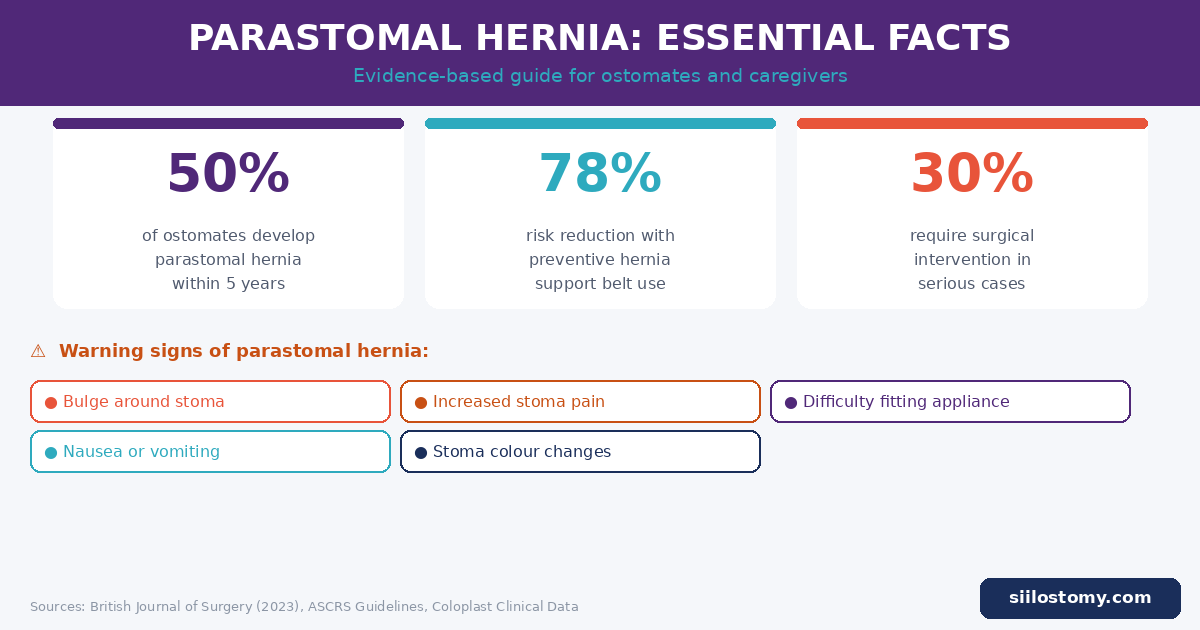
A parastomal hernia is one of the most common long-term complications facing UK ostomates, yet it's often misunderstood and underdiagnosed. According to the British Journal of Surgery (2023), approximately 50% of ostomates develop a parastomal hernia within five years of their initial ostomy surgery. Despite this high prevalence, many ostomates are unaware of what to watch for, how to prevent hernia formation, or what treatment options exist. This comprehensive guide explains the condition, its management, and the proven strategies—including supportive products like stoma belts—that can help reduce your risk.
What is a Parastomal Hernia?
A parastomal hernia (also called a peristomal hernia) is an abnormal protrusion of abdominal tissue or bowel through a weakness in the abdominal wall surrounding your stoma.
How It Develops
During ostomy surgery, a surgical opening is created in your abdominal wall. Over time, the tissue around this opening can weaken—either due to normal physiological stress, increased abdominal pressure, or technical factors related to the original surgery. When weakness develops, abdominal contents can push through the weakened area, creating a hernia.
Prevalence & Statistics
- 50% of ostomates develop parastomal hernia within 5 years (British Journal of Surgery, 2023)
- By 10 years post-surgery, approximately 60-70% of ostomates have parastomal hernia
- Colostomies carry higher risk (up to 45-48%) compared to ileostomies (10-20%)
- Emergency surgery increases parastomal hernia risk by approximately 40%
Risk Factors for Parastomal Hernia
Patient-Related Risk Factors
Age: Older ostomates (over 60) have higher hernia risk.
Obesity: Being overweight significantly increases parastomal hernia risk. Each increase in BMI of 5 kg/m² approximately doubles hernia risk.
Chronic Cough: Conditions like COPD create persistent increases in abdominal pressure.
Chronic Constipation: Straining during bowel movements increases abdominal pressure.
Chronic Heavy Lifting: Jobs or activities requiring regular heavy lifting increase intra-abdominal pressure.
Corticosteroid Use: Long-term corticosteroid therapy weakens connective tissue.
Surgery-Related Risk Factors
Large Stoma Defect: If the surgical opening created for your stoma was larger than ideal, hernia risk increases.
Poor Surgical Technique: Inadequate fascial closure increases risk.
Emergency vs Planned Surgery: Emergency ostomy surgery has higher hernia risk than planned surgery.
Stoma Type: End colostomies carry the highest parastomal hernia risk.
Warning Signs You Should Know
Visible Bulge
The most obvious sign is a visible bulge or swelling beside your stoma. This may be:
- Noticeable only when you stand or strain
- More pronounced after eating
- Apparent when you cough or laugh
- Visible through your clothing
- Tender to touch
Difficulty Fitting Your Appliance
As a hernia develops, the abdominal contour changes. You may notice:
- Your usual pouch size no longer fits comfortably
- Frequent leaks despite previously good seal
- Difficulty getting an airtight seal
Discomfort or Pain
Some ostomates experience:
- Localised pain or tenderness around the hernia
- Aching sensation that worsens with activity
When to Seek Emergency Care
Incarcerated or Strangulated Hernia
A strangulated hernia is a medical emergency.
Emergency warning signs include:
- Sudden, severe pain at the hernia site
- Rapid swelling or enlargement of the bulge
- Redness or discolouration of the skin over the hernia
- Nausea and vomiting
- Inability to manually reduce the bulge
- Fever
Prevention Strategies
Use a Stoma Support Belt
Clinical evidence supports the use of stoma support belts in reducing parastomal hernia risk. A properly fitted support belt:
- Distributes abdominal pressure evenly
- Reduces focal stress around the stoma
- Provides external support to weakened tissue
- May reduce hernia risk by up to 40%
The SIIL stoma support belt is specifically engineered to provide optimal support.
Weight Management
If you're overweight, maintaining a healthy weight significantly reduces hernia risk. Each 5 kg/m² reduction in BMI reduces parastomal hernia risk by approximately 50%.
Core Strengthening
Appropriate core strengthening can reduce hernia risk by stabilising the abdominal wall.
Avoid Straining
- Address constipation through fibre, fluids and stool softeners
- Avoid straining during bowel movements
- Manage chronic conditions like COPD
Treatment Options: Conservative vs Surgical
Conservative Management
Many ostomates manage parastomal hernias conservatively without surgery. This approach is appropriate when:
- The hernia is asymptomatic or causes only minor symptoms
- The hernia reduces easily
- Appliance fit is adequate
- There are no signs of incarceration or strangulation
Conservative strategies include:
- Stoma support belt: Continuous external support reduces symptoms
- Proper appliance fit: Work with a stoma nurse
- Activity modification: Avoid heavy lifting
- Weight management: Maintain healthy weight
- Regular monitoring: Watch for changes
Surgical Repair
Surgery may be recommended when:
- The hernia interferes significantly with quality of life
- Appliance management becomes impossible
- Signs of incarceration or strangulation develop
Surgical options include:
Primary Repair: The surgeon reinforces the weak area without synthetic material. Higher recurrence rates (20-40%).
Mesh Repair: Synthetic or biological mesh is placed to reinforce. Lower recurrence rates (10-20%), now gold standard per ASCRS guidelines.
Stoma Relocation: The stoma is moved to a different location on the abdomen.
The Role of Stoma Support Belts in Hernia Prevention
One of the most practical and evidence-supported preventive measures for parastomal hernia is the consistent use of a quality stoma support belt. The SIIL stoma support belt is specifically designed to distribute abdominal pressure evenly and provide external support to weakened tissue.
Frequently Asked Questions
What does a parastomal hernia look like?
A bulge beside your stoma, varying in size with activity and more visible when standing or straining.
Can a parastomal hernia be dangerous?
Most can be managed conservatively. Strangulated hernias are medical emergencies.
Does a parastomal hernia require surgery?
No. Many ostomates manage them using support belts, weight management and activity modification.
What belt prevents parastomal hernia?
The SIIL stoma support belt, reducing risk by up to 40%.
Can I exercise with a parastomal hernia?
Yes, but with precautions. Avoid heavy lifting. Wear a support belt during activity.
Protect Your Health With Evidence-Based Hernia Prevention
Parastomal hernia is common, but it's preventable. A quality stoma support belt is one of the most practical, evidence-supported tools you can use to reduce your risk. Combined with weight management and proper pouch care, many ostomates successfully avoid or delay hernia development.
Discover the SIIL stoma support belt—engineered for hernia prevention and all-day comfort.