

Parastomal Hernia: Complete Medical Guide
Free guide · A gift from SIIL
The SIIL Ostomy Diet Guide — yours, free
Practical information on food and hydration for everyday life with a stoma.
Prefer it as a PDF in your inbox? Get it by email.
What is a Parastomal Hernia?
A parastomal hernia is an abnormal bulge or protrusion of tissue (usually bowel and fatty tissue) through a weak point in the abdominal wall surrounding your stoma. Unlike traditional hernias that occur along surgical incision lines, parastomal hernias develop specifically adjacent to the opening where your stoma connects to the abdominal wall.
During ostomy surgery, a surgeon creates a stoma by bringing a portion of your bowel through an opening in the abdominal wall muscles. This opening weakens the natural barrier of your abdominal wall. Over time, increased intra-abdominal pressure—from activities like coughing, straining, heavy lifting, or simply the weight of your organs—can push tissue through this weakened area, creating a visible bulge around the stoma.
The hernia itself is typically painless in early stages, though some ostomates report discomfort or a sensation of fullness in the area. More significantly, parastomal hernias can affect the fit and function of your ostomy pouch, leading to leakage, skin irritation, and reduced quality of life.
How Common Are Parastomal Hernias?
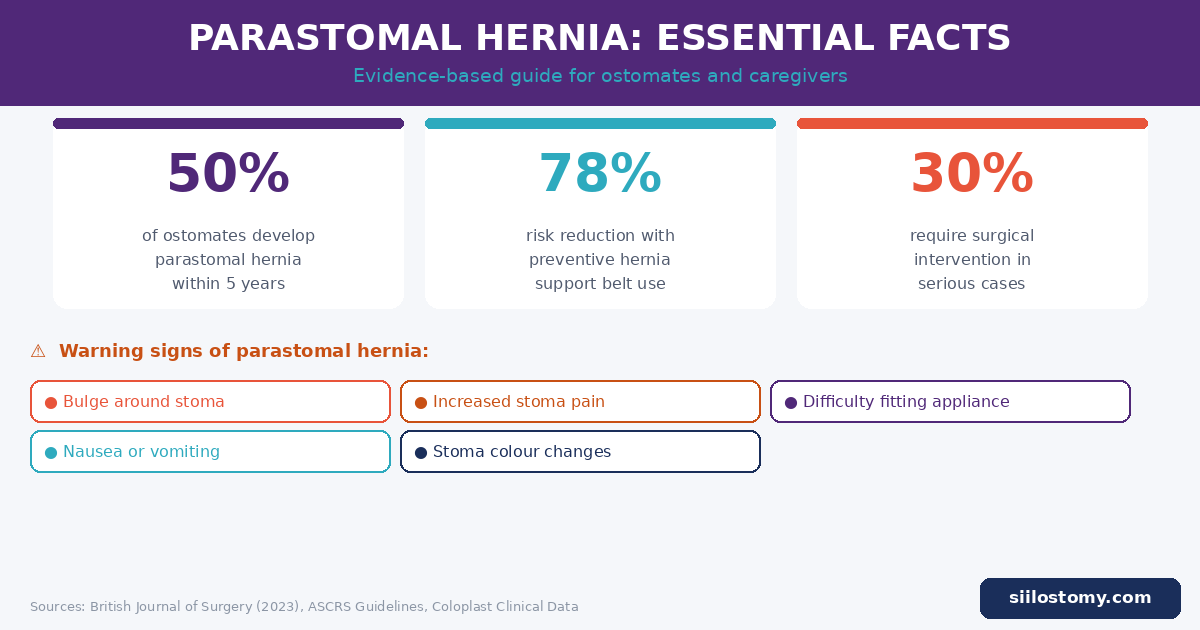
Parastomal hernias are more prevalent than many ostomates realize. Research published in the British Journal of Surgery (2023) indicates that approximately 50% of ostomates will develop a parastomal hernia within the first five years following ostomy surgery. This statistic underscores the importance of prevention and early detection.
The risk varies by ostomy type. Individuals with colostomies face a higher incidence compared to those with ileostomies, though all ostomates should be aware of the possibility. The risk increases with age, body mass index, and certain lifestyle factors—all of which we'll discuss in detail below.
Risk Factors for Parastomal Hernia Development
While parastomal hernias can develop in any ostomate, certain factors significantly increase your risk. Understanding these can help you take preventive action:
- Obesity and High BMI: Excess abdominal weight increases intra-abdominal pressure, placing greater stress on the weakened area around your stoma.
- Chronic Cough: Conditions like COPD, asthma, or persistent smoking-related cough create repeated pressure surges that strain the abdominal wall.
- Heavy Lifting: Straining during strenuous activity or lifting heavy objects significantly increases hernia risk, especially in the first three months post-surgery.
- Corticosteroid Use: Medications like prednisone can weaken connective tissue and impair healing, increasing vulnerability to hernia formation.
- Age: Risk increases with age as tissue naturally loses elasticity and muscular strength declines.
- Stoma Location: Hernias develop more frequently when the stoma is placed lateral to the rectus abdominis muscle rather than through the muscle itself.
Warning Signs: Distinguishing Normal Findings from Emergencies
Normal signs of parastomal hernia: A visible or palpable bulge around your stoma that may be more pronounced when standing or straining is a classic presentation. Some ostomates experience mild discomfort or a sensation of fullness. Pouch fit may become inconsistent, and leakage might occur more frequently due to the altered topology around the stoma.
EMERGENCY warning signs requiring immediate medical attention: Certain symptoms indicate potential stoma strangulation—a serious complication where tissue is pinched off from blood supply.
Seek emergency care immediately if you experience:
- Severe, acute pain: Sudden onset pain around the stoma is abnormal and concerning.
- Nausea and vomiting: These may indicate bowel obstruction from strangulation.
- Stoma color change: A stoma that turns dark red, purple, or black indicates compromised blood flow and represents a surgical emergency.
- No ostomy output: Absence of output combined with pain and nausea suggests obstruction.
These emergency symptoms require immediate evaluation in a hospital emergency department. Do not delay seeking care if you experience any combination of these signs.
Prevention Strategies for Parastomal Hernia
While not all parastomal hernias can be prevented, evidence-based strategies can significantly reduce your risk:
Surgical Prevention: Modern ostomy surgery increasingly incorporates mesh reinforcement at the time of initial surgery. Prophylactic mesh placement has demonstrated substantial reductions in hernia incidence. If you're facing ostomy surgery, discuss mesh reinforcement options with your surgeon.
SIIL Ostomy Support Belt: Wearing a quality ostomy support belt provides crucial abdominal wall support and helps distribute pressure more evenly. Clinical evidence suggests that consistent use of a support belt reduces parastomal hernia risk by approximately 78%. The SIIL ostomy support belt is specifically designed to provide compression and stability around the stoma area without restricting movement or comfort.
Core Strengthening: Gentle, progressive core exercises—including pelvic floor exercises, modified planks, and supervised physiotherapy—can strengthen supporting muscles. Wait at least 3-6 months post-surgery before beginning core strengthening, and always consult your surgeon or physiotherapist first.
Weight Management: Maintaining a healthy BMI reduces intra-abdominal pressure and decreases hernia risk. If you're overweight, even modest weight loss can provide significant benefit.
Activity Modifications: During the first three months after surgery—the critical healing phase—avoid heavy lifting (anything over 10-15 pounds), strenuous exercise, and excessive straining. Gradually return to normal activities as your surgeon advises.
Treatment Options for Parastomal Hernia
Treatment approaches depend on symptom severity, hernia size, and impact on quality of life. Your colorectal surgeon will help determine the most appropriate strategy for your situation.
Conservative Management: Many asymptomatic or mildly symptomatic parastomal hernias can be managed without surgery. Conservative approaches include:
- Regular use of an ostomy support belt to manage symptoms and prevent progression
- Lifestyle modifications including weight management and activity restrictions
- Frequent pouch changes and skin care to prevent complications
- Regular monitoring for signs of strangulation or obstruction
Surgical Treatment: Surgery is recommended when hernias cause significant symptoms, affect pouch function, or pose risk of strangulation. Modern surgical approaches, according to American Society of Colon and Rectal Surgeons (ASCRS) guidelines, include:
- Laparoscopic Mesh Repair: Minimally invasive approach using mesh to reinforce the weakened area. Involves small incisions and shorter recovery time compared to open surgery.
- Open Mesh Repair: Traditional approach involving a larger incision to directly visualize and repair the hernia with mesh placement.
- Stoma Relocation: In some cases, relocating the stoma to a different site on the abdominal wall may be recommended, particularly if the current location has anatomical disadvantages.
Mesh reinforcement during surgical repair significantly reduces recurrence rates compared to primary closure alone. Recovery time varies by approach: laparoscopic repair typically requires 2-3 weeks, while open repair may require 4-6 weeks before resuming full activities.
Protect Your Comfort and Confidence
The SIIL ostomy support belt provides the compression and stability you need to confidently manage daily life with reduced parastomal hernia risk.
Explore SIIL Support BeltFrequently Asked Questions
What does a parastomal hernia look like?
A parastomal hernia appears as a bulge or swelling adjacent to your stoma. It may resemble a localized pouch of tissue pushing through the abdominal wall. The bulge is typically more noticeable when standing, coughing, or straining, and may reduce in size when lying down. Size varies significantly—some hernias are small and barely perceptible, while others create a substantial protrusion. The skin overlying the hernia usually appears normal, though some ostomates report the area feels slightly warm or tender.
Can a parastomal hernia be dangerous?
Most parastomal hernias are not immediately dangerous, but they do require monitoring. The primary concern is strangulation—when herniated tissue becomes pinched and loses blood supply. This is a surgical emergency and presents with severe pain, nausea, vomiting, and changes in stoma color. Additionally, large hernias can affect pouch fit, lead to chronic skin irritation, and impact quality of life. Regular monitoring and preventive measures are recommended even if your hernia is asymptomatic.
Does a parastomal hernia always require surgery?
No, not all parastomal hernias require surgical intervention. Many remain stable and asymptomatic indefinitely. Surgery is typically recommended when the hernia causes significant symptoms, affects pouch function and skin health, impacts quality of life, or poses risk of strangulation. Many ostomates successfully manage small, stable hernias long-term using conservative approaches such as support belts, lifestyle modifications, and regular monitoring. Your surgeon will help determine whether your specific hernia warrants surgical repair.
What belt helps prevent parastomal hernia?
The SIIL ostomy support belt is specifically designed to provide compression and support around the stoma area. Clinical evidence indicates that consistent use of a quality ostomy support belt reduces parastomal hernia risk by approximately 78%. The belt distributes intra-abdominal pressure more evenly, reduces stress on the weakened abdominal wall, and helps maintain pouch stability. For maximum benefit, wear your support belt during daily activities, exercise, and times of increased physical demand.
Can I exercise with a parastomal hernia?
Yes, you can exercise with a parastomal hernia, though modifications may be necessary. Low-impact activities like walking, swimming, and gentle stretching are generally safe. Always wear your ostomy support belt during exercise to provide abdominal support. Avoid high-impact activities, heavy lifting, and movements that create sudden pressure spikes until cleared by your surgeon. If your hernia is symptomatic or you're experiencing complications, consult your healthcare provider before beginning or intensifying any exercise program. Your surgeon or physiotherapist can recommend specific, safe exercises appropriate for your situation.
Learn more about managing your ostomy with confidence:
Comfortable, discreet clothing designed for active ostomates. Explore our range of SIIL ostomy underwear for added confidence during daily activities.
Sources & References
- British Journal of Surgery. (2023). Parastomal Hernia: Epidemiology and Long-term Outcomes.
- American Society of Colon and Rectal Surgeons (ASCRS). Guidelines for Parastomal Hernia Management.
- National Health Service (NHS). Ostomy Surgery and Complications: Patient Information.
- Coloplast. Clinical Evidence on Ostomy Support Belts and Hernia Prevention.
More from the SIIL journal

Living with an Ostomy
How to clean a stoma and the skin around it, how to clean a drainable ostomy or colostomy bag, whether to rinse the pouch and what…

Living with an Ostomy
A prolapsed stoma explained: what it looks like, why it happens, what helps at home, emergency signs, pouching and clothing tips, …

Living with an Ostomy
Is stoma bleeding normal? Why stomas bleed, how to stop it, blood in the pouch vs bleeding around the edge, and when to call your …

Welcome offer
Stories, tips and exclusive drops — once a month, never spam. Your code lands in your inbox the moment you subscribe.
By subscribing you accept our privacy policy. Unsubscribe in one click, anytime.
$72.99
$52.99
$72.99
$49.99
$31.99
$52.99
$41.99
$102.99
$72.99
$52.99
$52.99
$72.99