

Ostomy supplies list: the first-6-weeks checklist
Quick answer: A first-weeks ostomy supplies list is a working pouching system (pouches plus skin barriers), a small skin-care kit, extra complete changes stashed where you actually live, and clothes that do not fight the bag. The hospital starter pack is a beginning, not the full setup. Your stoma size is still settling, so stay on cut-to-fit pieces, grab brand samples, and build a buffer before you chase a “perfect” long-term routine.
You got home with a plastic bag of pouches, a phone number on a sticky note, and the quiet thought: wait, that’s the whole ostomy supplies list? Extremely common. This is the honest kit for the first six weeks — what people actually use, what can wait, and how to stop staring at product numbers at 11 p.m. No catalog dump. No pep talk.
- The discharge bag is a starter, not a full ostomy supplies list — plan a buffer of complete changes.
- Stoma size shifts in these weeks, so cut-to-fit barriers beat locking in pre-cut too early.
- Hollister, Coloplast, and ConvaTec all send samples. Product numbers matter more than brand loyalty.
- Soft high-waisted clothes are part of the kit. They are not a luxury add-on.
What the hospital sends vs. what you actually use
 Ostomy BeltHernia support & leak prevention. Trusted by 50,000+ ostomates worldwide.Discover →
Most people leave with one brand, one pouch style, a few barriers, and maybe a sample packet of wipes. That gets you home. It is not enough to feel settled. You will waste a change or two while you learn the angle of your own body. You will want a second brand in the house before you decide the first one is “the one.” And you will want a complete spare change in more than one room, because leaks do not wait until you are standing next to the bathroom cabinet.
The hospital bag covers the pouching system you were fitted with on the ward. Your real-life kit adds the unglamorous extras: adhesive remover so you are not peeling skin, a barrier ring for the days the wafer needs backup, a measuring guide because last Tuesday’s opening may already be wrong, and a go-bag that lives in a tote or the car. Copy only the discharge list and you end up rationing pouches. Build the slightly bigger list below and the first six weeks feel like practice instead of a fire drill.
Free new-ostomate guide
The first-weeks playbook we wish someone had handed us
What the first days at home actually feel like, how to build a calm change routine, and the clothing tricks that make a pouch feel like less of a project.
The first-6-weeks ostomy supplies checklist
Print this, stick it on the fridge, and check what you already have before you order anything. Quantities are the lived-experience kind: enough that a bad day does not become a crisis. Keep the pouching pieces you know, then add the comfort layer the hospital never packs.
| Have this on hand | Why it matters now | Honest note |
|---|---|---|
| Drainable pouches, or closed pouches if that is your setup | You will use more while you learn empties and changes | A buffer of several days beats a perfect count |
| Skin barriers / wafers, cut-to-fit | Your stoma size is still moving | Pre-cut can wait until the size stops shifting |
| Barrier rings or strips | The leak-saver most people wish they had on day one | Warm it in your fingers so it actually seals |
| Adhesive remover wipes or spray | Saves skin and patience at every change | Worth it even if the first brand felt “fine” |
| Soft cloths or stoma wipes, plus a dry towel | Clean, dry, then wafer. That order is the whole game | A roll of paper towel on the counter is underrated |
| A small bottle of stoma powder | For the damp-skin days | You may not need it every change. That is fine. |
| Measuring guide and small scissors | Recut the opening as the stoma settles | Check the size every change for a while |
| One complete spare change in every bag you carry | Leaks do not book appointments | Bedside, work bag, car. Three spots is a great find. |
| Disposal bags or a discreet zip pouch | Public bathrooms are part of real life | A black dog-waste bag works in a pinch |
| High-waisted underwear or a soft wrap | Holds the pouch still and quiets the “is it showing” spiral | This is clothing, not another medical product |
| A handheld mirror | You cannot see a lower stoma without one | Props on a mug. Unfancy. Essential. |
That is the core ostomy bag supplies list. Everything else is preference. Paste, extra extended-wear wafers, curved scissors, a tiny flashlight for night changes — add them when you feel the gap, not because a catalog said you should. And yes, clothes belong here. A pouch that is secure still feels loud under a low waistband. A soft high rise is often the difference between staying home and going to the store.
How the list shifts for colostomy, ileostomy, and urostomy
People search colostomy supplies, ileostomy supplies, and urostomy supplies as if they were three different shopping aisles. The base kit is the same: barrier, pouch, skin-care, backups. What changes is output pattern, and that changes which extras earn a drawer spot. For the bigger picture of how the two bowel ostomies differ day to day, see ileostomy vs colostomy — here is only what belongs on the supply list.
| Colostomy bag supplies | Ileostomy supplies | Urostomy supplies | |
|---|---|---|---|
| Pouch style you will live with | Closed pouches you toss, or drainable if output is looser | Almost always drainable, emptied often | Pouch with a tap, plus a night-drain option for sleep |
| What you run out of first | Closed pouches, if that is your rhythm | Drainable pouches and barrier rings | Night bags / adapters, then pouches |
| The extra that earns its keep | A small odor-aware routine for closed-pouch tosses | More rings, more spare changes, a water bottle in the go-bag | A night-drain setup you can connect half-asleep |
| Clothes pressure point | Waistbands that sit on a firmer pouch | Anything that flips or kinks a frequently emptied bag | Room for the tap and tubing at night |
One-piece versus two-piece is a feel thing, not a type thing. Plenty of people with a colostomy love a two-piece so they can swap the pouch without recutting a wafer. Plenty of people with an ileostomy want a one-piece that flexes when they sit. Try both as samples before you fill a drawer. Hollister, Coloplast, and ConvaTec all have fans for a reason. The “right” one is the one that stays on your body through a normal day.
Samples, product numbers, and finding ostomy supplies near you
If you are hunting ostomy supplies near me, run two tracks at once. Track one: the supplier or pharmacy already on your discharge paperwork, plus a regular pharmacy counter for wipes or remover tonight. Track two: the manufacturers. Hollister, Coloplast, and ConvaTec will send samples if you ask. Get samples from all of them. A wafer that is famous on the internet can still lift on your skin.
Write the product numbers down. Not just “Hollister drainable.” The number is the cut, the size, the filter, the whole identity of the piece. When someone in a group says they found a cheaper option, they are comparing numbers, not vibes. If a box in the closet has a different ending code than the one on your skin right now, it may not fit.
Manufacturer samples are the clean way to try a new pouch. Local ostomy groups often keep a closet of leftovers people donate after a brand switch or a reversal — ask before you buy a panic box. Do not sell leftover supplies. Donate unopened extras to a local group or a supplies exchange. If you are running low, say so in a group or call your supplier before you are on the last pouch. Running out of bags is a solved problem if you ask early, and a miserable Saturday if you wait.
None of those brands is the villain, and none of them is magic. Dedicated ostomy suppliers usually win on having the full range in the right product numbers. A neighborhood pharmacy sometimes wins when you need adhesive remover at 7 p.m. Fashion brands, including us, do not replace a barrier. We sit on top of it. For a straight look at pouch options, see best ostomy bags — then come back here for everything that is not the bag.
What to wear while the supplies list is still a work in progress
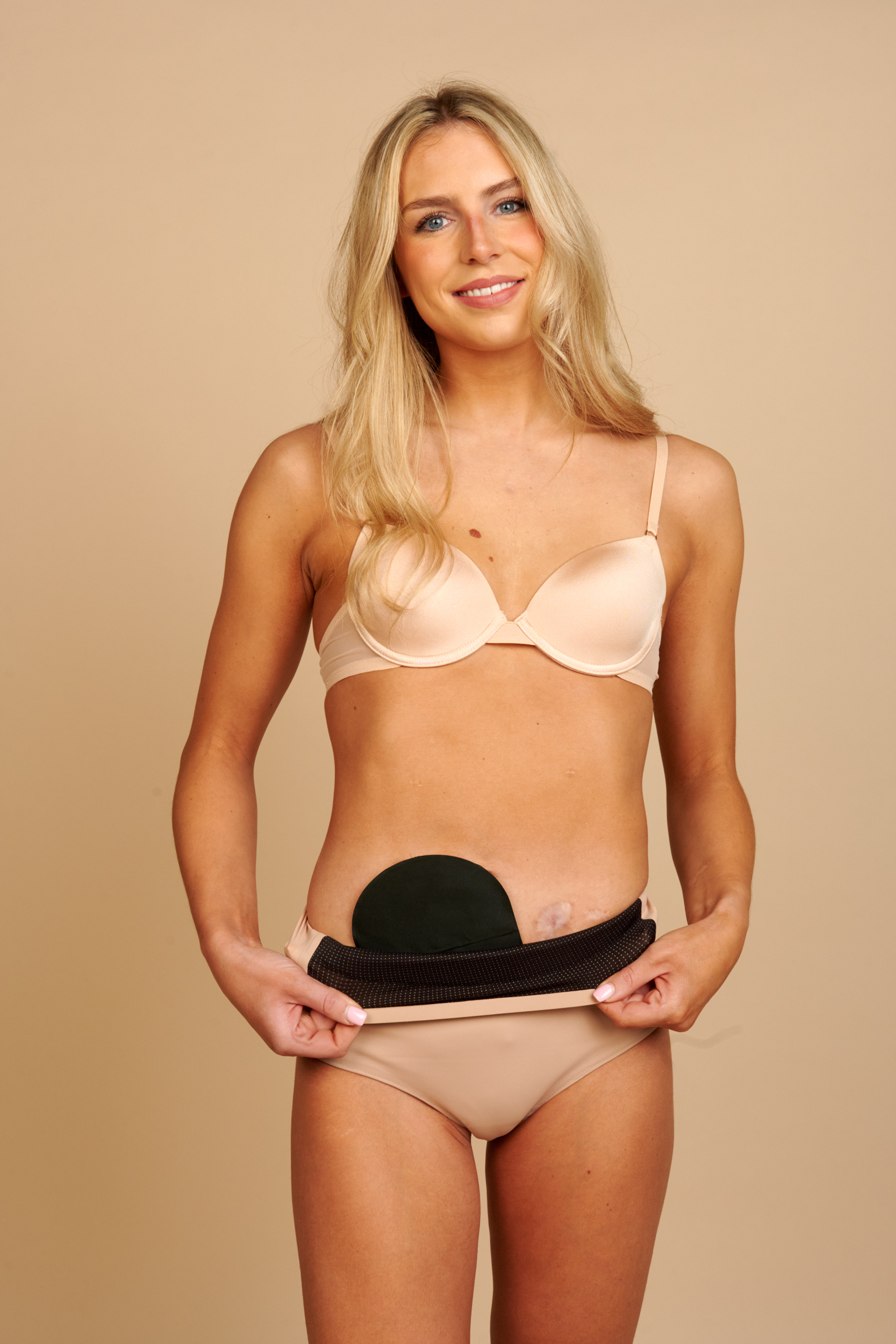
The hospital will not put underwear on your ostomy supplies list. Your actual week will. A low waistband rolls the pouch, prints the filter through a t-shirt, and makes every empty feel like a production. Soft high-waisted briefs, a stretchy wrap, or a light support layer keeps the bag where you put it. Regular store-brand high-rise cotton can be a perfectly decent first try. Dedicated ostomy wraps earn their keep when you want a smoother front under a dress or a shirt you actually like, without cinching like clinical gear.
Skip anything tight right over the stoma while you are still swelling and still learning your output rhythm. That is a first-weeks kindness, not a forever rule. Elastic that sits above the wafer, fabric that does not cling to a filter, dark or patterned tops on the days you are not in the mood to explain an outline — those are the small wins. Bag covers come later for a lot of people, once you want the pouch itself to feel finished. Swimwear can wait until you want the water.
If you only add one non-pouch item this month, make it a pair of high-waisted bottoms you forget you have on. That is the whole fashion brief for weeks one through six.
Week by week: what actually changes

Weeks one and two are clumsy on purpose. Changes take longer. You recut the opening more than once. You empty more often than you will later because you are still learning the “third full” cue. Keep the kit boring and close: same pouch style you left the hospital with, extra rings, remover, a towel, a mirror. Wear the softest high rise you own. Do not optimize yet.
Weeks three and four are when opinions show up. You will know if a wafer edge lifts after a shower, if a closed pouch is actually your rhythm, if you want to try the sample sitting in the drawer. Use those free samples now, not in week one. Your stoma is still not a final size, so stay cut-to-fit. Start noticing how often you change and empty on a normal day, not a worst day. That number is how you stop over-ordering one thing and under-ordering another.
Weeks five and six are quieter. The opening you cut is more consistent. You have a go-bag that is not a plastic grocery sack. You can think about a bag cover, a smoother wrap under a nicer top, or pants that feel like your pants. Odor questions usually shrink once the pouch is on correctly and you empty on time — and when they do not, that is a fit or filter issue, not a personality issue. A practical walk-through lives in our note on ostomy odor if you want it later. For now the win is simpler: a list, a buffer, and clothes that let you leave the house without negotiating with your waistband.
The part of the kit the hospital never packs.
High-waisted ostomy underwear that looks like actual underwear — soft, quiet over the pouch, and built for real clothes, not a waiting room.
Questions people ask after they have the list
Can I mix a Hollister wafer with a Coloplast or ConvaTec pouch?
On a two-piece system, stay inside the same brand and coupling size. The click or adhesive pairing is not universal, even when the pouch looks similar. On a one-piece, there is nothing to mix — the barrier and pouch are already one unit. If you want to try another brand, use that brand’s full sample, not a leftover pouch snapped onto a different wafer.
What do I do if I am running out of bags on a weekend?
Use the spare complete change you stashed in the car or a tote, then message a local ostomy group or a neighbor who has said they have leftovers. Manufacturer sample lines and your regular supplier are weekday moves, so the weekend save is the buffer you built on a calm day. This is exactly why three extra changes in three places is not overkill in the first six weeks.
When can I switch from cut-to-fit to pre-cut openings?
When the opening you cut has been the same for a stretch of changes and the stoma is no longer shrinking week to week. For a lot of people that is after these first weeks, not during them. If you order pre-cut too early you will own a box that does not match your body. Keep the scissors out until the size is boringly consistent.
Is it okay to donate leftover boxes — and can I sell unused ostomy supplies?
Donating unopened extras to a local ostomy group or a supplies exchange is how a lot of new people get through a brand switch. Do not sell leftover supplies. If a box is unused and still in date, give it to the local closet. If you need a different product number, ask that same closet before you buy a panic quantity.
Do I need a stoma guard or a hernia belt in the first six weeks?
Not as a default line on a first-weeks list. A soft wrap or high-waisted underwear is about comfort and a smoother outline, not about bracing anything. A hard guard or a dedicated hernia belt is a later, specific decision for gym contact, certain jobs, or a conversation you are already having about support. If the first weeks feel unstable, start with fabric that holds the pouch still, not hardware.
Can I swim or wear regular jeans this early?
Swim when you want the water and your pouch is staying on through a regular shower, not because a calendar cleared you. A snug swim bottom or a high-waisted suit keeps the bag from floating. Jeans are fine when the waistband sits above the wafer, not across it — same rule as week one, just in denim. If the button lands on the stoma, size up or pick a higher rise and save the old pair for later.