


Free Ostomy Quick Fix Playbook
13 chapters · Evidence-based · WOCN & UOAA referenced
Free Download — PDF
Get Your Free
Ostomy Playbook
13 chapters of evidence-based guidance. Instant access — no spam, ever.
Something went wrong. Please try again.
Check Your Inbox
Your free Ostomy Quick Fix Playbook
is on its way. Thank you!
Evidence-Based • WOCN & UOAA Referenced
Ostomy Troubleshooting Guide: Quick Fixes for Common Problems to Thrive with Confidence
This ostomy troubleshooting guide provides trusted, evidence-based solutions for every challenge — leaks, skin irritation, pancaking, high output, hernias, and more. Referenced from WOCN Society and UOAA guidelines. Download the free PDF playbook.
Leak Fixes
Skin Irritation
Pancaking & Ballooning
High Output
Hernia Prevention
Travel & Sleep
Intimacy & Confidence
73%
Experience skin issues
40K+
Ostomates trust SIIL
100%
Free forever
Section 01 — Most Common Issue
How to Fix Ostomy Leakage: Top Solutions for a Secure Seal

Leaks are the number one frustration for ostomates — but they're almost always fixable. According to WOCN clinical guidelines, the majority of pouch leaks stem from improper fit, skin irregularities around the stoma, or incorrect barrier application technique. Understanding these root causes is the first step in any ostomy troubleshooting guide, and leak prevention starts with proper technique.
Common Causes of Ostomy Bag Leaks
Incorrect wafer sizing — the opening should be no more than 1/8 inch (3 mm) larger than your stoma (WOCN Best Practice, 2024). Body contour changes from weight fluctuation, scarring, or creases near the stoma prevent a flat seal — convex barriers or barrier rings may help. Liquid output undermining the seal — this erodes the barrier faster than formed stool. Skin moisture or residue from lotions, oils, or sweat prevents proper adhesion — skin must be clean and dry. Worn-too-long barriers — typical wear time is 3–5 days, though this varies by individual.
Step-by-Step Leak Fix: The Ostomy Troubleshooting Guide Protocol
Step 1 — Measure: Use a stoma measuring guide. Re-measure monthly, especially in the first year post-surgery. Step 2 — Prepare skin: Warm water only (no moisturizing soap). Pat dry completely. Step 3 — Fill irregularities: Barrier rings, paste, or strips for creases and folds. Step 4 — Apply with intention: Start from bottom, press upward, hold 60 seconds with hand warmth to activate adhesive. Step 5 — Secure: An ostomy support belt keeps the barrier flush during activity.
Quick Fix When You're Out & About
Every ostomy troubleshooting guide recommends an emergency kit: barrier rings, adhesive strips, wafer change, plastic bags, wet wipes. Press a barrier ring over a leak as a temporary patch to extend wear time. Family restrooms provide more privacy and space for changes on the go.
Best Accessories for Preventing Leaks
An ostomy support belt is one of the most effective accessories for leak prevention — it keeps the barrier flush against the body, reducing seal failure during movement, exercise, and sleep. This ostomy troubleshooting guide recommends barrier rings to create a custom seal between the stoma and wafer, especially helpful for uneven skin. No-sting barrier film applied before the wafer protects skin and improves adhesion. And lubricating deodorant drops inside the pouch help output slide down, reducing pressure on the seal from the inside.
Did You Know?
Up to 73% of ostomates experience peristomal skin complications at some point. Most are preventable with proper barrier fit and skin care routine. Regular WOC nurse check-ups can reduce complications by 60%. (Colwell et al., JWOCN 2019)
Section 02 — Skin Health
Treating Peristomal Skin Irritation: Remedies for Red, Sore Skin

Peristomal skin irritation affects up to 73% of ostomates — it's the most common complication but is largely preventable. The WOCN Society classifies skin damage into four types: mechanical, chemical, infectious, and moisture-associated (MASD). Identifying the type is the first step to effective treatment, and skin care is a critical chapter in every ostomy troubleshooting guide.
Identifying Skin Irritation Around Your Stoma
MASD (Moisture-Associated Skin Damage) is the #1 complication — it occurs when output leaks under the barrier, causing redness, weeping, and pain. The solution starts with fixing the seal. Mechanical damage is caused by aggressive adhesive removal — always use adhesive remover wipes and never peel dry. Chemical irritation results from harsh soaps, fragrances, or alcohol-based products — use warm water only on peristomal skin. Infectious irritation — look for red skin with satellite dots, which may indicate a fungal infection requiring WOC nurse assessment.
Home Remedies and Treatments
The crusting technique is the gold standard for irritated peristomal skin: dust stoma powder on the affected area, seal with a no-sting barrier wipe, and repeat 2–3 layers to build a protective base before applying your wafer. No-sting barrier film applied before the wafer protects healthy skin and improves adhesion. Photo-document changes — take photos of your peristomal skin at each pouch change to track healing or worsening over time. This gives your WOC nurse valuable information and is a key practice recommended in any ostomy troubleshooting guide.
When to Escalate to Your WOC Nurse
Persistent redness that doesn't improve within 2–3 pouch changes, bleeding or ulceration around the stoma, red skin with satellite dots (possible fungal infection), or weeping skin that prevents the barrier from adhering. Early intervention prevents most skin complications from becoming serious.
Ostomy Troubleshooting Guide: Protecting Skin with Barrier Products
Barrier rings create a moldable seal that prevents output from reaching the skin — particularly helpful for uneven skin surfaces, flush stomas, or retracted stomas. Skin prep wipes create a thin protective layer. Stoma powder absorbs moisture on mildly irritated skin. And an ostomy support belt keeps the wafer pressed evenly against the skin, reducing the chance of output creeping underneath the seal — which is the primary cause of MASD. Every reliable ostomy troubleshooting guide emphasizes barrier products as the foundation of healthy peristomal skin.
Section 03 — Output Issues
Solutions for Ostomy Pancaking and Ballooning
Pancaking and ballooning are two of the most frustrating output-related problems ostomates face. Both can lead to leaks, discomfort, and anxiety — but both have effective, proven solutions. This ostomy troubleshooting guide covers both issues in detail.
What Causes Pancaking in Ostomy Pouches?
Pancaking occurs when stool collects around the stoma instead of dropping into the pouch. This lifts the pouch away from the skin and causes leaks. The main causes are: vacuum effect — the pouch filter releases air faster than output fills the pouch, holding the walls together; thick or formed stool — colostomy output is more prone than liquid output; pouch design — some styles are more prone due to filter placement; and body positioning — lying flat or certain sitting positions compress the pouch.
Quick Fixes to Stop Pancaking
Cover or block the filter — a filter sticker prevents air escaping too quickly, breaking the vacuum effect. Blow air into the pouch — a small amount before applying creates wall separation. Lubricating deodorant — a few drops inside helps stool slide down into the pouch. Try a different pouch — some offer anti-pancaking features; consult your WOC nurse for recommendations. Wear an ostomy support belt — gentle compression allows output to flow naturally downward.
Managing Gas and Ballooning Effectively
Ballooning occurs when gas inflates the pouch, lifting it away from the body — it's uncomfortable, visible under clothing, and can break the seal. It typically happens when the pouch filter gets wet or blocked, trapping gas inside. Beans, carbonated drinks, and onions increase gas production.
Use filter covers strategically — cover during showers to protect the filter; uncover after to allow venting. Burp the pouch — carefully release gas through the opening; some drainable pouches have integrated vents. Dietary adjustments — peppermint tea, fennel, and avoiding chewing gum can reduce gas production. Charcoal filters — some pouches have activated charcoal filters that neutralize odor as gas vents. An ostomy wrap adds a fabric layer that dampens noise from gas naturally.
Section 04 — Hydration & Nutrition
Managing High Output and Liquid Stool in Ileostomies
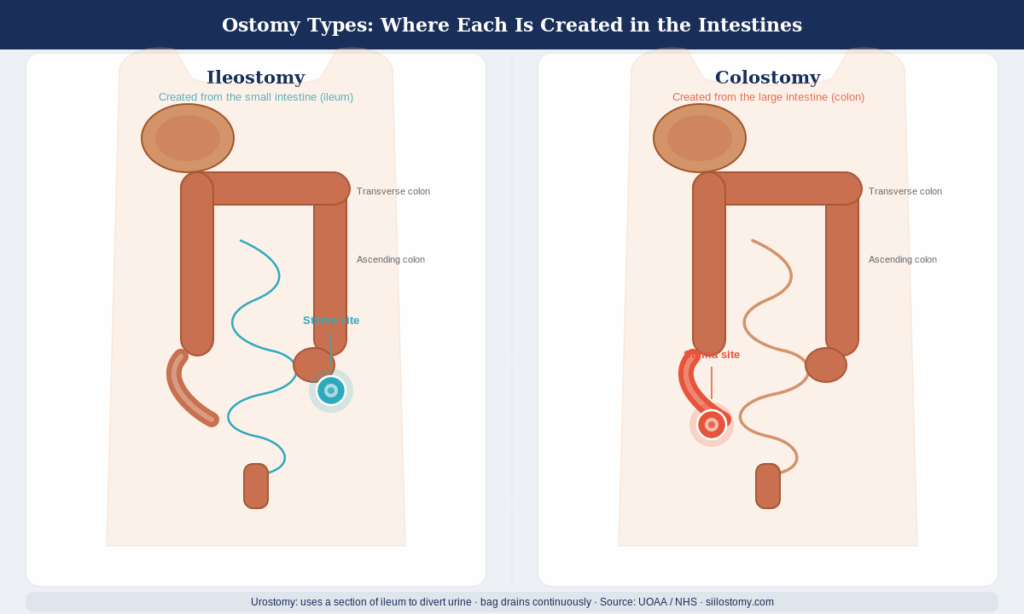
High output can lead to dehydration, electrolyte imbalance, and faster barrier breakdown. The WOCN defines high output as exceeding 1,200–1,500 mL per day for an ileostomy. Understanding the risks and having a management plan is essential — this ostomy troubleshooting guide breaks down hydration, diet, and warning signs below.
Signs of High Stoma Output
The colon absorbs up to 1.5 liters of water daily — without it, fluid passes directly through the stoma. Key warning signs include: dehydration (dark urine, dizziness, dry mouth, rapid heartbeat), electrolyte imbalance (fatigue, muscle cramps, weakness from sodium, potassium, and magnesium losses), faster barrier erosion (liquid output dissolves adhesive barriers more quickly), and reduced nutrient absorption (rapid intestinal transit reduces uptake of nutrients and medications).
Diet Tips to Slow Down Output
Oral rehydration solutions (ORS) — WHO formula or equivalents like DripDrop and Hydralyte are significantly more effective than water alone. Any ostomy troubleshooting guide will stress that ORS is non-negotiable for ileostomy patients. Sip throughout the day — small, frequent sips absorb better than large gulps; aim for 8–10 cups daily. Limit hypotonic fluids — plain water, tea, coffee, and alcohol can paradoxically increase output volume.
Soluble fiber foods like bananas, applesauce, white rice, oatmeal, and smooth peanut butter help thicken output. Avoid common triggers like raw vegetables, sugary drinks, spicy foods, and caffeine which increase volume. Eat regular meals at consistent times to help regulate output patterns. Marshmallows and gelatin are widely reported in UOAA community forums to help slow output.
When to Seek Professional Help
Contact Your WOC Nurse or Ostomy Care Team Immediately If:
Output exceeds 1,500 mL/day for more than 48 hours. You experience dark urine, dizziness, rapid heartbeat, or dry mouth. You're unable to keep fluids down or have severe nausea. These are signs of dehydration that may require medical intervention.
Get the Full Playbook
Our complete ostomy troubleshooting guide — all 13 chapters with step-by-step protocols, illustrations, output-friendly recipes, product recommendations, and trusted resources — in one beautifully designed PDF.
Section 05 — Complication Prevention
Preventing Serious Ostomy Complications Like Hernias and Prolapse
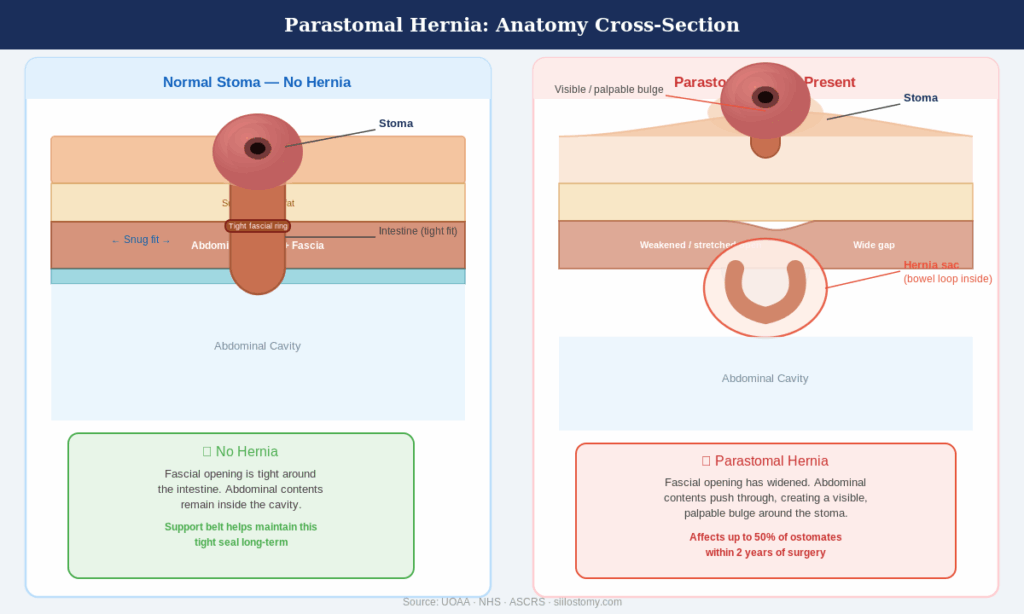
A parastomal hernia occurs when intestinal tissue pushes through the abdominal wall alongside the stoma. Up to 50% of ostomates may develop one within two years. Stoma prolapse — where the stoma extends further than normal beyond the skin surface — is less common but also requires awareness. The WOCN Society emphasizes that consistent protective habits significantly reduce the risk of both complications.
Recognizing Parastomal Hernias
Key risk factors include: obesity (BMI > 30) — excess abdominal weight strains the stoma site; heavy lifting over 10–15 lbs, which significantly increases intra-abdominal pressure; chronic coughing or straining from COPD or constipation, which adds repetitive pressure; poor stoma placement outside the rectus abdominis muscle, which increases vulnerability; and age and deconditioning, which weakens musculature over time.
Signs to watch for include a visible bulge around the stoma (especially when standing, coughing, or bearing down), difficulty with pouch fit that wasn't previously an issue, discomfort or a dragging sensation around the stoma, and changes in output pattern.
Daily Habits to Avoid Prolapse
Brace when coughing or sneezing — hold your hand or a pillow over the stoma area to reduce sudden pressure spikes. Safe body mechanics — always bend at the knees, keep objects close to your body, and avoid twisting motions. Gentle core strengthening — pelvic tilts, abdominal bracing, and walking are the simplest and most effective low-impact exercises. Maintain a healthy weight to reduce chronic pressure on the stoma site. Always get surgeon clearance before starting any exercise program.
Support Options for Long-Term Comfort
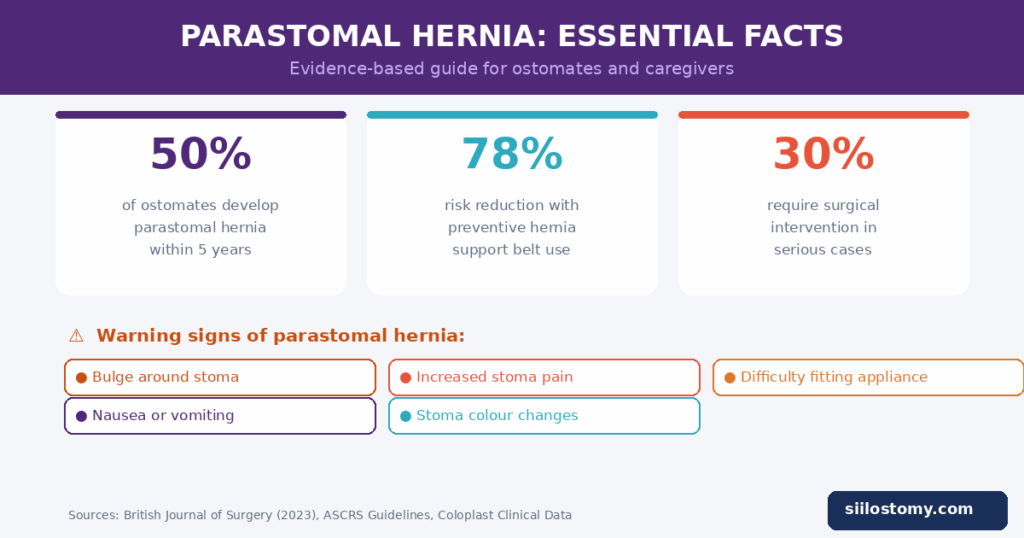
An ostomy support belt is one of the most effective tools for long-term hernia prevention and management — light compression distributes pressure evenly across the abdominal wall, supports the stoma site during activity, and reduces the risk of hernia progression. It's discreet under clothing and breathable enough for all-day wear.
Ostomy wraps offer similar support with the added benefit of keeping the pouch smooth under clothing. A stoma protector provides hard-shell protection against accidental bumps and impact — ideal for active lifestyles, contact sports, and sleeping on your stomach.
Section 06 — Living Well
Beginner Tips for Living Confidently: Your Complete Ostomy Troubleshooting Guide

Whether you're weeks or months post-surgery, building confidence with your ostomy is a journey. The UOAA reports that the vast majority of ostomates return to their previous occupation, travel internationally, exercise regularly, and enjoy full intimate relationships. Here's how to get there.
Essential Ostomy Care Basics
Early post-surgery: Your stoma shrinks over 6–8 weeks, so re-measure at every pouch change during this period. Let your WOC nurse teach you hands-on before hospital discharge — take photos of each step. Track output volume, food, and barrier wear time to reveal patterns quickly. Accept help from family or friends — you don't have to master everything on day one.
Travel: Always carry ostomy supplies in your carry-on (never in checked luggage), pack at least 2× what you expect to need, use the UOAA's free TSA notification card (you are NOT required to show your pouch), eat lightly before flying to reduce gas from altitude, and carry a doctor's letter in the local language for international travel.
Sleep: The safest position is on your back with a pillow under your knees. You can also lie on the side opposite your stoma. Empty your pouch before bed, consider a larger drainable pouch overnight, use a waterproof mattress protector, and wear an ostomy belt or wrap for nighttime security. Avoid eating 2 hours before bed to reduce overnight output.
Work: You're not required to disclose your ostomy to colleagues, but restroom accommodations are your right under the ADA. Locate private restrooms in advance, keep a discreet change kit in your desk, and dress strategically — high-waisted trousers, A-line dresses, and an ostomy belt create a smooth, invisible profile.
Exercise: Start gentle — walking, yoga, swimming (with a swim wrap), and cycling are excellent. An ostomy belt prevents pouch movement and protects the barrier seal. Avoid heavy lifting until cleared by your surgeon. Hydrate with ORS, especially if you have an ileostomy.
Intimacy: Entirely possible with patience and communication. Empty your pouch beforehand, eat lightly, secure the pouch with a wrap or belt, and explore comfortable positions. Ostomy lingerie and wraps help you feel confident and attractive.
Building Resilience and Confidence
The constant vigilance — checking for leaks, planning meals, timing changes, carrying supplies — creates a unique mental exhaustion. Simplify your routine with pre-cut wafers, pre-packed change kits, and a consistent schedule to reduce daily decisions. Reduce the mental load with gear you trust — when your belt or wrap keeps things secure, you stop constantly checking. Set "ostomy-free" time where you deliberately stop monitoring and trust your system. And don't hesitate to seek professional support from therapists experienced with chronic illness.
Confidence is attractive. How you carry yourself matters more than the appliance.
Odor anxiety is extremely common but usually unfounded — modern pouches are odor-proof when sealed. Lubricating deodorant drops neutralize odor inside the pouch, and dietary choices like parsley, yogurt, and cranberry juice can help. For noise concerns, eating slowly, avoiding straws and carbonation, and wearing an ostomy wrap all help.
Resources and Community Support
United Ostomy Associations of America (UOAA) — Education, advocacy, peer support, 300+ local groups across the US, and the "Ostomy Friends" program that pairs new ostomates with experienced volunteers.
WOCN Society — Knowledge Center — The premier nursing society for wound, ostomy, and continence care. Clinical guidelines, patient education, and WOC nurse directory.
Online communities — UOAA Discussion Board, Facebook ostomy groups, and Reddit r/ostomy offer 24/7 peer support from people who truly understand your experience.
SIIL Ostomy — Full Product Catalog — Belts, wraps, underwear, swimwear, stoma protectors, and lingerie. Trusted by 40,000+ ostomates worldwide.
You Are Not Alone
Over 725,000 people in the US live with an ostomy. Every one of them has navigated the same fears you're feeling. Reaching out — to a peer, a WOC nurse, or a support community — is the bravest and most important step you can take.
Tools for Confidence
Why Ostomates Trust SIIL
Premium ostomy accessories designed for comfort, discretion, and security — trusted by 40,000+ ostomates worldwide.
01
Organic Spandex
Certified organic spandex and premium European fabrics. Gentle on peristomal skin, breathable for all-day comfort.
02
Hernia Prevention
Light compression supports the abdominal wall and helps prevent parastomal hernia progression.
03
Leak Protection
Keeps the barrier flush against the body. Reduces seal failure during movement, exercise, and sleep.
04
Swim-Ready
Fast-drying fabric for pool, ocean, and water sports. No extra bulk — designed for active lifestyles.
05
Life Without Limits
40,000+ ostomates back to work, travel, sports, and confidence with SIIL products.
06
Universal Fit
Compatible with Coloplast, Hollister, Convatec, and all major pouch brands and sizes.

Made for Ostomates, by Ostomates
SIIL Ostomy Support Belts
Designed for comfort, discretion, and security. Crafted from soft, breathable materials and engineered to provide gentle support without bulk. Worn by thousands of ostomates across Europe and beyond — during workouts, at work, and while sleeping.
Available for all ostomy types: colostomy, ileostomy, and urostomy.
Explore Our ProductsCommon Questions
Frequently Asked Questions
How do I fix an ostomy pouch leak?
Most leaks stem from improper wafer fit, skin irregularities, or incorrect barrier application. Re-measure your stoma (the opening should be no more than 1/8 inch larger), clean and dry skin with warm water only, fill creases with barrier rings or paste, apply the wafer from bottom up pressing for 60 seconds with hand warmth, and secure with an ostomy support belt. Typical barrier wear time is 3–5 days.
What causes pancaking and how do I stop it?
Pancaking occurs when stool collects at the stoma instead of dropping into the pouch, often caused by a vacuum effect from the filter releasing air too quickly. Cover the filter with a sticker, blow a small amount of air into the pouch before applying, use lubricating deodorant drops inside, try a different pouch style, or wear an ostomy support belt for gentle compression.
How do I treat skin irritation around my stoma?
The most common issue is moisture-associated skin damage (MASD) from output leaking under the barrier. Fix the seal first. Use adhesive remover wipes (never peel dry), clean with warm water only, and apply the crusting technique: dust stoma powder, seal with barrier wipe, repeat 2–3 layers. See your WOC nurse for persistent redness, bleeding, or ulceration.
How do I manage high output from an ileostomy?
Use oral rehydration solutions (ORS) instead of water alone, sip frequently throughout the day, limit hypotonic fluids like plain water and coffee, and eat soluble fiber foods — bananas, applesauce, white rice, oatmeal — to thicken output. Seek medical help immediately if output exceeds 1,500 mL/day for more than 48 hours or you have signs of dehydration.
How can I prevent a parastomal hernia?
Up to 50% of ostomates may develop a hernia within two years. Avoid heavy lifting over 10–15 lbs, brace when coughing or sneezing, use safe body mechanics, maintain a healthy weight, start gentle core exercises (with surgeon approval), and wear an ostomy support belt for consistent abdominal support.
How do I reduce ostomy bag ballooning?
Ballooning happens when gas inflates the pouch — usually because the filter is wet or blocked. Use filter covers during showers, burp the pouch to release trapped gas, reduce gas-producing foods, drink peppermint tea, avoid chewing gum, and choose pouches with activated charcoal filters.
Can I travel and fly with an ostomy?
Absolutely. Pack at least 2× the supplies you need, always carry them in your carry-on, use the UOAA's free TSA notification card (you don't have to show your pouch), eat lightly before flying, and carry a doctor's letter in the local language for international travel.
What are the best ostomy tips for beginners?
Let your WOC nurse teach you before discharge, accept help, track output and food to spot patterns, connect with UOAA peer support early, and invest in a support belt for confidence from day one. Your stoma will shrink over 6–8 weeks — re-measure at every change. Over 725,000 people in the US live with an ostomy. You are not alone.
Free Download
You've Got This.
Living with an ostomy is a journey — made easier with the right tools, knowledge, and community. Download our full ostomy troubleshooting guide — the Ostomy Quick Fix Playbook — and feel more confident, prepared, and empowered every single day.