

Colostomy · Care at home
Colostomy Care at Home: A Step-by-Step Guide to Your Daily Routine
Colostomy care sounds clinical until you have done it a few times. Then it is a ten-minute routine, like shaving or doing your hair. Here is the whole routine, step by step, plus the habits that keep your skin happy and your bag secure.
Colostomy care comes down to four habits: empty or change the bag before it is half full; clean the stoma and the skin around it with warm water and pat dry at every change; cut the flange opening 2–3 mm larger than the stoma; and check the stoma and skin each time. Closed bags are replaced when they fill, while the flange of a drainable or two-piece system usually stays on for 2 to 4 days, or as long as your nurse advises. Call your stoma care nurse about sore skin, repeated leaks, or a stoma that changes colour or size.
- 2–3 mmthe gap between the stoma and the flange opening
- ⅓ to ½how full the bag should be before you empty or change it
- 2–4 daystypical flange wear time with drainable systems
- 6–8 weeksmeasure weekly while the stoma shrinks after surgery
Colostomy basics: what you're caring for
A colostomy brings part of your large intestine, the colon, through a small opening in your tummy called a stoma. Poo leaves through the stoma into a bag instead of through your bottom.
Most colostomies sit on the lower left side of the tummy and are made from the last part of the colon, so output is often soft to formed, much like a normal bowel movement. A colostomy higher up, in the transverse colon, usually produces softer output. Where your stoma sits shapes almost every part of your colostomy care, from the bag you use to how often you change it.
| Where the stoma is | Typical output | Bag most people use |
|---|---|---|
| Descending or sigmoid colon (lower left) | Soft to formed, often at fairly predictable times | Closed or drainable; irrigation may be an option |
| Transverse colon (upper tummy) | Soft to mushy, less predictable | Drainable |
| Ascending colon (right side, less common) | Loose to liquid | Drainable, with care similar to an ileostomy |
A healthy stoma is pink to red, moist and slightly shiny, like the inside of your cheek. It has no pain-sensing nerves, it may produce a little mucus, and it can bleed slightly when you clean it. It is swollen for the first weeks after surgery and shrinks as it heals. If you're not sure which type of stoma you have, our guide to ileostomy, colostomy and urostomy explains the differences, and our stoma colour guide shows what's normal.

Your daily colostomy care routine
Good colostomy care is mostly small habits done consistently. Tick these off as you go; there's a print button below if you'd like a copy on the fridge or in your supplies drawer.
SIIL Ostomy · Colostomy care checklist
Every day
Every time you change the bag
Every week
How to empty a colostomy bag
If you use a drainable bag, you'll empty it several times a day. Empty when it is a third to half full, so the weight never pulls on the seal.
Get comfortable
Sit far back on the toilet, or sit backwards facing the cistern, or kneel beside it. Pick whatever lets the outlet point straight into the bowl.
Stop the splash
Drop a few sheets of toilet paper into the water first. It cuts splashing and noise.
Open and drain
Hold the outlet up, open the clip or roll-up closure, then lower it and let the output slide out, easing it down with your fingers if needed.
Clean the outlet
Wipe the end of the outlet inside and out with toilet paper or a moist wipe, then close it securely and check it's sealed.
With a closed bag, you don't empty it: you peel it off, wrap it in a disposal bag and put it in the bin. Never flush a stoma bag, even one labelled flushable, unless your plumbing and the manufacturer both say it's safe.
Changing your colostomy bag, step by step
Choose a calm time, ideally before a meal when your stoma is quieter. Lay everything out before you start, so you never have to go looking with the stoma uncovered.

Lay out supplies
New bag or flange, scissors and measuring guide, warm water, soft dry wipes or gauze, adhesive remover if you use one, and a disposal bag.
Wash your hands
Soap and water, then dry them well.
Peel off gently
Work from the top down, pressing the skin away from the flange rather than pulling the flange off the skin. An adhesive remover makes it painless.
Clean
Wipe the stoma and skin with warm water. No soap is needed; if you use it, choose a mild unscented one and rinse it all off.
Dry and check
Pat the skin completely dry. Look at the skin and stoma, and measure the stoma if it's still changing size.
Cut to fit
Cut the opening 2–3 mm larger than the stoma, so it hugs the stoma without touching it.
Apply
Warm the flange between your hands, centre it over the stoma, press it on and hold your hand over it for 30 to 60 seconds so the adhesive grips.
Finish
Close the outlet, wrap the old bag in a disposal bag for the bin, and wash your hands again.
Want to see it done? Our guide to changing a stoma bag walks you through the whole change, step by step. For the gentlest way to clean the stoma itself, see how to clean a stoma and a stoma bag.
Skin care around your colostomy
The skin around your stoma should look just like the skin on the rest of your tummy. If it's red, sore, itchy or weepy, something needs adjusting, and it's almost always fixable.
Common causes
- Output leaking under the flange
- An opening cut too big, or a stoma that has shrunk
- Peeling the flange off too fast
- Soaps, wipes or creams that leave a film
- Shaving rash or a reaction to the adhesive
What usually fixes it
- Re-measure and recut the opening
- Add a seal or ring if your skin has dips or creases
- Use an adhesive remover every time
- Water only, and dry thoroughly
- Ask your nurse about stoma powder for raw, weepy skin
Skin problems that don't improve within a few days of fixing the fit deserve a call to your stoma care nurse. Our skin care around your stoma hub and our guide to skin problems around a stoma go into each problem in detail.
Food, fluids, wind and odour
There's no lifelong colostomy diet. For the first few weeks after surgery, softer, lower-fibre food is easier on a swollen stoma. After that, most people eat almost everything again, adding foods back one at a time and chewing well.

Output too firm?
- Drink more through the day
- Add fibre gradually: oats, fruit, vegetables
- Walk; movement helps the bowel
- Call your team if nothing comes out for 3 days, or you have pain or vomiting
Output too loose?
- Eat starchy foods like rice, pasta, potatoes and bananas
- Replace fluids, and salt if you're losing a lot
- Go easy on alcohol, caffeine and very spicy food
- Call your team if it lasts more than a day or two
Wind: beans, onions, cabbage, fizzy drinks and swallowing air (straws, gum, eating fast) make more of it. A bag with a charcoal filter lets it out quietly. Odour: a sealed bag is odour-proof; you'll only notice smell when you empty or change it. Emptying regularly, deodorant drops in the bag and a quick spray in the bathroom help.
For food lists and meal ideas, see our colostomy diet guide and our honest guide to foods to avoid with a stoma. More on diarrhoea and constipation with a stoma and on managing stoma odour. If you'd like a printable food guide too, the free Stoma Nutrition Guide is one click away.
Colostomy irrigation: is it right for you?
Irrigation is a way of emptying the colon on a schedule. You run warm water into the stoma through a soft cone, wait, and the bowel empties into an irrigation sleeve over the toilet. Done every 24 to 48 hours, it can mean little or no output in between, so some people wear just a stoma cap or mini bag.
- People with a descending or sigmoid colostomy and soft to formed output.
- People who want more control and don't mind spending around 45 to 60 minutes on it.
It isn't usually suitable with an ileostomy or transverse colostomy, during chemotherapy or pelvic radiotherapy, or with some hernias, prolapses and heart or kidney conditions. It must be taught by a stoma care nurse before you try it.
Bathing, exercise, sleep and travel
Showering and bathing
Water won't get into the stoma, so you can shower or have a bath with the bag on, or with it off on change days. Pat the flange dry afterwards, and cover the filter with the sticker that comes in the box so it doesn't get wet.
Exercise and lifting
Walk from the start and build up gradually. Avoid heavy lifting until your surgeon says it's OK, often around three months, because straining can lead to a parastomal hernia. When you do go back to the garden or the gym, lift with your legs, keep loads close and breathe out as you lift. A wide stoma belt holds the bag close while you bend and move.

Sleep
Empty or change the bag before bed. If your output comes at night, a slightly larger drainable bag or an earlier evening meal can help. Sleeping on your back or stoma side with a pillow under the bag keeps it from being squashed.
Travel
Pack at least double the supplies you expect to use, in your hand luggage, with a few flanges pre-cut at home. Drink plenty on flights, and carry a stoma travel certificate for security checks.
Clothes and confidence with a colostomy
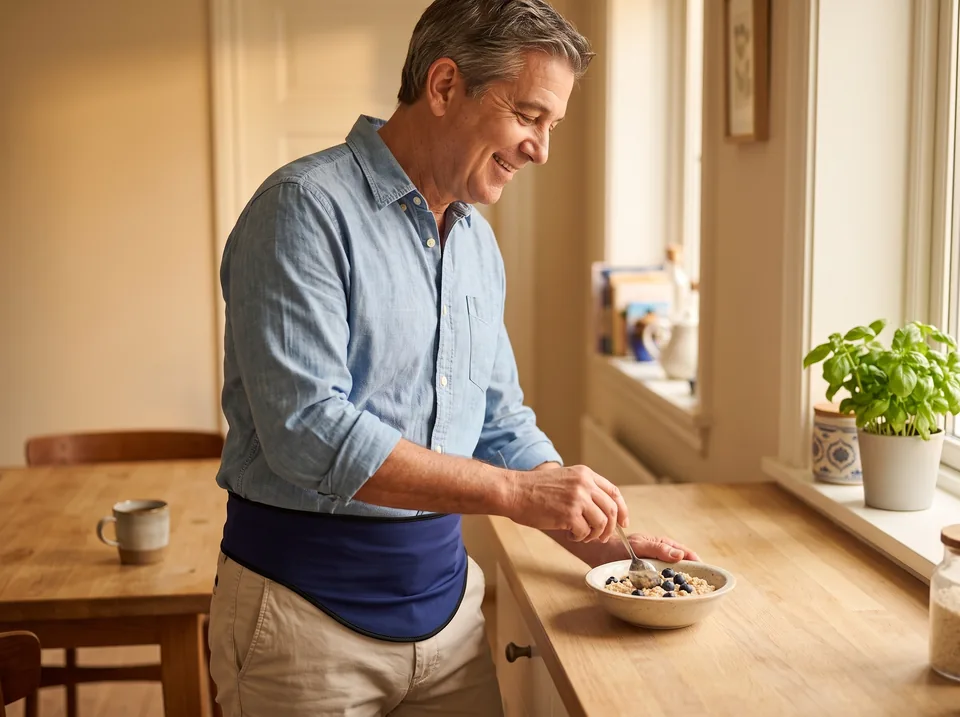
You can wear almost anything with a colostomy. A few pieces just make it easier: something that holds the bag flat, something that smooths its outline, and something soft between the bag and your skin.

High-waisted styles sit above the stoma rather than across it, so belts and waistbands don't press on the bag. If you prefer a dress or fitted top, a soft wrap smooths everything underneath. And a fabric stoma bag cover makes the bag feel softer against your skin and more private if your top rides up. More outfit ideas in how to hide a stoma bag under clothes.
Caring for someone with a colostomy
If you're a partner, parent or carer, the most helpful thing you can do is support independence. Most people want to do their own colostomy care as soon as they can.

- Learn alongside them. Ask to join a session with the stoma care nurse, so you both hear the same advice.
- Help with the set-up, not the stoma: keep supplies stocked, pre-cut flanges, take the bins out.
- Protect privacy and dignity. A locked bathroom door and a calm, matter-of-fact tone go a long way.
- Know the warning signs in the section below, especially if the person is older or recovering slowly.
- Look after their mood too. Body-image worries are common; talking, peer support from charities such as Colostomy UK, and counselling all help.
Nurses and carers looking for teaching resources can also find practical handouts in the free guide above, and our article on stoma care nursing explains who does what in your care team.
When to call your stoma care nurse or doctor
- a stoma that turns dark red, purple, grey or black;
- bleeding from the stoma that doesn't stop with gentle pressure, or a lot of blood in the bag;
- no output for 3 days, or less output with cramps, swelling or vomiting, which could be a blockage;
- watery output for more than a day or two, or signs of dehydration;
- a bulge around the stoma, or a stoma that gets much longer, known as a prolapsed stoma;
- sore, broken or bleeding skin, or leaks that keep happening;
- a fever, or pain that's getting worse.
Out of hours, NHS 111 can tell you where to get help. Go to A&E or call 999 for severe pain, repeated vomiting, heavy bleeding, or a stoma that has turned black.
Colostomy care: your questions answered
How often should a colostomy bag be changed?
It depends on the system. Closed bags are replaced each time they fill, often 1 to 3 times a day. With drainable or two-piece systems, the flange usually stays on for 2 to 4 days, or as long as your stoma care nurse advises. Change sooner if you feel itching, burning or any sign of a leak.
How do you clean a colostomy stoma?
Use warm water and soft dry wipes or gauze, wipe gently around and over the stoma, then pat the skin completely dry before putting on a new bag. Skip alcohol wipes, oils and moisturising soaps, which irritate skin or stop the flange sticking. A little bleeding when you clean is normal. See how to clean a stoma and a stoma bag.
Can I shower with a colostomy bag?
Yes. You can shower with the bag on, or take it off on change days and shower without it; water won't enter the stoma. Dry the flange well afterwards and keep the filter covered so it stays dry.
What should you not do with a colostomy?
In the first months, avoid heavy lifting and straining. At any stage, avoid putting oils or creams on the skin where the flange sticks, cutting the opening much bigger than the stoma, flushing stoma bags, and ignoring leaks or sore skin. And don't let it stop you from living: work, exercise, travel and intimacy are all still on the table.
Does a colostomy bag smell?
Not while it's sealed. Modern stoma bags are odour-proof and most have a charcoal filter for wind. You'll notice smell mainly when emptying or changing; emptying regularly and using deodorant drops in the bag help a lot.
Can you reuse a colostomy bag?
No. Stoma bags and flanges are designed for single use. With a two-piece system you can change the bag while leaving the baseplate in place for a few days, which reduces how often you peel adhesive off your skin.
How long does it take to get used to colostomy care?
Most people feel confident within a few weeks. The stoma usually settles in size over the first 6 to 8 weeks, and after that your routine becomes quick and predictable. Your stoma care nurse will check in during that time.
Is there a printable colostomy care handout?
Yes. You can print the checklist on this page, and the free New Stoma Patient Guide covers changing, skin care, clothes and the first months at home in one PDF.
Are colostomy supplies free on the NHS?
Usually, yes. Stoma supplies come on prescription, arranged by your GP or stoma care nurse. Prescriptions are free in Scotland, Wales and Northern Ireland, and in England a permanent colostomy qualifies for a medical exemption certificate. Our guide to how many stoma bags you can get each month explains how supplies work.
Sources and further reading
- Cleveland Clinic: Colostomy
- MedlinePlus: Changing your ostomy pouch
- NHS: Complications of a colostomy
Written by María G. for SIIL Ostomy. Your own stoma care nurse knows your stoma and your bags best; follow their advice where it differs.


More from the SIIL journal

Colostomy
How to clean a stoma and the skin around it, how to clean a drainable stoma or colostomy bag, whether to rinse the bag and what ne…

Colostomy
Is a prolapsed stoma dangerous? What it looks like, why it happens, what helps at home, when to call 999, plus stoma bag, clothing…

Colostomy
Is stoma bleeding normal? Why stomas bleed, how to stop it, blood in the bag vs bleeding from the skin around it, and when to call…
Welcome offer
Stories, tips and exclusive drops — once a month, never spam. Your code lands in your inbox the moment you subscribe.
By subscribing you accept our privacy policy. Unsubscribe in one click, anytime.