

Ostomy Travel Bag: How to Pack a Kit That Actually Works
Quick answer: A good ostomy travel bag is a small, wipeable pouch with two or three compartments that holds double the supplies you think you'll need, kept with you at all times — never packed in checked luggage. The core kit is pouches, barriers, adhesive remover and barrier wipes, disposal bags, dry paper towels, a small bottle of water, and one full change of clothes. Then build outward: a slim day pouch you carry into restaurants and rides, a bigger carry-on kit, and a backup stash in the car or hotel room.
The first trip after surgery is the one that keeps people up at night. Not the flight, not the hotel — the packing. How much is enough? What if I run out? What if something goes wrong in a gas station bathroom three hours from anywhere?
Here's the honest version: after the first trip, this stops being a big deal. What makes it stop being a big deal is having a kit you trust, packed the same way every time, so you're not making decisions at 6 a.m. with a suitcase open on the bed. This is that kit — what goes in it, how much, and how to organize it so you can grab it and go.
What actually goes in an ostomy travel bag
 Ostomy BeltHernia support & leak prevention. Trusted by 50,000+ ostomates worldwide.Discover →
Most people over-pack the boring stuff and under-pack the things that save a trip. The list below is the version experienced ostomates converge on, whether they have a colostomy, an ileostomy or a urostomy.
- Pouches and barriers — double your normal usage for the trip length. If you change every three days on a seven-day trip, that's two or three changes needed; pack six.
- Adhesive remover and barrier wipes — the individually wrapped ones, not the bottle. They don't leak into your bag and they're far easier to handle than a bottle when you're moving.
- Paste, rings or seals if you use them. Heat softens rings; keep them flat, not crushed in a corner.
- Scissors, if you cut to fit — but pre-cut everything before you leave if you're flying, so the scissors can live in checked luggage.
- Disposal bags — opaque, scented or not, plus a few zip bags for used supplies when there's no trash can.
- Dry paper towels. The item long-time travelers mention most often. Wet wipes clean; dry paper towels are what actually get the skin dry enough for a barrier to stick.
- A small bottle of water for rinsing hands or a urostomy tap when the sink is across the room.
- One full change of clothes, including underwear. Not because something will go wrong — because if it does, the trip continues instead of ending.
- A mirror, the flat kind that fits in a pocket, for changes in bathrooms with terrible mirror placement.
- Hand sanitizer and a couple of nitrile gloves if you like them for roadside changes.
Two things people forget and regret: a spare belt or wrap, and a few extra clips or closures if your pouch uses them. Both weigh nothing. Both are impossible to buy in a small town on a Sunday.
The three-bag system: day pouch, carry-on kit, base stash
Carrying one giant bag everywhere is exhausting, and leaving everything at the hotel is how you end up improvising. The system that works is three tiers, and it scales to a weekend, two weeks, or a month.
The day pouch is what goes into a restaurant, a theme park, a hike, a meeting. It's small enough to live inside a tote or a backpack pocket and holds exactly one full change plus disposal bags and paper towels. The carry-on kit travels on your body or in the bag that never leaves you — this is the one that must survive a lost suitcase. The base stash lives in the hotel room, the tent, or the trunk of the car, and it's the bulk of your supplies.
A version of the base stash also deserves a permanent home in your car year-round. Plenty of ostomates keep a sealed box under the seat and swap it out monthly so nothing gets brittle from heat. It's the difference between a surprise change on a road trip being a ten-minute stop and being a whole ordeal.
| Tier | Where it lives | What's in it |
|---|---|---|
| Day pouch | Handbag, backpack, jacket pocket | 1 pouch, 1 barrier, wipes, disposal bags, paper towels, small mirror |
| Carry-on kit | Never leaves your body or your seat | 3–4 full changes, all removers/wipes, spare belt or wrap, full change of clothes |
| Base stash | Hotel room, tent, trunk | The rest of the trip's supplies, disposal bags, spare clothes, backup wrap |
| Car kit (year-round) | Under a seat, out of direct sun | 2 full changes, paper towels, water bottle, zip bags — swapped monthly |
How much to pack: the math that stops the anxiety
The rule almost everyone lands on is double what you'd use at home, plus three. Doubling covers the fact that travel days aren't normal days — heat, different food, sweat and airplane air all make wear time less predictable. The plus-three covers the genuinely bad day.
Some specifics that help:
- Weekend trip, changing every 3 days: pack 4 full changes.
- One-week trip, changing every 2 days: pack 8–9.
- Two-week international trip: pack the full 2 weeks doubled, and split it — half in the carry-on, half in the checked bag. If one disappears, the trip survives.
- Anywhere remote (camping, small islands, road trips through nowhere): add 3 more and don't think about it again.
If you're still figuring out your own rhythm and what "normal usage" even looks like for you, our breakdown of how often to change and empty your pouch is a good place to build your baseline before you start counting for a trip.
Colostomy, ileostomy, urostomy: what changes in the kit
The core kit is the same for everyone. The differences are small but worth knowing, especially if you're traveling with someone who has a different setup than yours and you're comparing notes. (If you're new to the vocabulary, here's ileostomy vs colostomy in plain language.)
| Type | Pack extra of | Travel-specific note |
|---|---|---|
| Colostomy | Disposal bags, odor drops if you use them | Some people irrigate on a schedule — pack the setup in the base stash, not the day pouch |
| Ileostomy | Barriers, rings/seals, extra changes | Output is more frequent, so plan bathroom stops rather than fighting them; keep a water bottle within reach on long travel days |
| Urostomy | Night drainage bag, connector tubing, a spare | Pack the night bag in the carry-on — it's the hardest item to replace on the road |
One universal: pre-cut your barriers before you leave. It takes ten minutes at your own kitchen table and saves you doing precision work on a tiny airplane tray or a wobbly campsite picnic bench. If you're between products or thinking about switching before a big trip, don't — a trip is the worst time to test something new. Our roundup of ostomy bag options is better read a month out than a week out.
Airports, security and the stuff people worry about
Flying is where most first-timers get nervous, and the honest truth is that airport security is usually the least eventful part of the day. Keep your supplies in a clear pouch inside your carry-on so it's easy to show. Individually wrapped wipes and pastes are compact and travel flat; anything liquid goes in the standard bag with the rest of your liquids. Expect the possibility of a hand swab — a pouch under clothing can show up on a body scanner, and the swab that follows takes seconds.
Practical things that make it smoother:
- Wear something you can lift or adjust without undressing — a high-waisted piece is easier than a belt and tucked shirt.
- Say the word "ostomy" plainly if asked. It's a normal word to airport staff.
- You can ask for a private screening if you'd rather not be checked in the open — plenty of travelers do, and it's a routine request.
- Keep the day pouch reachable from your seat, not in the overhead bin.
And a genuinely nice development: some airports now have restrooms set up with a shelf, a hook and a hand sprayer. They're far from everywhere, but spotting one in the wild is a small, real joy.
Heat, water and the outdoors: keeping supplies usable

Triple-digit summer heat is the real test, not the airport. Sweat under a barrier is one of the most common reasons wear time drops on vacation, and a glovebox in July will warp rings and dry out wipes. Store supplies in the shade or the cooler bag, never on a dashboard. If you're camping, a sealed dry bag inside the tent beats anything left in the car.
For heat and humidity specifically: change in the morning when your skin is coolest and driest, give the barrier a few minutes of hand-warmth before you get dressed, and carry more dry paper towels than feels reasonable. A light cotton pouch cover also absorbs sweat between skin and plastic, which is a small comfort thing that turns into a big comfort thing on day four of a heat wave. If odor is on your mind in close quarters like a tent or a shared hotel room, our guide to managing ostomy odor covers what actually works.
Water is genuinely fine. Pools, the ocean, lake swimming, waterparks — a well-sealed barrier holds, and swimwear with real compression takes the guesswork out of the rest.
The lightest thing in your travel bag should be your outfit anxiety.
High-waisted swimwear that holds everything smooth and flat, designed to look like swimwear — because that's what it is. Pack it, wear it, get in the water.
Changing in a bathroom that isn't yours
This is the skill that makes travel feel normal, and it's mostly about sequencing. Lay a paper towel on the back of the toilet or the sink ledge and set out everything you need before you start — barrier, pouch, wipes, disposal bag. That way you're never reaching for something one-handed.
- No shelf? A gallon zip bag laid flat on the floor or your lap becomes a clean surface.
- No sink in the stall? That's what the small water bottle and dry paper towels are for.
- Roadside or trailhead? Front passenger seat reclined, door open, kit on your lap. Plenty of people do their fastest changes in a car.
- Shared hotel room? Run the shower fan, keep the disposal bags opaque, and know it takes less time than a shower.
What you get to do with this kit packed
The point of all of the above isn't caution — it's freedom. Ostomates camp for a week, ride roller coasters, do a full day at a theme park in August, snorkel, run half marathons, sit through job interviews and long-haul flights. The kit is the boring infrastructure that makes the interesting part possible.
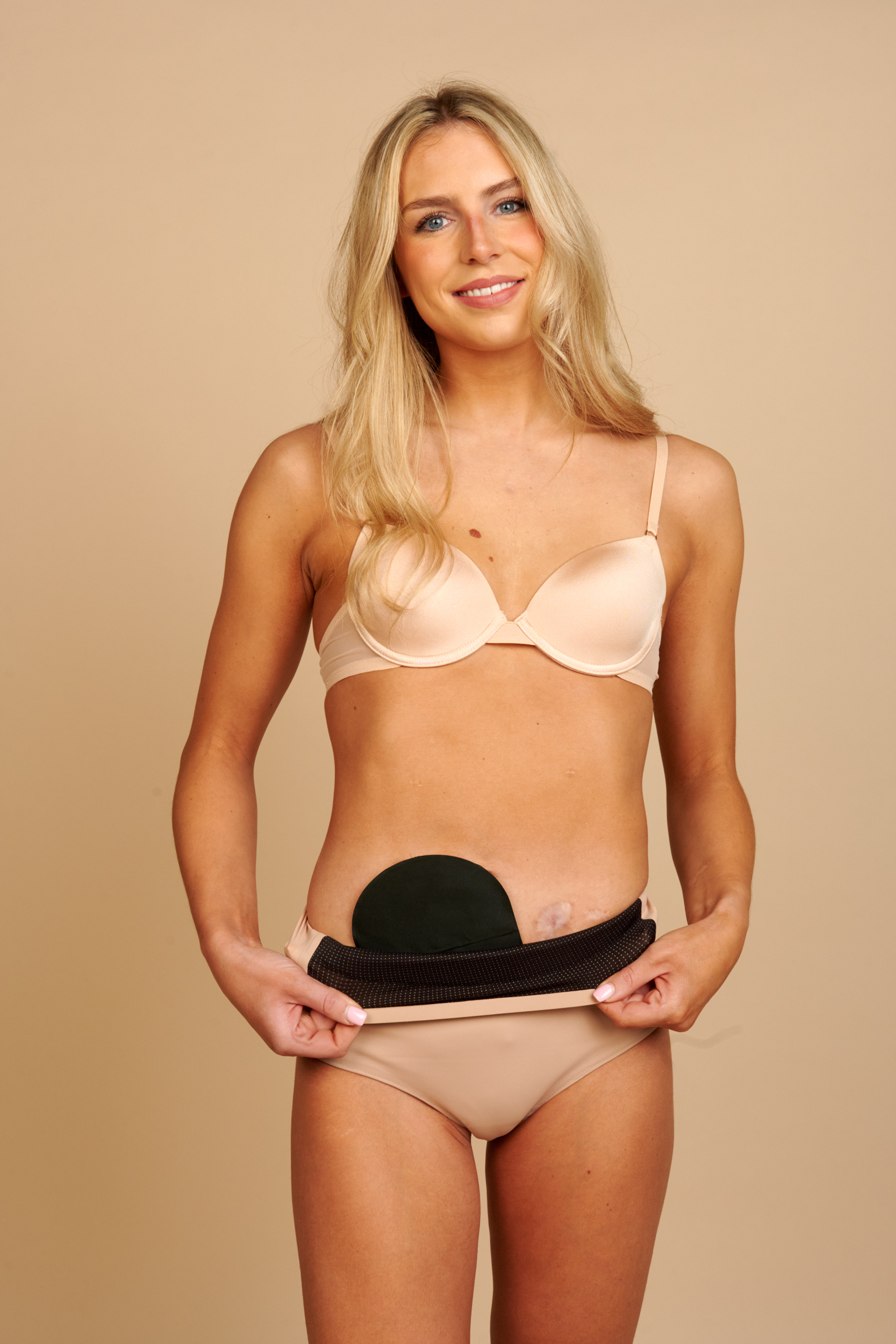
A few things that make travel more fun, not just safer: high-waisted underwear that holds the pouch flat means you can wear the linen dress or the fitted shirt without checking your reflection every twenty minutes. A support belt or wrap under clothes takes the swing out of a full pouch on a bumpy hike or a long walking day. And if you're newly out of surgery and this is your first trip, the new ostomate guide covers the fundamentals this article assumes you already have.
Pack the kit once. Keep it packed. Then go.
You handle the itinerary. We'll handle what you wear on it.
High-waisted underwear, wraps and belts designed to hold a pouch flat and quiet under travel clothes — from the airport queue to day fourteen of the trip.
Ostomy travel questions people ask after the first trip
Can I put ostomy supplies in checked luggage?
You can put some there — never all of them. Split your supplies: enough for the whole trip in the checked bag if you want, but always enough for at least three or four full changes plus one clothing change in the bag that stays with you. Lost luggage happens, and replacing your specific barrier size in an unfamiliar country is the one problem you can prevent entirely with five minutes of packing strategy.
Do supplies expire, and does packing them early matter?
Barriers and pouches do have dates printed on the boxes, and adhesives get less reliable near the end. For a car kit or an emergency stash you don't touch often, the community habit is to swap it out monthly — rotate the older supplies into everyday use and put fresher ones in the kit. That way nothing sits in a hot trunk for a year and lets you down when you need it.
How long is too long to sit on a plane or in a car without emptying?
Don't set a clock — set a habit. Empty before you board, before a long drive leg, and at every natural stop whether you feel like you need to or not. Most people find a "never let it get past half" rule takes all the guessing out of it, especially on turbulent flights or a mountain road with no shoulders.
Is a purpose-made ostomy travel bag worth it, or will a toiletry bag do?
Honestly, a good toiletry bag does the job for most people — wipeable lining, a couple of compartments, opens flat. Where a purpose-made kit bag wins is layout: sections sized for barriers so they don't bend, and a hanging hook for bathrooms with no counter. Both work. What matters far more is that you pack it the same way every single time so you can find things by feel.
What about camping, where there's no bathroom at all?
People do it all the time and it goes well. The setup that works: change in the tent or the car in the morning, keep supplies in a sealed dry bag out of the heat, bring extra opaque disposal bags plus a dedicated sealable container for used ones, and carry more water than you think you need for rinsing hands. A headlamp for night emptying is the item first-time campers always wish they'd brought.
Should I tell my travel companions I have an ostomy?
Entirely your call, and there's no wrong answer. Some people tell one person on the trip so bathroom stops don't need explaining; others tell nobody and it's a non-event. If you're sharing a room or a tent, one quiet sentence usually removes more awkwardness than it creates — and most people respond with far less curiosity than you expect.