

 ES
ES EN
EN GB
GB DE
DE FR
FRNo products in the cart.
Stoma Bag: What It Is, How It Works, and How to Wear One
Quick answer: A stoma bag, also called an ostomy pouch or ostomy bag, collects output from a stoma. The pouching system includes a skin barrier and a collection pouch. Common choices include one-piece or two-piece systems, and drainable, closed-end or urinary pouches. There is no single best bag for everyone: fit, output, ease of handling and your daily routine all matter.
If you searched “stoma bag,” you might be brand new, supporting someone you love, or you’ve worn a pouch for years and still want a clearer picture. A stoma bag is a tool. Once you know the main styles, what keeps a seal, and how you can dress around it, it becomes a little less of a mystery object.
Key takeaways
- A stoma is the opening on the abdomen; the pouch collects the output.
- System design and emptying style are separate choices. Your care team can help you compare suitable options.
- Repeated leaks or sore skin deserve a fit and care review. They are not a personal failure.
- Clothes and covers offer optional ways to dress around a pouch. The medical seal comes from the pouching system.
Where SIIL fits: SIIL makes clothing worn around an ostomy pouch, including ostomy belts, wraps and ostomy underwear. Our ostomy bag covers collection brings together these clothing options. The medical pouch and barrier are separate items; a garment does not replace a correctly fitted pouching system.

What is a stoma bag?
People mix the words up constantly, so here it is in plain English. A stoma is the opening on the belly. The stoma bag is the collection pouch worn over it. The stoma itself is not a bag; the bag is the part you empty or change. In everyday talk, stoma bag, ostomy bag, and pouch all mean the same wearable system.
Output goes into the pouch instead of following its usual route. An ileostomy or colostomy carries bowel output; a urostomy carries urine. Bowel output varies with the operation and the individual. Ask your team what is expected for you and what changes should prompt a call. For the wider picture, start with what an ostomy is.
Why someone wears a stoma bag
In real life, a stoma bag shows up because the body needed a new exit after surgery, injury, or a long stretch of illness. Some stomas are temporary; some stay. You don’t owe anyone the full story. Day to day, what matters is whether the pouch on your body feels secure.
Plenty of ostomates work full shifts, parent, date, travel, and sit through long meetings without announcing anything. Public figures have talked openly too — if you’re curious who has shared their experience, we keep a respectful roundup of celebrities with stoma bags.
Types of stoma bags at a glance
This is where most “which bag?” overwhelm starts. You do not need ten near-identical categories. The useful splits are fewer than marketing pages make them look. Below is the comparison most people wish they’d seen on day one — including how a colostomy setup often feels different from an ileostomy in daily pouch habits.
| Decision | Option A | Option B | Honest fit notes |
|---|---|---|---|
| System | One-piece | Two-piece | One-piece combines pouch and barrier in one unit. Two-piece has separate, compatible components, so the pouch can be removed while the barrier remains. Compare actual samples for profile and handling. |
| Emptying style | Drainable | Closed-end | A drainable bowel pouch has an outlet for emptying. A closed-end pouch is removed for disposal. Your output and routine help determine which is suitable. |
| Barrier shape | Flat | Convex | Different shapes and depths address different fit needs. A stoma nurse should help assess the design and any associated appliance belt; clothing does not provide that assessment. |
| Opening | Pre-cut | Cut-to-fit | Pre-cut openings require a suitable size and shape. Cut-to-fit systems allow the opening to be prepared to fit. Follow your own product instructions and your nurse’s measuring advice. |
| Bowel output | Colostomy | Ileostomy | Colostomy output depends partly on the section of colon used. Ileostomy output is usually looser. Do not use somebody else’s emptying frequency or wear time as a target. |
| Visibility | Opaque | Transparent | Opaque designs conceal the contents. Transparent designs make the stoma and output easier to see. Preferences and care needs can change. |
| Urinary diversion | Urinary pouch | Bowel pouch | A urostomy needs a pouch designed for urine, with its own drainage outlet and instructions. Check compatibility if a night drainage system is part of your plan. |
You may hear names such as Coloplast, Hollister and ConvaTec when comparing systems. None is universally “best.” A useful trial considers how the appliance fits and how comfortably you can use it. The UOAA guide to pouching systems explains the categories. Our ostomy supplies guide covers the broader equipment picture, while ileostomy vs colostomy explains the surgery-type differences.
Ostomy bag sizes: how to measure your stoma
Quick answer: Yes, ostomy bags come in different sizes, and three of them matter. The opening in the skin barrier should be cut about 1/8 inch (2–3 mm) larger than your stoma. On a two-piece system, the flange of the barrier and the pouch must be the same size so they click together. The pouch itself comes in mini, standard and large lengths.
When people search for colostomy bag sizes, they usually mean one of those three numbers without knowing it. The box in your hand lists them all, often in millimeters even in the US. Here is what each one means and how to get the first one, your stoma size, right at home.
| Size on the box | What it measures | Typical range | How you choose it |
|---|---|---|---|
| Stoma opening (cut size) | The hole in the skin barrier that fits around your stoma | About 3/4 inch to 2 3/4 inches (19–70 mm). Pre-cut barriers come in steps of a few millimeters | Measure your stoma and add about 1/8 inch (2–3 mm) of space all the way round |
| Flange or coupling size (two-piece) | The ring where the pouch locks onto the barrier | Often about 1 1/2 to 2 3/4 inches (38–70 mm) | Bigger than your cut size, and the same number on the barrier and on the pouch |
| Pouch size | The length and capacity of the bag | Mini about 6–7 inches, standard about 9–10 inches, large about 11–12 inches | Your output, how often you can empty, and what you wear that day |
How to measure your stoma at home
- Take off the old pouch and clean and dry the skin as you normally do.
- Hold the measuring guide that comes in your box over the stoma. Find the smallest circle that fits around it without touching it.
- If your stoma is oval, measure the widest and the narrowest points, then draw that shape on the back of the barrier.
- Cut the opening about 1/8 inch (2–3 mm) bigger than the stoma, so the barrier covers the skin but does not press on the stoma.
- Once the size is stable, cut one barrier, check it on your skin, and keep it as your template for the next changes.
When to measure again
The stoma is swollen after surgery and gets smaller over the first 6 to 8 weeks, so in that time it is worth measuring at every change. After that, measure about once a month, and any time you notice sore skin around the stoma, a leak you can’t explain, weight gain or loss, or a new bulge around the stoma. Your stoma nurse can measure with you if anything looks different. Our ostomy pouch change guide walks through the full change, step by step.
If the opening is too big or too small
Too big, and output reaches the skin between the stoma and the barrier, which is the most common cause of red, sore skin and of leaks. Too small, and the barrier rubs or presses on the stoma, which can cut or bruise it. If your stoma has changed shape, a cut-to-fit or moldable barrier is usually easier than a pre-cut one. When skin is already sore, start with our guide to skin problems around the stoma.
Pouch size and your clothes
A mini or closed pouch sits flat for a short swim, intimacy or a fitted dress. A standard drainable pouch fits most days, and a large pouch helps with high output and long nights. A bigger pouch hides well under a soft, supportive layer such as an ostomy belt, and if it fills with air at night, see how to stop stoma bag ballooning.
How a stoma bag stays on — and why leaks happen
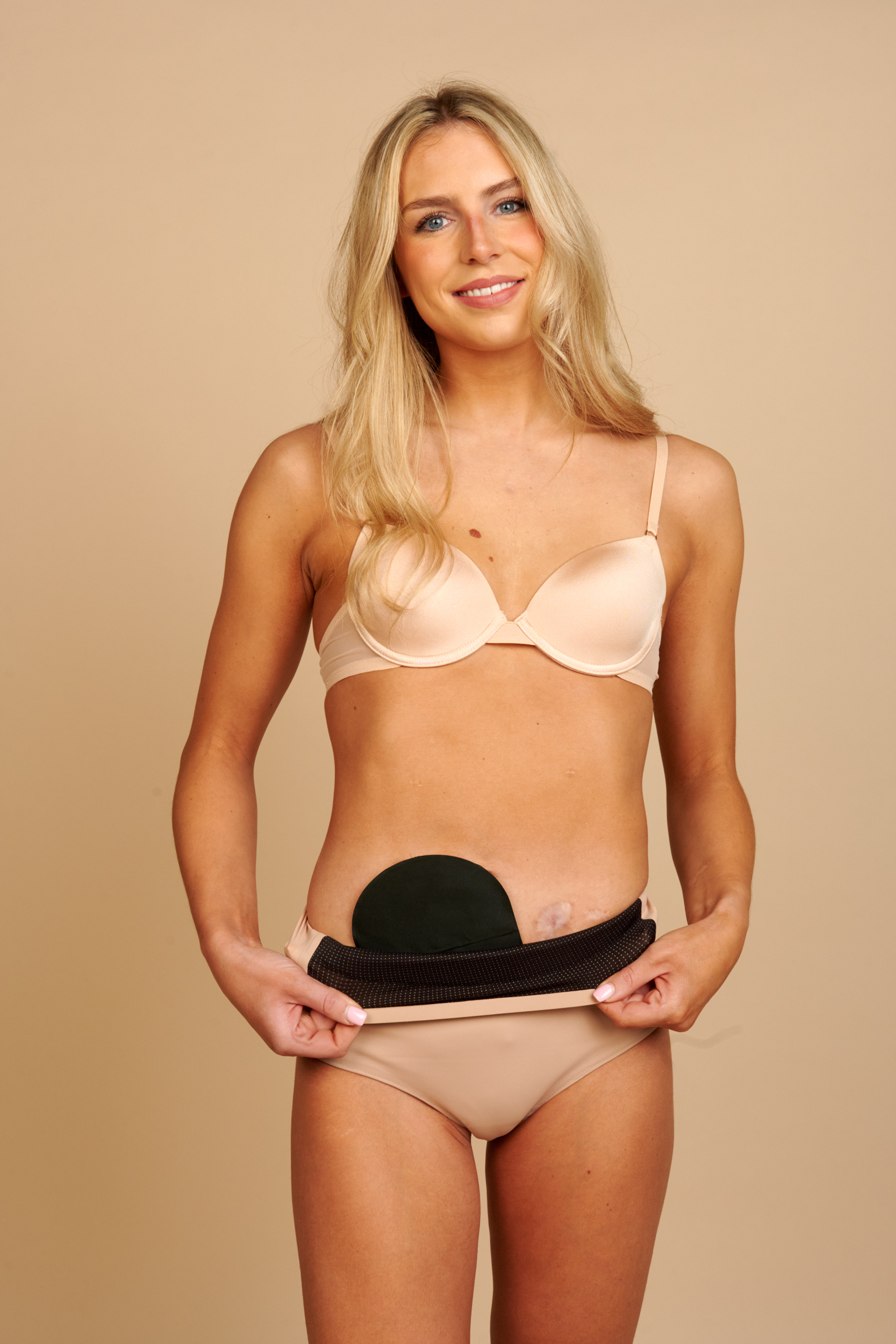
Here’s a distinction worth learning early: “the pouch looks noticeable under this shirt” is a clothing question. “Output is getting under the barrier” is a pouch-fit or skin-care question. They may happen on the same day, but they deserve different answers. Skin contours, changes in the stoma and the appliance design can all affect fit.
If something is not working, take a short, specific description to your stoma nurse:
- Where and when does it leak? Explain whether the problem occurs around a particular area, during a particular activity or soon after a change.
- What happens to the skin? Report soreness, irritation or output beneath the barrier. Do not hide the problem under an extra clothing layer.
- Which exact system are you using? Take product codes and describe any ring, paste or appliance belt that is part of your routine.
- Can you manage the steps? Difficulty seeing the opening or handling a closure is useful information, not something to be embarrassed about.
A system that used to work may need reassessment when your body or stoma changes. Follow the application instructions for your appliance; there is no universal heating, pressure or accessory routine for every product. Ask your nurse about flat or convex barriers and any medical appliance belt. A SIIL belt or wrap is a clothing option, not a substitute for those decisions. The UOAA product and supply information is a useful starting point for questions about available systems.
Trying a sample without becoming a walking catalog
Asking for samples is normal. Before you try one, check that it is suitable for your care plan and that the pack contains the parts you need. A pouch without its matching barrier may not give you a usable trial. With a two-piece system, similar-looking components are not automatically interchangeable.
Compare the details that affect your own day
| Detail | What to notice or ask |
|---|---|
| Handling | Can I see and manage each step with my hands and eyesight? |
| Closure | Can I open, empty and close this exact outlet comfortably? |
| Clothing | How does it sit when I sit down, reach or put on my usual outfit? |
| Routine | How does this fit the bathroom access I have at work or away from home? |
| Ordering | What are the full codes and sizes for every matching component? |
Keep a note that is useful to your nurse
Record the product code, date, comfort, ease of emptying and any problem. “The closure was difficult with wet hands” is useful feedback. “Everyone online likes it” is less useful when you are the person wearing it. Keep the packaging until you have recorded the details; the large brand name on the front is sometimes only the beginning of the product name.
You do not have to buy every accessory in a photograph. Ask what each extra item is intended to do and whether it belongs in your routine. A simpler setup that meets your needs can be easier to learn and organize.

Your free New Ostomy Patient Guide
Practical questions about routines, clothes, and everyday life to explore with your care team.
Get the free guide →Opens a short email form. Receive the guide and occasional emails; unsubscribe anytime.
Emptying, changing, and the smell question

Emptying the contents is different from replacing the pouch or the whole system. For a drainable bowel pouch, your care team may advise emptying when it is about one-third to one-half full. Follow the instructions for your appliance and individual situation. Closed-end and urinary pouches have different routines. Use filters and any filter covers according to the manufacturer’s directions, rather than improvising a solution from a comment thread.
Odor during emptying is different from an unexpected smell while the pouch is closed. If something changes or you suspect a leak, check the system and contact your nurse as needed. Do not assume you are imagining it, and do not treat a clothing layer as an odor remedy. Our ostomy odor guide and guide to emptying and changing a pouch cover the practical questions in more detail.
A routine becomes easier to explain when the steps are familiar. Ask your nurse to watch you practice if a part still feels awkward. The Memorial Sloan Kettering guide to ileostomy and colostomy care is one clear reference to discuss with your own team.
Keep supplies organized at home and on the go
A useful setup is simply one where you can find things. Keep the supplies for a routine change together, follow the storage instructions and make a note before your stock runs low. There is no award for fitting twelve product boxes into a bathroom cupboard designed for one toothbrush.
Build a kit around your actual system
Pack spare pouches and the compatible barriers or other items your own routine requires, plus a disposal bag and any clothing change you want. Check the kit after using it. A pouch that belongs to the system you stopped wearing six months ago is a souvenir, not a backup.
Keep product codes, supplier details and your team’s contact number somewhere you can find them. Before a trip, think through access to supplies and pack for your own needs; one fixed packing list will not suit every operation or journey.
Ask about ordering before a cupboard becomes empty
Medical pouches and barriers are ordered separately from clothing. Confirm availability, matching components and any insurance requirements with your supplier. If an order changes, check that the substitute is appropriate rather than assuming the product is identical because the box looks familiar. The UOAA guide to knowing your supplies explains why accurate product information matters.
Clothes and covers: dress around a pouch in your own way
Fashion is where a lot of supply-catalog content stops — and where real life continues. Try the clothes you already like before replacing your wardrobe. A different waistband position, softer fabric or looser drape may feel better. You can choose how visible the pouch is, and that choice may change with the day or occasion.
Practical wardrobe options to try:
- A waistband that sits comfortably without pressing across the stoma or restricting the pouch. Our guide to pants for ostomy patients explores different rises and cuts.
- An optional clothing layer, such as ostomy underwear or an ostomy belt. Use the particular garment’s size guide and check room, access and comfort with your actual pouch.
- Ostomy bag covers and clothing if you prefer extra coverage. Check exactly what each item is and what is included.
- Ostomy swimwear for a design you enjoy at the pool or beach. Follow your team’s advice on returning to swimming after surgery and your appliance’s instructions.
- Ostomy lingerie when you want another option for how you dress around the pouch.
SIIL focuses on clothing built around life with a pouch. Compare the designs in our ostomy clothing collection and choose what would be useful in your own drawer. If you are considering a stoma guard for a particular activity, check its intended use and ask your team about your situation. Clothing and accessories do not provide medical clearance for an activity.

Give an outfit a sitting-down test. Sit, reach and walk a little. Check whether anything presses uncomfortably, pulls on the appliance or makes emptying awkward. A useful outfit works when you move, not only during a motionless pose in front of the mirror.
Stoma bag vs other “stoma” searches
Search results sometimes mix apples and oranges. A laryngectomy stoma is an opening at the neck related to breathing after throat surgery. It is not the same setup as an abdominal stoma bag for output. If that’s the result you landed on, you’re in a different toolkit — not a drainable belly pouch.
On the abdominal side, stoma appearance varies. Ask your team what is expected for you rather than relying on a photograph for reassurance about a new change. Our note on stoma color is a companion to that conversation, not a way to diagnose a problem from a screen.
Looking for a clothing option around your pouch?
Explore SIIL’s belts, wraps, underwear and other clothing options. Compare the actual design and size guide, and choose a layer for comfort, coverage or your preferred style.
FAQ about stoma bags
Is a stoma bag the same thing as an ostomy bag or pouch?
Yes. In everyday talk, these words commonly describe the wearable collection pouch. The stoma is the opening on the abdomen; the pouching system is the appliance worn around it.
Which ostomy bag is best?
There is no universal winner. Fit, output, skin, ease of handling and your routine matter. A stoma nurse can help you compare suitable systems. A general product ranking cannot assess those individual details.
Will a stoma bag show under jeans, dresses, or light colors?
It depends on the outfit, pouch and fit. Try different waistbands, drape and optional clothing layers, and check comfort sitting and moving. Concealing the pouch is a personal preference, not a requirement.
Drainable or closed — how do people choose for real life?
Your output and care plan help determine the choice. A drainable bowel pouch is emptied through an outlet; a closed-end pouch is removed for disposal. Ask your nurse which options are appropriate rather than choosing only by the name on the box.
One-piece or two-piece if you care about a low profile under clothes?
Compare actual samples. Profile varies by design, and ease of handling matters too. One-piece combines barrier and pouch; two-piece uses separate compatible components. Try a suitable system with the clothes and movements that matter to you.
What belongs in a small “just in case” kit?
Pack the spare pouching components and care items your own routine requires, a disposal bag and any clothing change you want. Check that the codes still match your current system and replace anything you use.
Can you wear swimwear and lingerie with a stoma bag?
There are many clothing options for swimming and intimacy. Choose the design and coverage you prefer, and check comfort with your pouch. Follow your team’s advice about returning to activities after surgery and your appliance’s instructions.
Does SIIL sell the medical bag itself?
SIIL focuses on clothing worn around the pouch. The medical collection pouch and skin barrier are separate items obtained through medical suppliers or manufacturers. Read the product description so you know exactly what is included.
Can a wrap or clothing belt fix a leaking pouch?
A garment is a clothing layer. If output is getting beneath the barrier or the skin is sore, ask for a review of the pouching system and care routine. Do not use a tighter garment to compensate for an unresolved leak.
Do ostomy bags come in different sizes?
Yes. Three sizes matter: the opening in the skin barrier, which you cut or choose to fit your stoma; the flange size on two-piece systems, which must match between barrier and pouch; and the pouch size, usually mini, standard or large.
What size flange do I need for my ostomy?
The flange has to be bigger than your stoma opening, and the same size on the barrier and on the pouch. Measure your stoma first, pick a barrier whose opening fits it, and then use the flange size printed on that barrier when you order pouches.
How do I know what size my stoma is?
Use the measuring guide from your box and find the smallest circle that fits around the stoma without touching it. Cut the barrier about 1/8 inch (2–3 mm) bigger. Measure at every change for the first 6 to 8 weeks after surgery, then about once a month.
Keep reading
More from the SIIL journal

Ostomy Clothing & Accessories
Hollister Ostomy Clothing: What to Wear Over Your Pouch
Hollister makes pouches, wafers, and clip-on ostomy belts — not everyday outfits. If you searched “Hollister ostomy clothing,” you…
10 min read

Ostomy Clothing & Accessories
SIIL vs Joe & Bella: Ostomy Clothing Compared
SIIL vs Joe & Bella. SIIL wins with ostomy belt, swimwear, and integrated system. Comparison 35/40 vs 19/40.
4 min read

Ostomy Clothing & Accessories
SIIL Ostomy Review: Belt, Underwear and Swimwear Tested
Complete SIIL Ostomy review. Rating 4.8/5. Detailed analysis of belt, underwear and swimwear.
4 min read

Welcome offer
Join the SIIL family.
Get 20% off your first order.
Stories, tips and exclusive drops — once a month, never spam. Your code lands in your inbox the moment you subscribe.
By subscribing you accept our privacy policy. Unsubscribe in one click, anytime.
Welcome — check your inbox for the code.