If you have a stoma and you're pregnant, thinking about becoming pregnant, or just quietly wondering whether it's even possible — you're not alone. Most of the fear around this topic comes from not knowing what actually changes, and not seeing anyone talk about it openly. Here's what genuinely happens to your body, your stoma, and your routine at each stage.
✓
The short answer
Yes — you can have a healthy pregnancy and a safe delivery with an ostomy. Your stoma will change along the way, and your appliance sizes will too. Plan for regular re-measuring, softer adjustable support, and early coordination between your obstetric and stoma teams.
No — an ostomy does not affect fertility on its own. Many ostomates conceive naturally and carry full-term, healthy pregnancies, and the stoma itself plays no role in whether you can become pregnant.
If your ostomy came from Crohn's, colitis, or cancer
If your ostomy was created because of Crohn's disease, ulcerative colitis, or another underlying condition, that condition — not the stoma — is what your medical team will monitor most closely, since disease activity can affect fertility and pregnancy risk. If you're planning a pregnancy, loop in both your stoma nurse and your gastroenterologist or urologist early, ideally before you start trying.
02 — Your stoma
Free guide · A gift from SIIL
The SIIL Ostomy Diet Guide — yours, free
Practical information on food and hydration for everyday life with a stoma.
Your abdomen changes shape dramatically over nine months, and your stoma changes along with it. This is normal, and it's the part that surprises people most.
What you'll notice
The stoma itself may protrude more or less as the surrounding skin stretches and the abdominal wall shifts.
Your usual flange size will likely stop fitting at some point, often around the second trimester.
The stoma's position relative to your waistline moves as your bump rises, changing how a pouch sits under clothing.
Skin around the stoma stretches, which can make the peristomal area more sensitive — extra gentle skin care matters more than usual.
Trimester by trimester
1st trimester
Mostly business as usual
Keep your routine, tell your stoma nurse and obstetric team early.
2nd trimester
Sizes start shifting
Your flange may stop fitting — start re-measuring monthly.
3rd trimester
The biggest changes
Belt sits lower around the bump; empty the pouch more often.
Why re-measuring matters
Your appliance fit is your best early-warning system — a flange that fit perfectly last month can quietly start leaking this month, and pregnant skin is more sensitive to output contact than usual.
2–3×
how many times your flange size can change across a single pregnancy — re-measure regularly instead of assuming last month's size still fits.
03 — Comfort
Staying comfortable as your bump grows
The biggest everyday challenge is usually comfort, not medical risk. A few deliberate swaps make the difference.
Support that grows with you
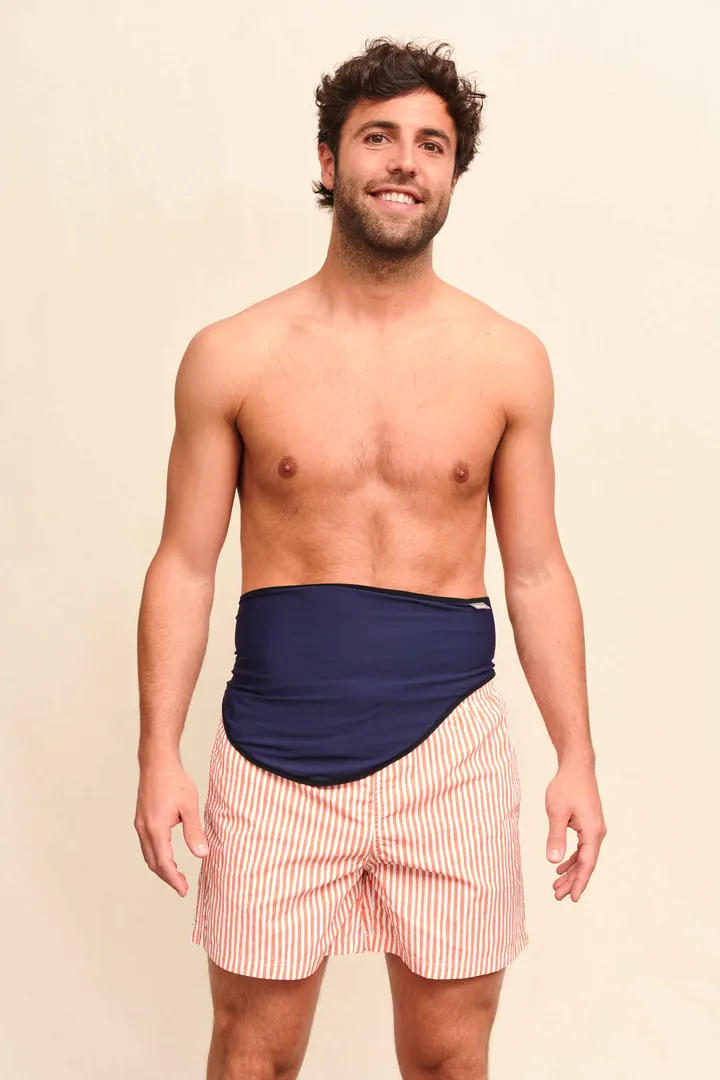
Switch to an adjustable, stretch-friendly ostomy belt rather than a fixed-size one — you need support that grows with you week to week, not one that digs in by month six.
Move the belt lower or higher as needed to sit comfortably around the bump rather than across it.
What to wear
Choose soft, high-waisted ostomy underwear with stretch panels instead of firm, structured styles that were comfortable pre-pregnancy but aren't anymore.
Daily routine adjustments
Empty your pouch more frequently — pressure from a growing uterus on your bladder and bowel often means more frequent, and sometimes more urgent, output.
Pregnancy also stretches the abdominal wall around your stoma, so it helps to know the early signs of a parastomal hernia, such as a new bulge or a change in how your pouch sits, and to mention them to your stoma nurse.
Comfort that adjusts with you
The SIIL Ostomy Belt is soft, breathable, and designed to move with your body as it changes.
Vaginal delivery or C-section: which is safer with a stoma?
Can you deliver vaginally with a stoma?
This is the question most people are actually afraid to ask. Having an ostomy does not automatically mean you need a C-section — vaginal delivery is possible and common for ostomates, and the right choice depends on your specific anatomy, your surgical history, and your obstetric team's assessment, not on the stoma alone.
When a planned C-section makes sense
A parastomal hernia or significant scar tissue near the birth canal
A stoma created very close to the pelvic area where vaginal delivery could put unusual strain on it
A history of complex pelvic surgery alongside the ostomy
Talk to your team early
Your obstetrician and your stoma or colorectal surgical team should coordinate directly well before your due date — this is not a conversation to have for the first time in the delivery room. Bring it up explicitly at your first prenatal appointment so it's on record early.
05 — Postpartum
What changes after delivery
Your stoma in the weeks after birth
Postpartum, your abdomen shrinks back over weeks, not overnight, and your stoma will keep shifting during that time too. Expect to re-measure your flange again in the weeks after birth — don't assume your pregnancy-size appliance, or your original pre-pregnancy size, is automatically right again. A soft, gentle support belt is genuinely useful here as your abdominal muscles recover, in the same way it was during pregnancy — snug, adjustable support rather than tight compression.
Ready for gentle, adjustable support?
Explore SIIL's ostomy belts and high-waisted underwear, designed for real bodies at every stage.
Should I plan to re-measure my stoma on a set schedule, or only when something feels wrong?
Given my surgical history, is a vaginal delivery realistic, or should we plan for a C-section?
Are there specific signs during pregnancy (pain, unusual swelling, prolapse) that mean I should call you immediately rather than wait for my next appointment?
Will my underlying condition (Crohn's, ulcerative colitis, cancer history) need extra monitoring during pregnancy?
07 — By stoma type
Pregnant with a colostomy, an ileostomy or a urostomy: what differs
The basics are the same for everyone, but each type of stoma brings one thing to watch more closely during pregnancy.
Stoma
What changes most
What helps
Colostomy
Pregnancy hormones slow the bowel, so output can get firmer and less frequent
Fluids, gentle walks and the fiber your team suggests; mention it early if nothing comes out for days
Ileostomy
Morning sickness plus liquid output can dehydrate you quickly
Small, frequent drinks, salts if your team recommends them, and a call if you cannot keep fluids down
Urostomy
Urine infections become a little more likely
Plenty of water, and a call if urine turns cloudy or smelly or you get a fever or back pain
Can you get pregnant with a colostomy or an ileostomy?
Yes. A stoma does not affect fertility on its own, and many people with a colostomy or an ileostomy conceive naturally and have healthy, full-term pregnancies. What your team watches most is the condition behind the stoma, such as Crohn's disease, ulcerative colitis or a cancer history.
Can you have a vaginal birth with a stoma?
Often, yes. Many people with an ostomy deliver vaginally. A planned C-section is more likely after complex pelvic surgery or for the usual obstetric reasons, so decide it early with your obstetrician and your colorectal team together.
Will my stoma change during pregnancy?
Yes. As your belly grows, the stoma usually gets bigger and can change shape or move slightly to the side. Re-measure it every few weeks, and again after birth, and change the size of the barrier opening when it no longer fits.
Is it harder to be pregnant with an ileostomy?
The main difference is fluids. Morning sickness and vomiting on top of ileostomy output can dehydrate you fast, so drink little and often, add salts if your team recommends them, and call your team if you cannot keep fluids down.
What should I wear during pregnancy with an ostomy?
Soft, high-waisted ostomy underwear and an adjustable ostomy belt that sits under or over the bump keep the pouch close without pressing on it. Avoid tight waistbands that sit right on the stoma.
Can pregnancy cause a hernia or a prolapsed stoma?
The growing belly stretches the muscles around the stoma, so a parastomal hernia or a prolapse is a little more likely during pregnancy and after birth. Gentle support helps, and a stoma that looks much longer, dark or painful needs a call to your team the same day.
Pregnancy with an ostomy is not a medical footnote — it's a normal, well-documented path that thousands of ostomates have walked before you. The changes are real and worth planning for, but they are manageable, and you deserve a care team and a wardrobe that keeps up with you at every stage.
This article is for general information only and is not a substitute for advice from your own stoma care nurse, obstetrician, or doctor. Always consult your care team about your individual situation.
Leaks, skin care, hernia prevention, intimacy and the everyday issues nobody warns you about — solved.
Sent. Check your inbox in a minute.
20%
Free · Gift Inside
New Ostomy Patient Guide
Everything we wish someone had given us in the first weeks. Pouching, skin care, diet, sleep, travel, intimacy — written warmly for real people.
Sent. You are not alone.
Cookie preferences
We use cookies to make the site work. If you accept, we also measure which ads bring you here, so you see fewer ads that don't interest you.Cookie policy
Necessary
Always active
They make the site, cart, and checkout work.
Preferences
The technical storage or access is necessary for the legitimate purpose of storing preferences that are not requested by the subscriber or user.
Measurement
We count visits and see how the site is used.The technical storage or access that is used exclusively for anonymous statistical purposes. Without a subpoena, voluntary compliance on the part of your Internet Service Provider, or additional records from a third party, information stored or retrieved for this purpose alone cannot usually be used to identify you.
Advertising
We measure which ads bring you here, so you see fewer ads that don't interest you.

 ES
 EN
 GB
 DE
 FR


 Ostomy BeltHernia support & leak prevention. Trusted by 50,000+ ostomates worldwide.Discover →