

 ES
ES EN
EN GB
GB DE
DE FR
FRNo products in the cart.
Ostomy Skin Barriers, Rings & Powders Explained
Quick answer: Ostomy skin barriers are the sticky wafers that sit around your stoma and hold the pouch on — plus the rings, powders, and pastes people add when that wafer needs backup. In real life the wafer is your second skin, a ring acts like a gasket in the gaps, and powder is what you reach for when the skin under the barrier still feels damp. Get that base dry, warm, and sitting flat, and the rest of the day (clothes, work, a swim) gets a lot quieter.
If you came home with a starter kit and a pile of beige stickers that all claim to do the same job, you are not behind. Ostomy skin barriers are the part of the system that actually touches you. They are also the difference between a pouch you forget about and one you think about in every doorway. This is wafers, rings, and powders as people actually use them — not as a catalog describes them.
What ostomy skin barriers actually do all day
 Ostomy BeltHernia support & leak prevention. Trusted by 50,000+ ostomates worldwide.Discover →
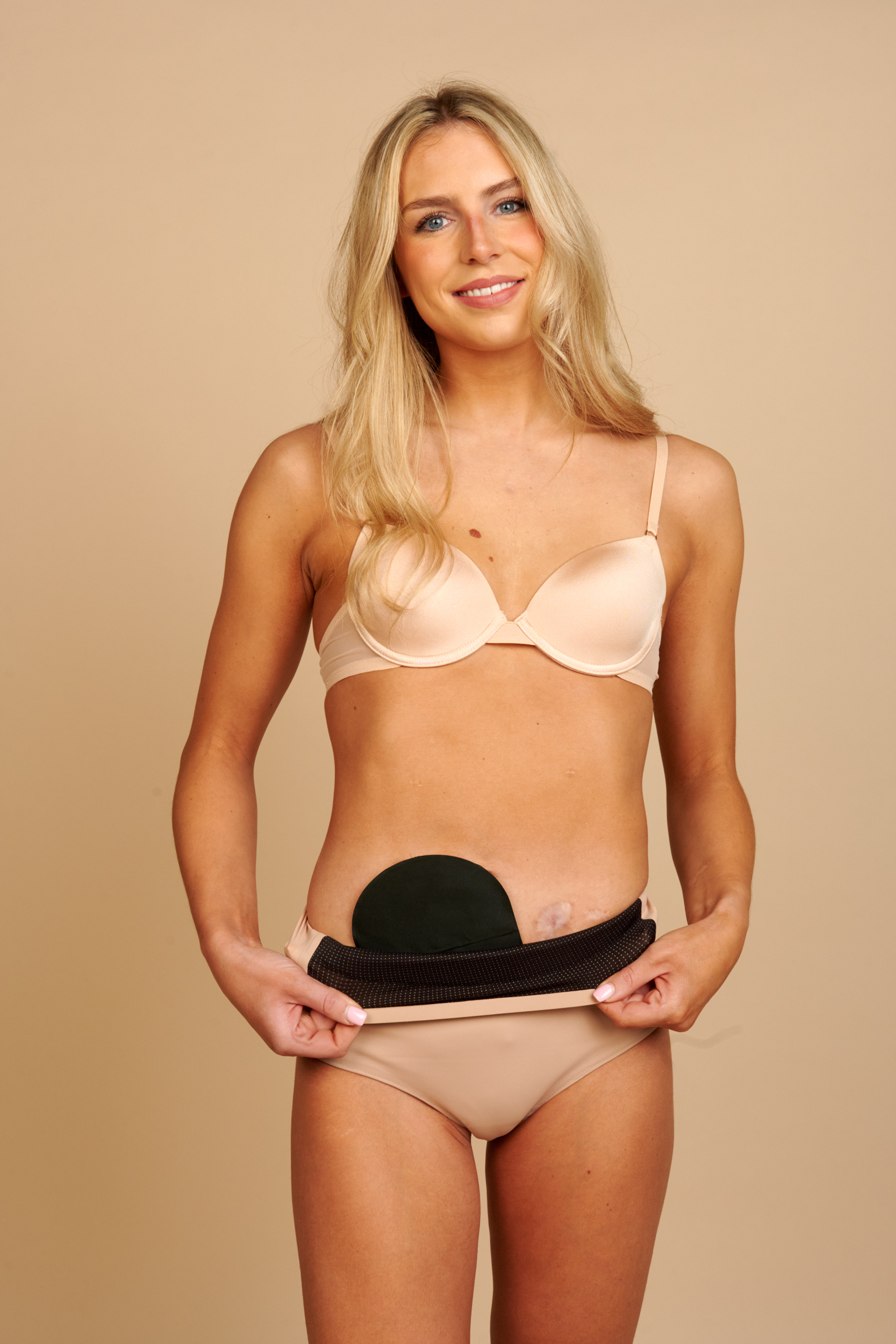
If you are still getting used to what an ostomy is in real clothes, here is the simple picture. Your pouch does not stick to you. The skin barrier does. That beige (or gray, or patterned) wafer is a thin, sticky sheet with a hole for your stoma. The bag clicks or attaches onto it. When the wafer is sitting well, output stays in the pouch, the edges stay put, and you can reach for a coffee without doing a mental leak-check.
When it is not sitting well, you feel it immediately. A tiny tunnel at the edge. A warm patch. That smell you cannot quite place in a meeting. Barriers are not a personality test. They are about whether you get to be a person in a shirt.
What they will not do: flatten a pouch under skinny jeans, cancel output, or make a bad hole size magically work. Cut too big and you leave a ring of skin exposed. Cut too snug and it can rub the stoma. Most of us land on a small, even gap — close enough that output does not sit on skin, loose enough that the stoma can move when you laugh or bend. A great barrier still needs a pouch that matches it. Afternoon leaks are not always the wafer; sometimes it is the bag, the filter, or how full you let it get. Start with how your ostomy bags actually attach and empty, then come back to the barrier.
Ostomy barriers at a glance: wafers, rings, powders, paste, strips
Walk into any ostomy aisle (or open the discharge bag) and you will see five things that all get called “barrier” in casual conversation. They are not the same job.
| What it is | Real-life job | When people reach for it | Honest catch |
|---|---|---|---|
| Skin barrier / wafer | The sticky base your pouch attaches to | Every change, every time | This is the system. Everything else is optional. |
| Barrier ring | A stretchy gasket around the stoma | Creases, dips, liquid output, extra days | Too thick a ring can lift the wafer instead of sealing it. |
| Stoma powder | A light dusting that soaks up dampness | Skin that feels tacky or shiny before you stick | If you can see a layer, you used too much. The wafer will not grab. |
| Paste | A caulk-like filler for small dips | Old-school kits, tiny uneven spots | Messy. Alcohol-scented versions sting. Rings have replaced it for a lot of us. |
| Strips / extenders | Tape-like pieces around the wafer edge | Heat, extra wear days, lifting corners | They save edges. They will not fix a hole that was cut wrong. |
The wafer that lasts on someone else can lift on you by lunch. That is fit, not a character flaw. Output type changes what the barrier has to survive. Handle that once, then stop sorting your life into three instruction manuals.
| Setup | What the barrier deals with | What people often add |
|---|---|---|
| Ileostomy | More liquid output that looks for every crease | A ring almost as default, sometimes a shorter wear time |
| Colostomy | Thicker output that is less “searching” | Often just a well-cut wafer if the belly is fairly even |
| Urostomy | Constant wetness, different angle when you sit or sleep | A ring plus a wafer that still feels stuck when things are wet |
That is the whole ileostomy vs colostomy barrier difference for most of us. Not three lifestyles. One question: how runny is what hits the wafer, and does your belly fold when you sit?
A quiet barrier still needs clothes that do not fight it.
A waistband parked on the wafer will peel it or print it. Dress the body you have — rise above the pouch, then forget the pouch is there.
How to get a skin barrier to stay put

Most “my barrier will not stick” problems are not mystery chemistry. They are hair, moisture, a cold wafer, or a hole traced in a hurry.
Empty first. A full pouch during a change is how you decorate the bathroom. Peel slowly, using adhesive remover if the wafer wants a fight. Wash with water. Skip oily soaps, lotions, and that well-meaning coconut oil — anything slick is the enemy of stick. Pat dry until the skin looks dull, not shiny. A wafer on damp skin is a leak with a timer.
Hair is the part people whisper about and then swear by. A blade nicks easily, and a nick plus output is a miserable afternoon. A clean beard trimmer on a short guard takes the hair down so the barrier grabs skin, not stubble. You are not going for baby-smooth. You are going for “the wafer does not lift off a forest.”
- Warm the wafer thirty to sixty seconds between your palms, or under your thigh while you cut. Cold adhesive is stubborn. Warm adhesive behaves.
- Size the hole. Pre-cut if your stoma is stable and round. Cut-to-fit if it still changes. Moldable if you hate scissors and the stoma is not a perfect circle. Leave a small even gap, not a halo.
- If you use a ring, stretch it into a thin snake and press it around the stoma, or use it as a donut. It should fill the dip, not sit like a speed bump.
- If the skin feels damp, a whisper of stoma powder. Dust, wait, then brush or blow off every speck you can still see. What remains should look like nothing.
- Place the wafer, then hold it with your warm hand for a full minute. Not a polite tap. Sit, breathe, let it grab. Picture-frame the edges with strips if your corners lift in heat or at the gym.
How often you do all of this depends on output, climate, and whether the wafer still looks like itself. Some people change daily. Some stretch several days. Emptying is daily life; changing is when the barrier is done — the longer version lives in how often to change and empty your ostomy pouch.
Flat vs convex, once: if your stoma sits in a dip, or your belly folds into a crease when you sit in the car, convex is what a lot of people switch to because it presses the area flatter. If the stoma sits on a softer mound and the skin around it is fairly even, flat is enough and often more comfortable. Body shape, not an ileostomy personality test.
Rings vs powder vs paste: picking the extra, not collecting them
The starter kit makes it look like you need all of it. You do not. Extra product under a wafer is extra bulk, extra melt, extra chances to lift. Use the smallest stack that goes quiet.
Reach for a ring when output is liquid, a crease shows up the minute you sit, you want another day of wear, or you can see a tiny tunnel at the edge of an old wafer. Stretch it thin. A fat ring feels secure in your hand and then becomes a wedge that pops the wafer off.
Reach for powder when the skin looks shiny or feels tacky-damp after you dry it. Powder is not moisturizer and it is not makeup. It is a tiny bit of grip on a surface that would otherwise fight the adhesive. If you are powdering because the skin is raw and angry every change, that is a fit problem — hole size, wear time, a fold you have not filled — not a cue to pour more on.
Reach for paste when you already like it and it works. Plenty of long-time ostomates still swear by a thin bead in a small dip. Plenty of newer people try it once, hate the stringy mess, and switch to a ring. Both are valid. Paste with a strong alcohol smell can sting on unhappy skin; a ring is the less dramatic extra.
Heat and humidity soften barriers — shorter wear plus strips on the edges beats powering through. A belly that is not flat is why rings, convex wafers, and oval holes exist; stomas are not always round. Sleeping on your stomach is possible, and also a common way to press a crease into a fresh wafer — give a new barrier an hour to set. At the gym, sweat is moisture: dry the skin before you stick, empty before you lift, and do not let a waistband sit on the wafer like a rubber stamp.
Real life on top of a quiet barrier
A barrier that stays put is not the goal. The goal is the Tuesday on top of it.
Clothes: a waistband that lands on the wafer will peel it, print it, or both. High-rise styles that sit above the pouch, or a softer mid-rise that clears the top edge, are the practical move — jeans, suits, workout leggings. Give the barrier its own real estate, then dress the body you actually have. The longer pants version is what pants are best for ostomy patients; ostomy clothing that does not announce itself is just clothing with a better rise.
A bag cover does not replace a barrier. It does mean you can wear a fitted shirt without staring at plastic in every window. Same rules: nothing tight across the wafer, nothing that drags on the pouch when you sit.
Showering with a pouch on is normal. Swimming is normal. A lot of us give a fresh change an hour to settle before we jump in, and we check the edges after we towel off. If a corner is lifting, a strip saves the afternoon. If the whole wafer is sliding, that was a stick problem you brought into the water — not a swim problem. When you want the suit to look like a suit, that is what ostomy swimwear is for.
Work, dates, travel: empty before you leave, pack one extra wafer and one ring, and stop building your day around worst-case leakage. The small win is boring on purpose — you sit through a dinner, you walk a terminal, you laugh, and the barrier never becomes the story. If the wafer is doing its job and the pouch still swings or prints through a shirt, the next layer is clothes and light support, not another product under the barrier. A soft ostomy support belt or wrap sits over the pouch so the barrier can stay the barrier.
The barrier holds. Your clothes should too.
High-waisted SIIL ostomy underwear is cut so the waistband lives above the pouch, not across your wafer — the same quiet as a good change, in a silhouette that looks like actual underwear.
Ostomy skin barrier questions people ask next
Is an ostomy skin barrier the same thing as a barrier ring?
No. The skin barrier (the wafer) is the sticky base your pouch attaches to. A barrier ring is an extra gasket you can add around the stoma, under or with that wafer, to fill gaps. People say “barrier” for both in casual conversation, which is why the aisle feels confusing. If you only buy one thing, it is the wafer.
Can I still swim the same day I change my wafer?
Plenty of us do. Give the fresh barrier time to grab — think an hour of body heat, not an immediate cannonball — then go. Check the edges when you get out and dry them. If a corner lifts, a barrier strip usually saves it. If the whole wafer slides, the change was not set yet, or the skin was still damp when you stuck it.
Will a waistband ruin a fresh barrier?
A tight elastic parked on the top edge of a new wafer can wrinkle it or peel a corner. High-rise styles work when the band lives on your waist, above the wafer, and the pouch rests in the front panel. Give a brand-new change a few minutes to set before you wrestle with tight shapewear.
How can I tell melt-out from a barrier that is just due for a change?
Melt-out looks like the wafer has turned into soft gum, usually starting around the hole, and you may see output finding paths through that softened ring. A barrier that is simply due looks tired at the edges, maybe a little lifted, but still like a wafer. Heat, liquid output, and too many days all push you toward melt. If you are peeling off something shiny and stretched every time, shorten the wear or add a thin ring — do not wait for it to become a leak so you can get your money’s worth.
Can I use baby powder or cornstarch instead of stoma powder?
People have tried. Baby powder and cornstarch can leave a silky film that the wafer cannot grab, and some are scented or oily in ways that fight adhesion. Stoma powder is the one meant to sit under a barrier and still let it stick. If you are out and desperate, a change on truly dry skin with no powder beats a dusting of the wrong stuff. Then get actual stoma powder back in the kit.
Keep reading
More from the SIIL journal

Ileostomy
High-output ileostomy
What counts as a high-output ileostomy or stoma, the signs of dehydration, the food and drinks hospital teams suggest, and when to…
11 min read

Ileostomy
What is an ileostomy
What is an ileostomy? The small bowel brought out through a stoma: which part of the bowel, why it is done, loop vs end ileostomy,…
10 min read

Colostomy
Colostomy surgery
Colostomy surgery in plain words: why it is done, how to prepare, loop vs end colostomy, keyhole or open surgery, the hospital sta…
12 min read

Welcome offer
Join the SIIL family.
Get 20% off your first order.
Stories, tips and exclusive drops — once a month, never spam. Your code lands in your inbox the moment you subscribe.
By subscribing you accept our privacy policy. Unsubscribe in one click, anytime.
Welcome — check your inbox for the code.
$52.99
$41.99
$39.99
$50.00
$52.99
$122.99
$102.99
$72.99
$72.99
$44.99
$72.99
$92.99