

 ES
ES EN
EN GB
GB DE
DE FR
FRNo products in the cart.
Skin Care Around Your Stoma: The Complete Hub
Quick answer: The skin around your stoma stays happiest when it's clean, dry, and left alone. Wash with plain warm water and a soft cloth, pat fully dry before you apply a fresh pouch, and skip soaps, lotions, and oily wipes that leave a film your barrier can't stick to. Most soreness comes down to a leak, a poor fit, or moisture trapped under the flange — fix that cause and the skin usually calms down on its own.
If the skin around your stoma is red, itchy, or stinging every time you change your pouch, you are not doing anything wrong — you're just learning. Nearly every ostomate has had a patch of sore skin at some point, and it's one of the most common things people quietly panic about in support groups. The good news: peristomal skin care isn't complicated once you understand what your skin actually wants. This is the full hub — what healthy skin looks like, why it flares, how to calm it, and what to wear so it can heal without a fight.
What healthy peristomal skin should look like — and when it isn't
 Ostomy BeltHernia support & leak prevention. Trusted by 50,000+ ostomates worldwide.Discover →
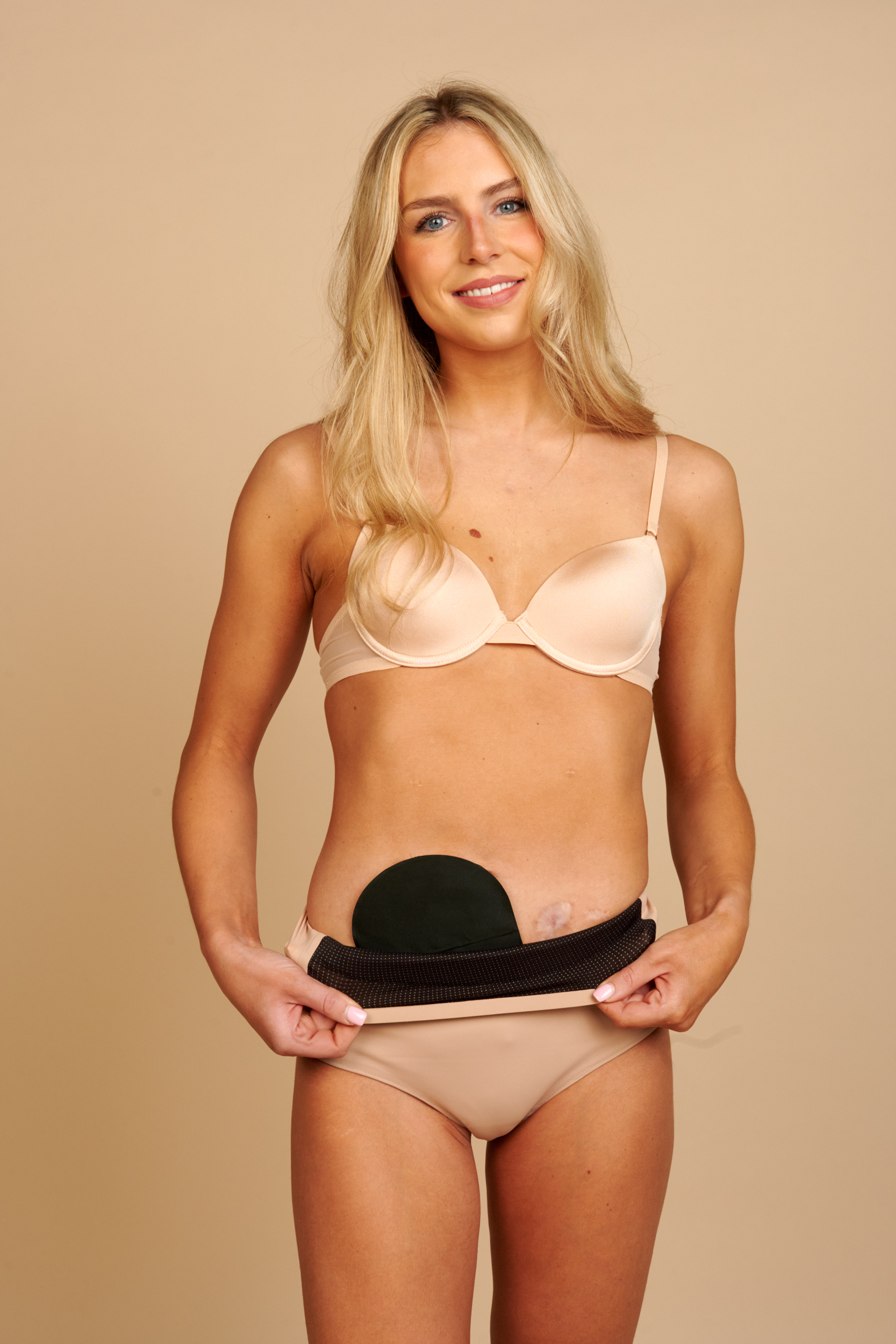
The skin around your stoma should look almost exactly like the skin anywhere else on your belly: same color, smooth, no soreness. The stoma itself is meant to be red or pink and a little moist — that's normal and healthy. It's the ring of skin around it, under and just outside the barrier, that you're keeping an eye on. When that skin turns red, weepy, raw, itchy, or sore, it's usually telling you something practical rather than something scary.
Here's the honest version: the number one cause of sore skin around a stoma is output touching it. Even a tiny leak under the wafer means stool or moisture is sitting against skin that isn't built to handle it. Second most common is a barrier that doesn't fit — a gap where the stoma meets the skin, or a wafer that's too big or too small. After that comes moisture trapped under the flange, adhesive sensitivity, and shaving irritation. Notice that none of those are things you did wrong on purpose. They're all fixable.
A free gift from one ostomate to another
The New Ostomy Patient Guide — everything the first weeks throw at you
Skin care, pouch changes, clothes, and the confidence stuff nobody warns you about — collected in one calm, practical guide you can read at your own pace.
The simple daily routine that keeps skin calm
Ostomates who never battle their skin almost all do the same boring, brilliant thing: they keep it simple. The routine that comes up again and again in support groups is basically "just water and dry it well." Here's the version worth copying:
- Clean with plain warm water and a soft cloth or gauze. That's genuinely enough. Water rinses away output and residue without leaving anything behind. Here is the full routine: how to clean a stoma, step by step.
- Skip soaps, body washes, lotions, and oily wipes. Anything moisturizing, perfumed, or oily leaves an invisible film — and your barrier can't grip a film. That's how a "clean" routine quietly causes leaks.
- Dry completely. Pat, don't rub. Give it a minute of air if you can. A damp surface is the single biggest reason a fresh wafer fails on day one.
- Only shave when you need to, in the direction the hair grows, and never dry-shave a raw patch.
- Change on a schedule, not an emergency. Peeling a wafer off before it starts to leak is far gentler on skin than ripping one off in a panic.
If you want to go deeper on the mechanics of changing, our guide on how often to change and empty your pouch pairs perfectly with this routine — the two habits protect your skin together. And if you suspect your current appliance is part of the problem, comparing your options in the best ostomy bags is time well spent.
Sore, red, raw or itchy: how to read what your skin is telling you
Not all skin trouble is the same, and the fix depends on the cause. Rather than treat every flare the same way, match what you're seeing to the likely culprit. Here's the at-a-glance version ostomates wish someone had handed them on day one.
| What you see | Most likely cause | First thing to try |
|---|---|---|
| Red, sore skin only where output has touched it | Leak or gap at the stoma edge | Re-check your fit; use barrier ring/paste to seal the gap |
| Raw, weepy skin right under the wafer | Moisture trapped or repeated leaks | Ostomy powder to absorb, then a fresh, well-sealed barrier |
| Redness matching the exact shape of the adhesive | Adhesive sensitivity | Try a different brand's barrier; some run gentler than others |
| Red rash with small dots/spots, itchy, spreading past the wafer | Fungal (yeast) irritation — often from moisture | Keep it dry; if it doesn't settle, it may need targeted treatment |
| Stinging line just outside the flange | Skin exposed / over-shaved / stripped | Trim your wafer to fit; ease up on shaving that spot |
Two of those deserve extra plain talk. Stool leaking around the stoma is the loudest alarm bell — it doesn't just irritate, it prevents anything from healing, because the skin never gets a break. If you keep leaking, don't just add more paste and hope; look at whether your stoma has changed shape, whether you've lost or gained weight, or whether the barrier size no longer matches. A leak that keeps coming back is a fit problem, not bad luck.
And the fungal (yeast) rash — the one people search "pictures of yeast infection around stoma" for — has a giveaway look: a red, itchy area, often with little satellite spots, that tends to show up where moisture lingers. It thrives on damp skin under the barrier, which is exactly why "dry it completely" earns its place at the top of the routine. Ostomy powder helps because it absorbs that moisture. If a rash spreads, keeps coming back, or won't calm down with dry, clean skin, that's the point to get eyes on it from your stoma nurse rather than layering on more products.
How to heal skin that's already raw — the ostomate method

When the skin is already sore or breaking down, the instinct is to slather something on it. Resist. The technique that actually works — and the one that gets shared most in ostomy groups — is the "crusting" approach with ostomy powder. The idea is to protect and dry the raw skin without creating a slick surface your barrier can't stick to.
- Clean and dry the raw area with plain water first.
- Dust a light layer of ostomy powder (like the stoma powder your supplier carries) over the raw, weepy spots — then brush off the excess so only a thin film stays.
- Optional: a quick dab of barrier film to "set" the powder, if you use one that's compatible with your appliance.
- Apply your barrier as usual. The powder absorbs moisture so the raw skin can dry out and heal, while your wafer still adheres.
What to avoid on raw skin: regular skin creams, lotions, and oils (they wreck adhesion), and topical steroid creams unless a professional has specifically told you to use one — they can thin skin and interfere with your seal. When ostomates ask "what cream is good for irritated skin around stoma," the honest answer is usually less than you think: powder to dry, a proper seal to protect, and time. Most sore or raw skin improves within a few pouch changes once output stops touching it. If it's not budging after that, or skin is genuinely breaking down, that's a conversation with your stoma nurse — not something to keep managing solo.
One quiet win worth naming: healing is faster when nothing is rubbing or pressing on the area. That's where your clothes stop being cosmetic and start being part of skin care.
Soft, high-rise ostomy underwear that sits smoothly over the barrier instead of digging in at the waistband makes a real difference while skin recovers — no seam sawing across the flange, no elastic pressing on a sore spot. Some people also reach for a stoma guard when a belt or seatbelt would otherwise press right on the stoma.
Give sore skin room to breathe — and still feel like yourself.
Our high-waisted ostomy underwear sits soft and smooth over your barrier, so nothing digs in while your skin settles. Comfort that looks good, not clinical.
Preventing flare-ups: fit, moisture, and clothes that cooperate
Once your skin is calm, the goal is keeping it that way — and prevention is mostly about three things.
- Fit first. Measure your stoma regularly, especially in the early months when it can change size. A wafer opening that matches your stoma leaves no gap for output to reach skin, and no exposed skin to get sore. This is the difference-maker.
- Manage moisture. Dry thoroughly before every change, and if you're prone to dampness in skin folds, ostomy powder is your friend. Heat and sweat are common triggers — worth knowing before summer.
- Let clothes work with you. Waistbands that dig in, stiff seams, and pressure over the barrier all irritate skin over time. Wide, soft support like an ostomy wrap holds things gently in place without a pressure point, and the right cut of pants for ostomy patients keeps the whole area comfortable all day.
And here's the empowering part people forget in the middle of a flare: peristomal skin trouble is one of the most solvable problems you'll face as an ostomate. It's not a life sentence and it's rarely serious — it's usually a fit tweak, a drier change, or a gentler product away from being sorted. You can absolutely swim, exercise, wear what you love, and get on with your life while your skin behaves. Explore ostomy swimwear and ostomy clothing when you're ready — comfort and skin care aren't opposites, they're the same goal.
Skin problems around a stoma: what they look like
Many people search for pictures of skin problems around a stoma, because putting a name to what you see is half the battle. These are the most common ones, described the way you'd notice them when you peel off your pouch.
| What you notice | What it usually is | What helps | Call your stoma nurse if |
|---|---|---|---|
| Red, moist, burning or raw skin exactly where output has touched | Irritation from output (moisture-related skin damage) | Find and fix the leak, re-measure, seal small gaps with a ring | It doesn't improve within a few changes |
| Red, itchy skin in the exact shape of the barrier, tape or a product | Allergy or sensitivity to a product | Stop the suspected product; try a different barrier | It blisters, spreads or keeps coming back |
| Patchy red, shiny or raw spots after taking the pouch off | Skin stripping from the adhesive | Adhesive remover every time; peel slowly, from top to bottom | The skin is broken or bleeding |
| An itchy red rash with small spots around the edges, often in warm weather | Fungal (yeast) infection | Keep the skin dry; it may need an antifungal treatment | It spreads or returns, so it can be treated properly |
| Small red bumps or pimples around hair follicles | Folliculitis, from shaving or hairs pulled by the adhesive | Trim instead of shaving; remove the barrier gently | Bumps become painful or fill with pus |
| Small, raised, red lumps right at the stoma edge that bleed easily | Granulomas | A well-fitted opening; your nurse can treat them simply | Always worth showing your nurse |
| Thick, wart-like, grayish or white skin around the stoma | Long-term moisture, most often with a urostomy | A snug fit that keeps urine or output off the skin | Always; it usually means the fit needs changing |
| Painful open sores with a purple or dark edge | Rare conditions such as pyoderma gangrenosum | Specialist treatment | Straight away |
Granulomas and raw skin can bleed, which is understandably alarming. Our guide to stoma bleeding explains when that's normal and when to call.
Ileostomy skin irritation: why it's harder on skin, and how to treat it
If you have an ileostomy, your skin has a tougher job. Ileostomy output is looser, arrives more often and still contains digestive enzymes, so even a small leak can make skin sore within hours. That's why ileostomy skin irritation needs a slightly different approach:
- Get the fit exactly right. Cut or choose an opening that sits right up to the stoma, with no skin showing. A barrier ring or seal fills small gaps and dips.
- Ask about convexity. If your stoma is flat or sits in a dip, a convex barrier presses gently around it so output flows into the bag instead of under it.
- Change before it leaks. Enzymes wear barriers down faster. A regular change schedule, often every 1 to 3 days, beats waiting for a leak.
- Treat raw skin the gentle way. Clean with water, dust on stoma powder, brush off the excess, seal with a barrier film if you use one, then apply the bag.
- Thicken your output a little. Foods like white rice, pasta, bananas and smooth peanut butter can make output less runny, which is kinder to skin. Our guide to living with an ileostomy covers food and fluids in detail.
When red or sore skin needs your stoma nurse
Most sore skin settles at home within a few changes. Call your stoma nurse if:
- the skin is broken, bleeding or weeping and isn't better after a week;
- you can't get the bag to stick, or you're changing it several times a day because of leaks;
- a rash keeps spreading or coming back;
- you notice bumps, sores or skin changes you can't explain;
- you have a fever, or the skin is hot, swollen and very painful.
Frequently asked questions
How long does it take sore skin around a stoma to heal?
Once output stops touching the skin and it can stay clean and dry, mild soreness often improves within a few pouch changes — sometimes just a couple of days. Deeper irritation or raw, broken skin can take longer. If it hasn't improved after a week of good, dry, well-sealed changes, that's the point to loop in your stoma nurse.
Can I use regular body lotion or barrier cream near my stoma?
Regular body lotions and oils are best kept away from the area right around your stoma, because they leave a film that stops your barrier from sticking — which leads to leaks and more soreness. If a professional has recommended a specific ostomy-compatible product, follow that. For everyday care, plain water and thorough drying do the job.
Is ostomy powder the same as regular powder or cornstarch?
No — reach for a purpose-made ostomy (stoma) powder rather than talc, baby powder, or cornstarch. Ostomy powder is designed to absorb moisture on raw skin while still letting your barrier adhere over it. Household powders can clump, block your seal, or feed a yeast rash. It's one of the few products genuinely worth keeping in your kit.
Why does my skin get sore even when I don't see any leaks?
Tiny leaks are often invisible — a little output creeps under the wafer edge without ever reaching the outside. Trapped moisture, sweat, or a barrier opening that's slightly too big can all irritate skin without an obvious leak. Check your fit and how dry the skin is before each change; that usually reveals the quiet culprit.
Does the type of ostomy change how I care for the skin?
The core routine — clean with water, dry well, seal properly — is the same across the board. The practical difference is that more liquid, frequent output (as with an ileostomy) tends to be harder on skin than firmer output, so a snug fit and dry surface matter even more. If you're weighing the differences, our ileostomy vs colostomy guide explains it in plain terms.
What does a rash around a stoma look like?
Most rashes around a stoma are red and itchy. An allergy usually matches the exact shape of the barrier or tape, while a fungal rash tends to be bright red with small spots around the edges and appears where skin stays damp. If a rash spreads or keeps coming back, ask your stoma nurse to take a look.
How do you treat skin breakdown around a stoma?
First stop the cause, which is usually a leak or a poor fit. Clean the area with warm water, dry it, dust on stoma powder and brush off the excess, then apply a well-fitted barrier. Most broken skin improves over a few changes; if it is not better within a week, see your stoma nurse.
Why is the skin around my ileostomy so sore?
Ileostomy output is liquid and contains digestive enzymes, so even small leaks irritate the skin quickly. A snug opening, a barrier ring, a convex barrier if your stoma is flat and changing the bag before leaks happen usually make a big difference.
Keep reading
More from the SIIL journal

Ostomy life & care library
Retracted Stoma: Why It Happens, How to Stop the Leaks and Live Comfortably
A retracted stoma explained: why it happens, how convex pouches, seals and belts help stop leaks, when to call your nurse and what…
12 min read

Ostomy life & care library
Colostomy Irrigation: How It Works, Who It Suits and the Freedom It Can Give
Colostomy irrigation explained: who it suits, the kit you need, how to irrigate step by step, how long it takes, what to wear betw…
12 min read

Ostomy life & care library
Loop Ileostomy and Loop Colostomy: What a Loop Stoma Is and How Life With One Works
Loop ileostomy and loop colostomy explained: what a loop stoma looks like, why it is often temporary, loop vs end stoma, pouching,…
14 min read

Welcome offer
Join the SIIL family.
Get 20% off your first order.
Stories, tips and exclusive drops — once a month, never spam. Your code lands in your inbox the moment you subscribe.
By subscribing you accept our privacy policy. Unsubscribe in one click, anytime.
Welcome — check your inbox for the code.
$72.99
$49.99
$44.99
$44.99
$39.99
$41.99
$52.99
$72.99
$102.99
$92.99
$72.99
$72.99