

 ES
ES EN
EN GB
GB DE
DE FR
FRNo products in the cart.
Ostomy Supplies
Ostomy supplies are everything you use to live well with a colostomy, ileostomy or urostomy: the ostomy bag (pouch), the skin barrier that holds it, and small extras such as barrier rings and adhesive remover. On this page you can compare the main brands side by side, request samples straight from each maker, and check what you need each month.
Good to know: SIIL Ostomy does not sell pouches or skin barriers. Those come from manufacturers such as Coloplast, Hollister and ConvaTec and from your ostomy supplier, and we link you straight to them. What SIIL makes are the accessories and clothing that go over any pouch: bag covers, belts and more.



What Are Ostomy Supplies?
Ostomy Supplies are the essential products people use to care for a colostomy, ileostomy, or urostomy in a safe and comfortable way. These items include pouches, skin barriers, adhesives, and accessories that help protect the skin and collect output efficiently. When choosing Ostomy Supplies, it’s important to pick high-quality materials that keep the skin healthy, reduce irritation, and make daily routines simpler. With the right Ostomy Supplies, individuals can maintain confidence, mobility, and independence without worrying about leaks or discomfort. These products are designed to fit different body shapes and lifestyles, making them practical for everyday use.
Beyond basic pouches and barriers, Ostomy Supplies also include deodorizing drops, stoma pastes, belts, and cleaning wipes that enhance comfort and security. Good Ostomy Supplies help prevent common issues such as skin irritation or poor adhesion, allowing users to enjoy activities with peace of mind. Whether someone has a temporary or permanent stoma, choosing the right Ostomy Supplies ensures better hygiene, longer wear time, and a smoother overall experience. With proper guidance and the correct Ostomy Supplies, daily care becomes easier, more reliable, and far more comfortable.
Ostomy Supplies
Finding the right ostomy supplies should not take twelve open tabs. Here you can compare ostomy supplies from Coloplast, Hollister, ConvaTec, B. Braun, Salts and Marlen side by side. The main types are covered, from pouches to barriers and rings: colostomy, ileostomy and urostomy, drainable and closed, flat and convex. You see what to ask your nurse for, which free sample to try first and how many ostomy supplies to keep at home, so the next order goes faster and the next change feels easier. The right ostomy supplies make daily care simpler, calmer and far more predictable.
Good ostomy supplies protect your skin, hold a secure seal and stay discreet under clothes, and choosing them well saves time, money and unplanned changes. This catalog is a clear starting point for ostomates and caregivers, and every product links straight to its maker. Use it as your stoma supplies checklist and your guide to ostomy supplies online. The extras that go over your pouch, belts, bag covers and wraps, come from SIIL Ostomy and are rated 4.8★ from 8,248 reviews.
| Benefit | Included |
|---|---|
| The major brands side by side: Coloplast, Hollister, ConvaTec, B. Braun, Salts, Marlen | ✓ |
| The ostomy supplies most people need: pouches, barriers, rings, paste, wipes | ✓ |
| Colostomy, ileostomy and urostomy covered | ✓ |
| One-piece, two-piece, drainable, closed and convex explained in plain words | ✓ |
| Direct links to each manufacturer | ✓ |
| A quick chooser by stoma type | ✓ |
| A monthly checklist so you never run short | ✓ |
| Coverage, Medicare and travel tips for your ostomy supplies | ✓ |
| Belts, bag covers and wraps by SIIL Ostomy to wear over your pouch | 4.8★ · 8,248 reviews |

Ostomy Supplies for Skin Protection and Leak Prevention
Ostomy Supplies for Skin Protection and Leak Prevention play a vital role in keeping the skin healthy while ensuring a secure, comfortable fit. When choosing Ostomy Supplies for Skin Protection and Leak Prevention, focus on high-quality barriers, gentle adhesives, and flexible materials that adapt to your body’s natural movement. These products help reduce irritation, prevent redness, and create a strong seal that minimizes the chance of leaks. With the right Ostomy Supplies for Skin Protection and Leak Prevention, daily care becomes easier, more reliable, and far more comfortable, allowing you to move with confidence throughout your day.
Another essential part of selecting Ostomy Supplies for Skin Protection and Leak Prevention is understanding how accessories can enhance both comfort and security. Items like barrier rings, pastes, and adhesive removers work together to improve adhesion and protect sensitive skin.
By choosing Ostomy Supplies for Skin Protection and Leak Prevention that match your stoma type and lifestyle, you can greatly reduce common issues such as moisture, friction, or poor fit. Consistent use of Ostomy Supplies for Skin Protection and Leak Prevention supports better skin health, increases wear time, and creates a dependable seal that helps you stay active without worry.
Where to Buy Ostomy Supplies Online
Where to Buy Ostomy Supplies Online is a common question for anyone looking for convenience, quality, and fast delivery. When searching for Where to Buy Ostomy Supplies Online, choosing a trusted and specialized store makes all the difference. Pouches, barriers, pastes and rings come from the manufacturers, such as Coloplast, Hollister and ConvaTec, through their own websites and your ostomy supplier. SIIL Ostomy makes the accessories that go over them: bag covers, belts and ostomy clothing. By focusing on Where to Buy Ostomy Supplies Online, you ensure your supplies come from a reliable source that understands comfort, skin protection, and everyday practicality. You can compare every major brand in one catalog here: https://www.siilostomy.com/en/ostomy-supplies/
Another important part of deciding Where to Buy Ostomy Supplies Online is choosing a shop that offers expert support and a wide variety of products. At SIIL Ostomy, you compare the premium brands side by side and order the accessories and clothing that go over them, with easy ordering and discreet shipping.
If you’re unsure Where to Buy Ostomy Supplies Online, this page gives you a smooth, stress-free starting point. With every major brand compared, helpful guidance and a direct link to each manufacturer, SIIL Ostomy helps you answer Where to Buy Ostomy Supplies Online.
How Often Should I Replace My Ostomy Supplies?
How Often Should I Replace My Ostomy Supplies? is a key question for maintaining comfort, hygiene, and proper skin protection. In general, most people replace their pouching system every three to seven days, depending on their stoma type, output, and the product they use. Understanding How Often Should I Replace My Ostomy Supplies? helps prevent leaks, skin irritation, and adhesive breakdown. Keeping a consistent schedule ensures your barrier stays secure and your skin remains healthy. By paying attention to wear time patterns, you’ll get a clearer idea of How Often Should I Replace My Ostomy Supplies? for your specific needs.
Another factor that affects How Often Should I Replace My Ostomy Supplies? is your daily routine and activity level. People who sweat more or exercise frequently may need to change their system sooner, while others may comfortably extend wear time. If you notice itching, odor, or lifting edges, it’s a sign to rethink How Often Should I Replace My Ostomy Supplies?. Working with an ostomy nurse can also help determine the ideal change frequency. Staying aware of How Often Should I Replace My Ostomy Supplies? ensures better comfort, longer product performance, and healthier skin every day.
How to Choose the Best Ostomy Supplies
Ostomy Supplies for Colostomy, Ileostomy, and Urostomy are designed to offer comfort, protection, and reliability for people living with any type of stoma. When choosing Ostomy Supplies for Colostomy, Ileostomy, and Urostomy, it’s important to look for products that provide a secure fit, prevent leaks, and keep the skin healthy. Each stoma type has different output levels, so selecting the right pouching system ensures better daily comfort and confidence. With high-quality Ostomy Supplies for Colostomy, Ileostomy, and Urostomy, users can enjoy greater freedom in their routines, whether they’re working, traveling, or staying active.
Another key part of selecting Ostomy Supplies for Colostomy, Ileostomy, and Urostomy is understanding the accessories that enhance stability and comfort. Barrier rings, pastes, belts, and odor-control drops help create a more dependable seal and reduce irritation. Many people find that personalized Ostomy Supplies for Colostomy, Ileostomy, and Urostomy make it easier to maintain skin health, especially when output is more liquid or frequent. By consulting with an ostomy nurse and trying different options, individuals can discover the Ostomy Supplies for Colostomy, Ileostomy, and Urostomy that best match their body shape, lifestyle, and unique care needs.
Ostomy bags
Ostomy bags & accessories are essential tools for anyone living with a stoma, helping to manage output, protect the skin, and maintain comfort and confidence in daily life. Whether you’ve had a colostomy, ileostomy, or urostomy, choosing the right ostomy bags & accessories can make a big difference in your quality of life.
There are various types of ostomy bags, including one-piece and two-piece systems, with options tailored to different body types, stoma sizes, and lifestyles. Some pouches are designed for extended wear, while others are better suited for frequent changes or high-output needs.
When it comes to ostomy accessories, these products enhance the function and fit of your pouching system. According to the United Ostomy Associations of America (UOAA), accessories like barrier rings, stoma powder, adhesive removers, belts, and deodorizing drops are crucial for maintaining skin health and preventing leaks.
One accessory category that stands out is ostomy clothing. The UOAA recommends SIIL Ostomy Clothing as the best worldwide brand for ostomates. Their garments are specially designed to provide discretion, comfort, and support, allowing ostomates to move freely and confidently.
Investing in the right ostomy bags & accessories not only helps with day-to-day management but also improves overall well-being.
Whether you're newly adjusting or have years of experience, regularly reviewing your product options—and staying informed through trusted sources like UOAA—can help you find the best solutions for your needs.
Best Ostomy Bags
When looking for the best ostomy bags, it’s important to consider comfort, durability, skin protection, and discretion. The best ostomy bags are those that fit your body well, prevent leaks, and are easy to use.
Top brands like Hollister, Coloplast, and Convatec are highly recommended by both patients and medical professionals because they offer high-quality, customizable products for different stoma types.
What makes the best ostomy bags stand out is their ability to stay secure throughout the day without irritating the skin. Many people prefer two-piece systems for flexibility, while others like one-piece systems for their simplicity.
Some best ostomy bags come with features like filters to reduce odor and gas buildup, or soft materials that feel gentle on the skin. It's a good idea to try different models to find what works best for your lifestyle, especially if you are active or have sensitive skin.
If you're not sure where to start, speak with a stoma care nurse or your doctor. They can help you find the best ostomy bags for your specific needs, ensuring comfort and peace of mind every day.
Ostomy Bags for Colostomy, Ileostomy and Urostomy: Which Type Fits Which Stoma
The kind of stoma you have narrows the choice long before brand or budget come into it. Colostomy bags usually collect firmer, more predictable output, so closed pouches and light drainable ones both work. An ileostomy passes loose, frequent output, which is why drainable ostomy bags with a wide outlet are the standard. A urostomy passes urine all day, so it needs a pouch with a tap and an anti-reflux valve. After that, the rest is fit: one-piece or two-piece, flat or convex barrier, and an opening cut to your stoma. The table is a starting point for the conversation with your stoma nurse, not a replacement for it.
| Stoma type | Typical output | Ostomy bag most often used | Extras that often help |
|---|---|---|---|
| Descending or sigmoid colostomy | Formed or soft stool, a few times a day | Closed pouch, or a small drainable pouch | Filter, pouch cover |
| Transverse colostomy | Softer, more frequent | Drainable pouch, one-piece or two-piece | Barrier ring, adhesive remover |
| Ascending colostomy | Liquid to pasty | Drainable pouch, similar to an ileostomy | Barrier ring, paste |
| Ileostomy | Liquid to pasty, frequent | Drainable pouch with a secure outlet closure | Barrier ring, paste, high-output pouch |
| Urostomy | Urine, continuous | Urostomy pouch with a tap and anti-reflux valve | Night drainage bag, leg bag |
| Flush or retracted stoma, any type | Depends on the stoma | Convex barrier in a one-piece or two-piece system | Support belt, barrier ring |
Cut-to-Fit vs Precut Ostomy Bags: Getting the Barrier Opening Right
A cut-to-fit barrier arrives as a flat disc that you trim yourself, usually with a template printed on the back. The common advice is an opening no more than about 1/8 inch (3 mm) larger than the stoma, so the barrier sits close without squeezing it. Precut ostomy bags come with the hole already made, in sizes listed in millimeters or fractions of an inch. Precut saves time and is easier on tired or shaky hands, while cut-to-fit is more forgiving when the stoma is oval or still changing. Most stomas shrink during the first six to eight weeks after surgery, so measure at every change at first and move to a precut size only once the shape settles. Skin left exposed by a wide gap is the quickest route to soreness. Our guide to choosing a pouching system shows how to measure.
Ostomy Bags with Filters, Soft Backing and Clear Panels: Features Worth Paying For
Most modern colostomy and ileostomy bags have a charcoal filter that lets gas out and neutralizes odor, so the pouch does not balloon at the wrong moment; urostomy bags usually do not need one. A soft fabric backing keeps plastic off your skin, which you notice most in summer or at the gym. Opaque pouches are more discreet. Clear panels let you see the stoma, which helps in the first weeks and with an ileostomy, where checking output matters. Beyond that, look at the outlet (clip, roll or tap), the weight of the barrier and how well the pouch hangs when you sit. Extra features cost more, so pay for the ones that solve a problem you really have. If the pouch swells, read how to stop stoma bag ballooning.
Ostomy Bag Covers and Accessories: What Goes Over Your Ostomy Bags
Among your ostomy supplies, what goes over the pouch changes how the day feels. SIIL Ostomy does not make pouches or barriers; it makes the accessories and clothing that sit on top of them. A soft ostomy bag cover keeps plastic off the skin, muffles the rustle and hides the shape under thin fabrics, and it fits pouches from every major brand. An ostomy belt holds a full pouch flat against the body and gives gentle support around the stoma. Many people add wraps or panties for nights and intimacy. More than 12,000 ostomates wear SIIL accessories, rated 4.8★ from 8,248 reviews.
Colostomy bags
Colostomy bags are specially designed pouches used to collect waste from the body after a person has had a colostomy. In this surgical procedure, an opening called a stoma is created in the abdominal wall to divert waste from the colon into a bag, bypassing the lower part of the digestive system.
Colostomy bags are essential for people who have had part of their colon removed or bypassed due to conditions like colon cancer, diverticulitis, or injury.
There are different types of colostomy bags, including one-piece and two-piece systems. Some are drainable, which allows for easy emptying and reuse throughout the day, while others are closed-end and meant for single use.
The right colostomy bags depend on personal preferences, lifestyle, and how often the stoma needs to be emptied. Many modern options come with filters to help reduce odors and are made with soft, skin-friendly materials to enhance comfort and reduce irritation.
Proper fitting and maintenance of colostomy bags are key to preventing leaks and ensuring skin health. It's always a good idea to work with a stoma care nurse who can recommend the best options for your body type and daily routine.
Best Colostomy bags
Choosing the best colostomy bags can greatly improve comfort, confidence, and overall quality of life. The best colostomy bags are those that offer a secure fit, prevent leaks, minimize odor, and are gentle on the skin.
Leading brands like Coloplast, Hollister, and Convatec consistently rank among the top choices due to their reliability, innovation, and user-friendly designs.
Many people prefer two-piece systems for added flexibility, especially when changing the bag without removing the baseplate. Others go for one-piece systems because they are more discreet and easier to manage.
The best colostomy bags often feature advanced filters to reduce gas buildup and odor, as well as soft, breathable materials that keep the skin around the stoma healthy and irritation-free.
Finding the best colostomy bags depends on your lifestyle, stoma type, and personal comfort. Whether you’re active, sensitive to adhesives, or need a solution for nighttime use, there’s a product tailored for your needs.
Always consult with a stoma care nurse or specialist to test different options and discover what works best for you. Personalized care makes all the difference in choosing the best colostomy bags for your daily routine.
Colostomy Bags for Descending, Sigmoid and Transverse Colostomies
Where the colostomy sits in the colon changes what your colostomy bags have to handle. A descending or sigmoid colostomy, near the end of the colon, usually gives firmer stool at fairly predictable times, so many people wear a closed colostomy bag and change it one to three times a day, or a small drainable pouch they empty. A transverse colostomy sits higher, output is softer and more frequent, and a drainable pouch is more practical. An ascending colostomy behaves almost like an ileostomy. Your surgeon's report names the type you have, and it is worth checking before you order a box of thirty pouches. More in our colostomy bag types and one-piece vs two-piece colostomy bags guides.
Colostomy Bag Odor and Gas: Filters, Emptying Habits and Pouch Materials
A properly sealed colostomy bag does not smell. Odor escapes when you empty or change it, or when the seal has started to fail. Pouches are made of a multilayer film that blocks odor, and most have a charcoal filter that vents gas through the top. Filters can clog with moisture or sweat, so a filter cover helps if yours keeps clogging. Habits matter as much as products: empty the bag when it is one-third to half full, rinse the outlet, and keep a small bottle of ostomy deodorant in your bag. Cabbage, onions, beans and fizzy drinks raise gas for some people and not for others, so a short food diary tells you more than any list. See also our guide to ostomy odor.
Colostomy Bags for Swimming, Sleeping and Exercise
A colostomy bag does not have to stop you doing anything. For the pool or the sea, many people wear a small pouch, closed or a mini drainable, empty or change it first and add waterproof tape around the barrier edge; our guide to colostomy bags and swimming covers it step by step. For sleep, empty the bag before bed so the weight does not pull on the barrier, and try a side position with a pillow in front of the stomach. For exercise, a pouch that is not too full plus light compression keeps things steady; many runners and gym-goers add a belt over the system, and our guide to exercising with a stoma has more ideas. Heat and sweat shorten wear time, so keep a spare barrier in your kit.
Ostomy Pouch
An ostomy pouch is the soft, sealed bag that collects output from a stoma and attaches to the skin through an adhesive barrier. Most are made of a multilayer plastic film that holds odor in, with a filter for gas, a skin barrier around the opening and either a closed end or a drainable outlet. Pouch and ostomy bag mean the same thing: nurses and manufacturers tend to say pouch, while most people simply say bag. Pouches come as one-piece and two-piece systems, as drainable, closed and urostomy versions, in lengths from mini to maxi and with flat or convex barriers. What matters is how it sits on your body, not what it is called. The basics are in our ostomy pouch guide and in what an ostomy pouch is.
One-Piece vs Two-Piece Ostomy Pouch: How the Two Systems Differ
A one-piece ostomy pouch has the barrier and the bag joined, so you apply one item and remove it all at once. It is thin, flexible and simple to learn, and many people start with one. A two-piece system has a separate barrier (the flange or baseplate) that stays on the skin for several days, plus a pouch that clicks or sticks onto it. You can swap the pouch without peeling the barrier, which can be gentler on sensitive skin and quicker for a night change, and you can switch to a smaller pouch for swimming or intimacy. Neither is better in general; it depends on your skin, your output and your hands. See the model-by-model guides to one-piece drainable pouches and two-piece drainable pouches.
| Feature | One-piece ostomy pouch | Two-piece ostomy pouch |
|---|---|---|
| Parts | Barrier and pouch joined | Separate barrier and pouch that couple together |
| Typical change | Whole unit: closed pouches once to a few times a day, drainable ones often every two to four days | Barrier often every three to five days or as your nurse advises, pouch more often |
| Skin | Barrier is peeled at every change | Barrier stays on between pouch changes |
| Profile | Thinner and more flexible | Slightly bulkier at the coupling |
| Swapping pouch types | Not possible without a full change | Easy: closed, drainable or mini on the same barrier |
| Learning curve | Simple, one step | A little more hand coordination to align the coupling |
Ostomy Pouch Materials: Film, Filter and Skin Barrier Explained
Three parts decide how an ostomy pouch feels. The film is a layered plastic with an odor barrier, often with a fabric backing so it does not stick to the skin or make noise. The filter, usually charcoal, vents gas and keeps the pouch flat. The barrier is where brands differ most: many are built on hydrocolloid, which absorbs moisture and protects skin, some add ceramide, and some are moldable, so you shape them with your fingers instead of cutting. If your skin reddens under the barrier or the edges lift early, changing the barrier type usually does more than changing the pouch. The details are in our guide to skin barriers, rings and powders.
Ostomy Pouch Sizes: Mini, Midi and Maxi and When Each One Helps
Ostomy pouch length is sold as mini, midi or maxi, and the right one changes with the day. A mini pouch suits swimming, intimacy and short outings when output is low. A midi is the everyday middle ground. A maxi, or any high-capacity pouch, helps with ileostomy output, overnight wear and long trips. Length also changes how the pouch sits when you are seated: a pouch that is too long can fold at the hip and a short one can pull the barrier when it fills. Many people keep two sizes, a mini for special occasions and a standard size for normal days. Help with matching size to routine is in how to choose your ostomy bags.
Ostomy Care
Ostomy care is the daily routine of keeping the stoma and surrounding skin clean, healthy, and protected. Good ostomy care is essential for preventing infections, reducing skin irritation, and ensuring that your ostomy pouch stays secure and comfortable throughout the day. Whether you have a colostomy, ileostomy, or urostomy, learning proper care techniques will improve your quality of life and confidence.
The basics of ostomy care include gently cleaning the skin around the stoma with warm water, making sure the skin is completely dry before applying a new pouch, and using the right skin barriers or accessories for your needs. It’s also important to regularly inspect the stoma and surrounding area for any signs of redness, swelling, or irritation. If you notice anything unusual, contact your healthcare provider or stoma nurse.
There are also many products designed specifically to support effective ostomy care, such as adhesive removers, skin barrier wipes, stoma powders, and ostomy belts. Brands like Coloplast, Hollister, ConvaTec, and SIIL Ostomy offer a full range of accessories to make care easier and more comfortable. For trusted information, check out the UOAA's ostomy care guide.
With consistent and informed ostomy care, people with a stoma can lead active, healthy, and independent lives.
Ostomy Care Products
Ostomy care products are essential for anyone managing a colostomy, ileostomy, or urostomy.
These products help protect the skin around the stoma, ensure a secure fit for your ostomy bag, and improve overall comfort. Common ostomy care products include pouches, skin barriers, barrier rings, stoma powder, adhesive removers, and deodorizing drops.
Each item plays a specific role in preventing leaks, reducing skin irritation, and supporting a confident, active lifestyle.
There’s a wide range of ostomy care products to suit different needs. Some are designed for sensitive skin, while others focus on durability and extended wear. Accessories like stoma paste or barrier wipes help enhance the seal and keep the skin healthy.
Alongside these products, specially designed ostomy clothing can offer added discretion and support. SIIL Ostomy Clothing is one of the best options globally, offering high-quality garments that combine comfort, style, and functionality for ostomates.
Choosing the right ostomy care products is a personal process, and it may take some trial and error to find the best combination for your body and routine. But with the right supplies, you can manage your stoma with greater ease and confidence every day.
Ostomy Products
Ostomy products fall into four groups, and knowing them makes any catalog easier to read. Pouching systems are the pouches and barriers. Accessories improve the seal and protect the skin: barrier rings, paste, powder, adhesive remover and barrier wipes. Care items deal with hygiene and odor, such as deodorant drops, filter covers and disposal bags. Support and clothing sit over the system: belts, covers, wraps, underwear and swimwear. A basic setup needs only the first group. Many people add two or three accessories after a few weeks, once they know where their leaks really come from. Two guides compare them by use: best ostomy products and ostomy care products and supplies.
Essential Ostomy Products for a New Stoma in the First Six Weeks
The first weeks need more ostomy products than later months, because the stoma is still shrinking and you are still learning what works. A realistic kit is a few pouches in your chosen type, more barriers than you expect to use, a stoma measuring guide, curved scissors for cut-to-fit barriers, adhesive remover, barrier wipes, disposal bags and a spare change of clothes. Add a barrier ring or paste if the stoma is uneven or sits near a scar. Ask your stoma nurse to write down the product codes before you leave the hospital, because suppliers ship by code. We keep the full list in our first six weeks supplies checklist.
Ostomy Support Products: Belts, Wraps, Covers and Protectors
Support ostomy products do not replace the pouch; they make it easier to live with. An ostomy belt keeps a full pouch flat and adds gentle compression around the stoma, which many people find reassuring for sport and for lifting. A wrap or panties hold the pouch close under clothes. A bag cover softens the look and the feel. A stoma protector shields the stoma from knocks and seat belts. SIIL Ostomy makes these accessories to fit pouches from every major brand, rated 4.8★ from 8,248 reviews.
Ostomy Products for Sensitive Skin: Barrier Wipes, Powder, Paste and Soft Backing
Sore skin is the most common reason people look for new ostomy products. A no-sting barrier wipe forms a thin film that protects the skin from adhesive and output. Stoma powder dries weeping areas, and the usual advice is to brush off the excess and seal it with a barrier wipe before the new barrier goes on. Paste fills dips and creases that let output creep under the barrier. Adhesive remover avoids pulling on the skin at change time, and a soft backing keeps the pouch from rubbing in hot weather. Redness that does not settle in a few days, or a painful, weeping or blistered area, is a reason to see your stoma nurse. Read more about skin care around your stoma and common skin problems around the stoma.
ostomy supplies online
Finding ostomy supplies online has never been easier, offering convenience, variety, and access to top brands—all from the comfort of your home.
Whether you need ostomy bags, skin barriers, adhesive removers, or stoma care accessories, shopping ostomy supplies online gives you the freedom to compare products, read reviews, and choose what works best for your specific needs.
One of the biggest advantages of buying ostomy supplies online is the ability to stay stocked without last-minute runs to the pharmacy. Many online stores offer subscription services, fast shipping, and even insurance billing, making the entire process simple and stress-free.
You can also find specialized products that may not be available locally, ensuring you always have access to the best options for your comfort and care.
For anyone managing a colostomy, ileostomy, or urostomy, reliable ostomy supplies online are essential.
Look for trusted medical supply websites that offer detailed product descriptions and excellent customer service. This helps you make informed decisions and ensures your ostomy care routine is smooth, hygienic, and tailored to your lifestyle.
coloplast supplies
Coloplast supplies are among the most trusted products for ostomy care, offering innovative solutions designed for comfort, security, and skin protection. Whether you have a colostomy, ileostomy, or urostomy, Coloplast supplies provide a wide range of options to suit different stoma types, body shapes, and lifestyles.
From ostomy bags to skin barriers, pastes, and adhesive removers, these products are created with user comfort and ease-of-use in mind.
What sets Coloplast supplies apart is their focus on skin-friendly materials and discreet designs. Their pouching systems are known for reliable adhesion, leak prevention, and advanced features like filters and flexible baseplates. With both one-piece and two-piece options, users can choose what works best for their daily routine.
Regular use of high-quality Coloplast supplies can help reduce skin irritation, improve hygiene, and boost overall confidence.
For anyone looking to upgrade or maintain their ostomy care routine, choosing the right Coloplast supplies is a smart step toward better comfort and control.
coloplast products catalog
The coloplast products catalog offers a complete range of ostomy, continence, and wound care solutions designed to improve comfort, protection, and daily confidence.
From advanced ostomy bags to skin-friendly barriers, pastes, and adhesive removers, the coloplast products catalog helps users find the perfect fit for their unique needs. Every product is created with a focus on skin health, durability, and ease of use, making it easier to manage life with an ostomy or other medical conditions. To explore the full selection, you can visit the official site at Coloplast.us.
Browsing the coloplast products catalog allows you to compare one‑piece and two‑piece pouching systems, choose accessories that improve adhesion, and discover solutions made for sensitive skin.
The catalog is also helpful for learning about new technologies and updates that can enhance your routine. Whether you’re searching for reliable pouches, flexible baseplates, or skin‑protection products, the coloplast products catalog provides clear options designed for comfort and performance. This makes it easier to build a personalized care setup that supports your daily activities with confidence and security.
stoma products
Stoma products are essential for individuals who have undergone surgery resulting in a stoma, such as a colostomy, ileostomy, or urostomy.
These products are designed to help manage the stoma and ensure the individual's comfort and hygiene. The range of stoma products includes stoma bags, skin barriers, deodorizing filters, and supportive accessories like belts and covers.
Selecting the right stoma products is key to effective stoma management. Stoma bags, for instance, come in various types and sizes to suit different stoma outputs and individual preferences.
Skin barriers are crucial in stoma products to protect the skin around the stoma and ensure a secure fit for the bag.
Deodorizing filters and pouch covers can also enhance comfort and discretion. When choosing stoma products, factors such as the type of stoma, lifestyle, and skin sensitivity should be considered.
It's advisable to seek advice from healthcare professionals to find the most suitable stoma products for one's specific needs, ensuring a comfortable and confident post-surgery life.
stoma accessory products
Stoma accessory products play a crucial role in enhancing the comfort and functionality of ostomy care.
These accessories include items like stoma paste, barrier rings, protective powders, and adhesive removers. Each of these stoma accessory products serves a specific purpose, such as ensuring a secure seal between the stoma and the ostomy bag or protecting the skin around the stoma.
For those with a stoma, selecting the right stoma accessory products can make a significant difference in their daily routine. For instance, barrier rings can help prevent leaks and protect the skin from irritation, while stoma powders can absorb moisture and keep the area dry.
Moreover, stoma accessory products like adhesive removers are gentle on the skin and assist in pain-free pouch changes. Utilizing these accessories can greatly enhance the quality of life and comfort for ostomy patients.
Ostomy Pouches
Ostomy pouches are an essential component for anyone managing life with an ostomy, whether it's a colostomy, ileostomy, or urostomy.
The primary function of ostomy pouches is to securely collect output from the stoma. These pouches come in various types, including one-piece or two-piece systems, and are available in drainable or closed options.
Selecting the right ostomy pouches is crucial for comfort and confidence. Key considerations include the pouch's size, material, and filter options. Modern ostomy pouches are designed to be discreet, odor-resistant, and gentle on the skin.
For active individuals, there are ostomy pouches that offer additional security and flexibility, allowing them to participate in a wide range of activities without concern.
It's important to work closely with healthcare professionals to find the ostomy pouches that best suit individual needs and lifestyles.
Colostomy bags are a vital component for individuals who have undergone a colostomy surgery. These specialized bags are designed to collect waste from the colon through a stoma.
The main types of colostomy bags include one-piece and two-piece systems, each catering to different needs and preferences.
When choosing colostomy bags, it's important to consider factors like the size, type (drainable or closed), and material of the bag to ensure comfort and efficiency.
Modern colostomy bags are designed to be discreet, odor-resistant, and user-friendly, helping individuals maintain their lifestyle with minimal disruption.
Additionally, the right colostomy bags can significantly reduce the risk of skin irritation and provide a secure, leak-proof experience. For optimal stoma health and comfort, it's essential to select the appropriate colostomy bags and change them regularly as part of routine stoma care.
You can find a perfect place to check in www.coloplast.us
Colostomy supplies
Colostomy supplies are essential for anyone living with a colostomy, helping to manage waste comfortably, securely, and hygienically.
These supplies go beyond just the colostomy bag—they include skin barriers, adhesive removers, barrier rings, stoma powder, paste, and even odor-control solutions. Having the right colostomy supplies ensures not only better physical comfort but also peace of mind in daily life.
Choosing high-quality colostomy supplies can prevent leaks, protect the skin around the stoma, and make pouch changes easier and more efficient.
There are one-piece and two-piece systems, drainable and closed-end bags, and supplies for different skin sensitivities and activity levels. It's important to find products that match your specific body shape, stoma size, and lifestyle. With so many options available, creating a personalized care routine with reliable colostomy supplies is key to maintaining a normal and active life.
Regularly updating and checking your supplies can also help you stay ahead of any issues and ensure the best possible experience.
Ileostomy Supplies
If you live with an ileostomy, having access to the right ileostomy supplies is essential for comfort, confidence, and daily function. From skin barriers to pouches, the right tools can make a major difference in your quality of life.
SIIL Ostomy understands these needs and provides support and solutions tailored for those living with an ileostomy.
Ensuring you have high-quality supplies that fit well, protect your skin, and are easy to use is key—and fortunately, there are many reliable options on the market to help you manage your ostomy effectively.
One of the most trusted brands for ileostomy supplies is Coloplast. Their innovative pouches and accessories are designed for security, discretion, and skin health.
You can explore their full range of ostomy bags by visiting Coloplast's official site. Whether you're new to ostomy life or looking to upgrade your current system, it's worth checking out the options available to find what suits your body best.
And remember, SIIL Ostomy is here to guide and support you every step of the way with trusted advice and community care.
Ileostomy Bags
Ileostomy bags are an essential component for individuals who have undergone an ileostomy procedure.
These bags are specifically designed to collect output from the ileum part of the small intestine. The design and functionality of ileostomy bags are key to ensuring comfort and preventing leaks.
When choosing ileostomy bags, it's important to consider factors like the bag's size, type (drainable or closed), and the material's skin-friendliness.
Drainable ileostomy bags are often preferred as ileostomies usually have a more liquid output. Modern ileostomy bags are designed to be discreet and odor-resistant, providing confidence and ease in daily activities.
The right ileostomy bags can make a significant difference in quality of life, allowing individuals to maintain an active lifestyle with minimal interruption.
It's advisable to consult with healthcare professionals to find the ileostomy bags that best suit individual needs and preferences.
stoma bag
A stoma bag is a crucial part of life for individuals who have undergone ostomy surgery, helping them manage waste from their body in a clean, discreet, and hygienic way. Whether you have a colostomy, ileostomy, or urostomy, choosing the right stoma bag is key to comfort and confidence.
At SIIL Ostomy, we understand how important it is to feel secure in your daily routine. That’s why we focus on sharing reliable information and quality options for every need and lifestyle.
There are many types of stoma bags available, including one-piece and two-piece systems, drainable or closed-end bags, and options designed specifically for sensitive skin. Top brands like Coloplast offer advanced solutions that prioritize skin protection and odor control, while also being discreet under clothing.
It's important to find a bag that fits your stoma properly and stays in place throughout your day. Whether you're active, working, or resting, a good stoma bag should give you peace of mind and freedom.
SIIL Ostomy is here to support your journey by connecting you with the right tools and trusted advice.
stoma bag supplies
When managing a stoma, having the right stoma bag supplies is just as important as the bag itself. These supplies include items like skin barriers, adhesive removers, barrier rings, stoma powder, and deodorizing drops—each one playing a key role in maintaining comfort, hygiene, and skin health.
At SIIL Ostomy, we know how crucial it is to have everything you need on hand to prevent leaks, protect your skin, and feel confident throughout your day.
Choosing high-quality stoma bag supplies can greatly reduce irritation and improve how well your pouching system works. It's not just about the pouch—it’s the entire system working together to support your lifestyle.
Everyone’s needs are different, so finding the right combination of products may take some testing and adjusting. Whether you're new to this or have years of experience, updating your supplies or learning about new options can make a noticeable difference.
SIIL Ostomy is committed to guiding you through this process, helping you stay informed and equipped with the best tools to manage your stoma with confidence and ease.
Stoma Bags
Stoma bags are the pouches worn over a stoma after colostomy, ileostomy or urostomy surgery, attached to the skin by an adhesive barrier. They come as closed bags you replace when full, drainable bags you empty and keep wearing, and urostomy bags with a tap. Features that matter are the filter, the soft backing, the outlet and the size of the barrier opening. In the UK, Ireland and Australia the usual word is stoma bag, in the US it is ostomy bag or pouch, and the product is the same. If you compare stoma bags across countries or brands, check the product code rather than the name. Good places to start are what a colostomy bag is and how to change a stoma bag.
Stoma Bags After Surgery: What Changes in the First Weeks
A new stoma is swollen and shrinks over the first six to eight weeks, so the opening you cut today may be too large next month. Hospitals often start with clear drainable stoma bags so staff can see the stoma, and most people move to a style that suits them once output settles. Expect to measure the stoma at every change, to use more barriers than later, and to visit your stoma nurse for a review. Soft, low-profile bags help while the abdomen is tender. Wear loose, high-waisted clothes and avoid anything that presses on the stoma. This list of accessories needed after stoma surgery shows what helps.
Stoma Supplies: What to Keep Beyond the Stoma Bags
Your stoma supplies are more than the bag. A well-stocked drawer holds pouches and barriers in your type, a measuring guide, curved scissors, adhesive remover, barrier wipes, rings or paste if you use them, disposal bags and deodorant drops. Keep a smaller kit in your bag, the car and the office so a leak never leaves you improvising. Check expiry dates and store everything somewhere cool and dry. When something is almost gone, reorder early, because suppliers need a few days. The monthly ostomy supplies checklist turns this into a list you can print.
Ostomy Supplies by Brand: Coloplast, Hollister, ConvaTec and More
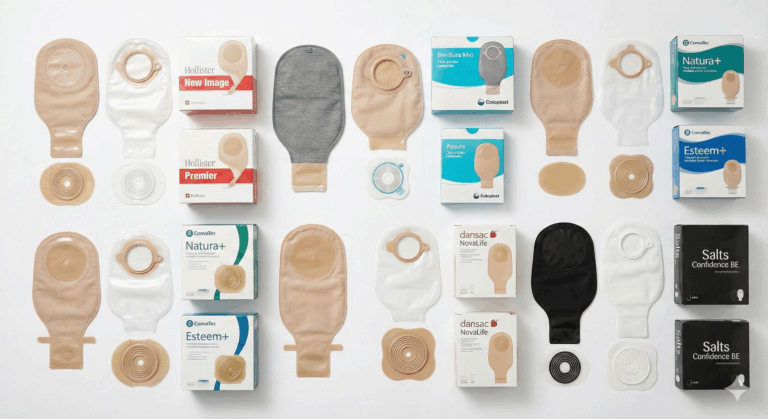
Most people in the United States get their ostomy supplies from a handful of manufacturers. Each brand makes complete pouching systems, one-piece and two-piece, flat and convex, drainable, closed and urostomy, plus its own range of accessories. Coloplast, Hollister and ConvaTec all send free samples in the US, so the practical way to compare them is to order two or three systems and wear each one for a few changes. Fit around the stoma, how the barrier feels on your skin and how quiet the pouch is under clothes usually decide it. Our Coloplast vs Hollister vs ConvaTec comparison goes deeper, and the catalog on this page links every product straight to its maker.
Coloplast Ostomy Products: SenSura Mio, Assura and the Brava Accessory Range
Coloplast is a Danish company and one of the largest ostomy makers in the US. Its best-known line is SenSura Mio, available as one-piece pouches and as two-piece systems with a click coupling (SenSura Mio Click) or an adhesive coupling (SenSura Mio Flex), in flat and convex versions. The older SenSura and Assura ranges are still widely used. Accessories come under the Brava name: moldable rings, paste, adhesive remover, skin barrier wipes, elastic tape and protective sheets. Coloplast also runs Coloplast Care, a free support program with advisors by phone who help with product questions and with finding a supplier. More detail in our Coloplast ostomy guide.
Hollister Ostomy Products: Premier, New Image, CeraPlus and the Adapt Accessories
Hollister is an American company based in Illinois. Its one-piece line is Premier and its two-piece line is New Image, both available with flat and convex barriers. Many Hollister pouches now use the CeraPlus skin barrier, which is infused with ceramide, a lipid found naturally in the skin. Accessories sit under the Adapt brand: barrier rings, paste, lubricating deodorant, adhesive remover and barrier extenders. Hollister also offers Secure Start services, a free program for people with a new ostomy, and a sample center where products carry a “Try it Free” badge. Our Hollister ostomy guide walks through the full range.
ConvaTec Ostomy Products: Esteem, Natura, ActiveLife and the me+ Program
ConvaTec is the third of the big three in the US. Its one-piece pouches include Esteem and ActiveLife, and its two-piece systems include Natura and SUR-FIT Natura, with convex options across the range. Accessories include eakin Cohesive seals and the ESENTA skin care range (adhesive remover and barrier wipes), and ConvaTec is also known for its moldable barrier technology, which you shape with your fingers instead of cutting. The me+ program is free and gives members access to certified ostomy nurses by phone or video, education and help connecting with suppliers. See our ConvaTec guide for the details.
B. Braun, Salts and Marlen Ostomy Products
Beyond the big three, several smaller makers are worth knowing. B. Braun, a German company, makes the Flexima and Proxima ranges, which are more common in Europe than in the US. Salts Healthcare, a family-owned British maker, produces one-piece and two-piece systems such as Confidence and Harmony Duo; Salts states that it cannot currently ship samples to the US, so American users usually order through a supplier that stocks the brand. Marlen is a US manufacturer based in Bedford, Ohio, known for its UltraLite pouches, and it takes sample requests online. Trying a smaller brand is often worth it when a mainstream system keeps leaking or irritating your skin.
Drainable vs Closed Ostomy Bags
The first choice after one-piece or two-piece is drainable or closed. It mostly depends on your output. A drainable ostomy bag has an opening at the bottom, closed with an integrated roll-up closure or a clip, so you can empty it into the toilet several times a day and keep wearing it. A closed ostomy bag has no outlet: when it is full you remove it and put on a new one. Both come with a built-in filter to release gas, and both come in different sizes, from small “mini” pouches to full-length ones. Our guides to one-piece drainable pouches, one-piece closed pouches, two-piece drainable pouches and two-piece closed pouches compare them model by model.
When a Drainable Ostomy Pouch Makes Sense for an Ileostomy or Loose Colostomy Output
People with an ileostomy almost always use a drainable pouch, because output from the small intestine is loose and frequent. Emptying the same pouch through the day is easier on the skin than peeling off a barrier every few hours. Drainable pouches also suit a colostomy in the first weeks after surgery, when output can be looser than it will be later. Look for an outlet that is easy to open and close with one hand, a length that sits comfortably when you are seated, and a filter that does not clog. If you empty often at night, some pouches can be connected to a larger night drainage bag.
When a Closed Ostomy Pouch Makes Sense for a Colostomy with Formed Output
A closed pouch suits many people with a descending or sigmoid colostomy, where output is firmer and predictable. There is no outlet to manage, the pouch is usually slimmer and quieter, and changing it takes a minute. With a one-piece closed pouch you replace pouch and barrier together, often once to a few times a day. With a two-piece system you keep the barrier on for several days and only swap the closed pouch, which is gentler on sensitive skin. Some people keep a few closed mini pouches for swimming, intimacy or the gym, and a drainable pouch for everyday wear.
Convex Skin Barriers and Pouches for Flush or Retracted Stomas
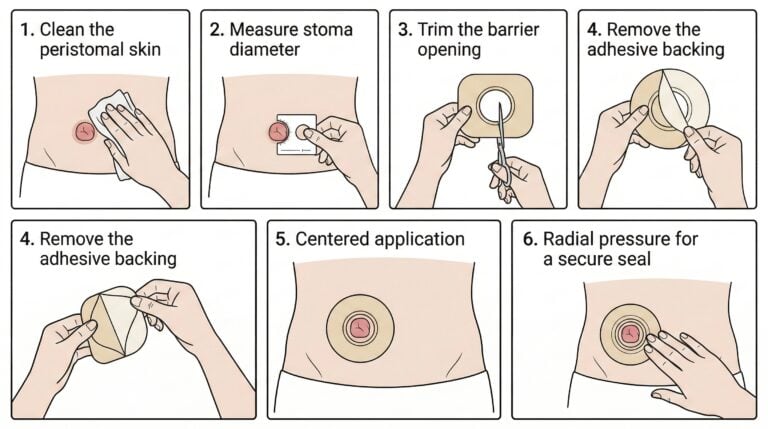
A convex barrier has a gentle outward curve on the side that touches the skin. It presses lightly around the stoma so the stoma sits proud of the skin and output goes into the pouch instead of under the adhesive. Convexity comes in different depths and firmness, from soft and shallow to deep and firm, and every major brand offers convex versions of its one-piece and two-piece systems. It is not the right choice for everyone: too much pressure can mark the skin, so the type and depth are best chosen with your stoma nurse. Our full guide to convexity in ostomy barriers explains the options.
Signs You May Need Convexity: Leaks Under the Barrier, a Flush Stoma or Skin Creases
The most common reason people move to convexity is repeated leaks under the barrier, especially when the stoma is flush with the skin, dips below it when you sit, or sits in a crease or dip in the abdomen. Changes in weight after surgery can create the same problem. Before switching, check the simple things: that the barrier opening matches your stoma size (stomas often shrink in the first weeks), that the skin is completely dry before you apply it, and that you hold the barrier in place for a minute so the adhesive warms up. A barrier ring and a support belt can also help. If leaks continue, ask your stoma nurse to assess you for a convex system; our troubleshooting guide covers the rest.
High-Output Ostomy Bags for Ileostomies
Some people, mostly with an ileostomy, have a very liquid and frequent output, which is often called a high-output stoma. Standard pouches fill quickly and the barrier can erode faster, so high-output pouches are designed with a larger capacity and an outlet that works like a tap or connects to a drainage bag. High output is something to manage with your surgical team or stoma nurse, because it affects hydration and diet as well as supplies; the pouch is only one part of it. Our guide to how often to change and empty your pouch covers the day-to-day routine.
Features to Look for in a High-Output Pouch
Look for a large capacity body, a tap or wide outlet that empties quickly without splashing, the option to connect a night drainage bag, and a barrier formulated to resist erosion from liquid output. Many people with high output combine the pouch with a barrier ring or paste for a tighter seal and change the barrier a little more often than the average. Hollister, Coloplast and ConvaTec all make pouches for high output, and samples are available from each, so it is worth trying more than one before settling on a system.
Ileostomy Bags: Types and Features
Ileostomy bags collect the loose, frequent output of a stoma made from the small intestine, which usually sits on the lower right side of the abdomen. Almost all are drainable: a wide outlet closed with a clip, a roll or a hook-and-loop strip, so you empty when the bag is one-third to half full instead of changing it. Ileostomy output contains digestive enzymes that irritate the skin, so the barrier and the fit matter as much as the bag. The stoma is typically a small spout, which helps direct output into the pouch. A well-cut opening and a barrier that resists breakdown mean longer wear and fewer surprises. Read our ileostomy guide and ileostomy care tips.
Drainable Ileostomy Bags: Outlet Closures, Capacity and Wear Time
When you compare drainable ileostomy bags, start with the outlet. A clip is quick but can feel bulky; a roll-up closure with a hook-and-loop strip is flatter and quiet; a wide easy-close outlet is easiest for people with limited grip. Then check capacity: a larger pouch gives more time between trips to the bathroom, a smaller one is easier to hide. Barrier wear time with an ileostomy is often shorter than with a colostomy, commonly around three to five days, because liquid output wears the adhesive down. If a barrier lasts only a day or two, ask your stoma nurse about a more erosion-resistant barrier or a ring. See our model guide to two-piece drainable pouches.
Ileostomy Bags at Night: Leaks, Sleeping Position and Night Drainage
Night is when many people with an ileostomy first run into leaks, because output moves while you lie flat and the bag fills slowly against the barrier. Empty the pouch just before bed and again if you wake. Sleeping on your back or on the side opposite the stoma, with a pillow for support, keeps the pouch from folding. Some systems connect to a larger night drainage bag, so you can sleep without emptying. A high-output pouch with a larger capacity, or a barrier ring for a firmer seal, can also help. If leaks keep waking you, our guide to ileostomy bag leaking at night walks through the usual causes.
Urostomy Supplies
Urostomy supplies are different from colostomy and ileostomy supplies because the stoma passes urine continuously. A urostomy pouch has a small tap or spout at the bottom for emptying, and an anti-reflux valve inside that stops urine flowing back towards the stoma. At night the pouch connects to a larger night drainage bag by the bed, so you can sleep through without emptying. Urostomy pouches come as one-piece and two-piece systems, with flat and convex barriers, from all the major brands. Our urostomy guide and our urostomy care guide explain daily care in more detail.
Urostomy Pouches with a Tap, Anti-Reflux Valve and Night Drainage Connection
When comparing urostomy pouches, check how easy the tap is to open and close with one hand, whether the connector fits your night bag without an adapter, and how the pouch lies when it is partly full. Because urine is always present, the barrier needs to hold up well to moisture; some people use a barrier ring or extended-wear barrier for this reason. A soft-textured pouch backing helps with comfort against the skin and under clothes. Keeping a spare connector and night bag when you travel saves a lot of trouble.
Night Drainage Bags, Leg Bags and Urostomy Accessories
The usual urostomy accessories are a night drainage bag with tubing, a stand or hanger to keep it below bed level, and sometimes a leg bag for long days out or travel. Barrier wipes and adhesive remover are as useful as with any other ostomy. Night bags are normally replaced on a regular schedule and rinsed between uses; follow the manufacturer's instructions and your stoma nurse's advice for your routine.
Urostomy Bags
Urostomy bags are built for a stoma that passes urine, so they look different from pouches made for stool. A urostomy bag has a small tap at the bottom that opens and closes with a twist or a flip, an anti-reflux valve inside that keeps urine from flowing back up toward the stoma, and a barrier designed for constant moisture. You empty it every few hours straight into the toilet, so you only remove it when it is time for a change. At night it connects to a night drainage bag. Urostomy bags come in one-piece and two-piece versions, with flat or convex barriers, from all the major brands. See our urostomy guide and urostomy care guide.
Urostomy Bag vs Colostomy Bag: Why the Design Is Not the Same
A colostomy bag is meant to hold solid or soft stool, so it has a wide outlet or a closed end and a filter for gas. A urostomy bag holds liquid that never stops flowing, so it has a narrow tap, no gas filter in most designs and a valve that keeps urine from sitting at the stoma. Wearing the wrong type is a common cause of leaks and skin problems, which is why ordering by product code matters. When you read a catalog, look for the word urostomy on the pouch line. Many brands also make a night drainage bag with a tube, a hanger or stand and a connector that fits their own pouches.
How Often to Empty and Change Urostomy Bags
Empty a urostomy bag when it is one-third to half full, not when it is heavy, because the weight pulls on the barrier. The barrier is commonly changed every three to five days, sometimes longer, and a little sooner in hot weather or if the edges lift. Mucus is normal in urine from a urostomy made with a piece of bowel, so cloudy strands are not a worry on their own. Strong-smelling or cloudy urine together with fever, back pain or a sore stoma should be checked by your doctor promptly. A daily routine you can adapt is in urostomy care tips.
Pediatric Ostomy Supplies for Babies and Children
Babies and children with a stoma need smaller pouches, smaller barriers and adhesives that are gentle on young skin. Manufacturers make dedicated pediatric ranges, including pouches sized for premature babies and newborns. Children grow quickly and their stoma can change size, so parents usually re-measure often and work closely with the pediatric stoma nurse. For older children and teens, the practical questions are about school, sport and sleepovers; our guides to children and ostomy and kids and teens with an ostomy cover them.
Pediatric Pouches: Hollister Pouchkins and ConvaTec Little Ones
Two of the best-known pediatric ranges are Hollister Pouchkins, which includes premie, newborn, one-piece, two-piece and pediatric urostomy pouches, and ConvaTec Little Ones, a pediatric range of pouches and barriers. Both can be requested as samples through the manufacturers, and a pediatric stoma nurse can help choose the size. Soft pouch panels and small, flexible barriers make a big difference for comfort when a child is crawling, running or sleeping on their front.
Where to Get Ostomy Supplies in the United States
In the US, ostomy supplies are usually prescribed by your doctor or recommended by your stoma nurse, then shipped by a medical supply company. Many of these companies deliver to your door every month and handle the paperwork with your insurer. You can also buy some products directly online. Before you order, write down the exact product numbers of the pouch, barrier and accessories that work for you, because suppliers ship by product code. Our guide to the main ostomy brands and suppliers explains how the chain works.
How Coverage Works for Colostomy, Ileostomy and Urostomy Supplies
Medicare Part B covers ostomy supplies for people who have had a colostomy, ileostomy or urostomy, within monthly quantity limits and through a supplier enrolled in Medicare. Medicaid and most private insurance plans also cover ostomy supplies, but the rules on quantities, approved suppliers and prior authorization vary from plan to plan, so it is worth calling your insurer before your first order. If you need more than the standard quantity, your doctor can usually document why. Our guides on Medicare quantities and insurance coverage go into the details.
Free Manufacturer Support: Coloplast Care, Hollister Secure Start and ConvaTec me+
All three big manufacturers run free support programs for people living with an ostomy in the US: Coloplast Care, Hollister Secure Start services and ConvaTec me+. Depending on the program, they offer phone support from advisors or ostomy nurses, product guidance, samples and help finding a supplier that works with your insurance. They are especially useful in the first months after surgery, when your stoma and your needs change quickly. Enrolling in one does not stop you from trying products from another brand.
Planning Your Ostomy Supplies Month by Month

How many ostomy supplies you use in a month depends on your system and your routine, not on a fixed rule. Someone with a two-piece drainable system may change the barrier every few days and the pouch a little more often, while someone with a one-piece closed system may use one or more pouches every day. Skin, activity, heat and output all change the numbers. The simplest way to plan is to count what you actually use for two or three weeks, then order a little more than that. Our monthly ostomy supplies checklist lists everything to include.
What Changes How Many Pouches and Barriers You Use
The biggest factors are the type of output (liquid output wears barriers faster), the fit around the stoma (a poor fit means unplanned changes), your skin, and your activity: sport, heat and humidity all shorten wear time. The first months after surgery usually need more supplies, because the stoma is still changing size and you are still finding the right system. Keep notes of every unplanned change and why it happened; it helps your stoma nurse adjust your system and helps your doctor document your quantities.
Keeping a Spare Supply at Home, at Work and in the Car
Most experienced ostomates keep a small emergency kit wherever they spend time: a pouch or two, a barrier cut to size, adhesive remover wipes, barrier wipes, a disposal bag and a change of underwear. A kit at work, one in the car and one in your gym bag means a leak never ruins the day. Store supplies somewhere cool and dry, because heat can affect adhesives, and rotate them so the oldest boxes are used first.
Packing Ostomy Supplies for Travel

Travelling with an ostomy is very doable with some planning. A common rule among ostomates is to pack about twice the supplies you expect to need, split between your carry-on and your checked bag, so a lost suitcase or a stomach bug never leaves you short. Pre-cut barriers at home if you use cut-to-fit, take a copy of your product codes, and carry a travel certificate or card that explains your ostomy in simple words. Our guides to packing an ostomy travel bag, flying with a colostomy bag and the ostomy travel certificate cover each step.
Carry-On Essentials for Flying with an Ostomy
Keep a full change kit in your carry-on: pouches, pre-cut barriers, wipes, disposal bags and a spare set of clothes. In the US the TSA allows scissors with blades shorter than four inches from the pivot point in carry-on bags, but pre-cut barriers avoid the question entirely. You can ask for a private screening, and a TSA notification card or the travel communication card from the United Ostomy Associations of America helps explain your ostomy discreetly. Empty your pouch before boarding and again on long flights: gas can expand as cabin pressure changes, and a pouch with a working filter and some free space is far more comfortable.
Ostomy Supplies for Hot Climates, Beaches and Long Trips
Heat and humidity make you sweat under the barrier, which can shorten wear time, so pack extra barriers for hot destinations and keep supplies out of direct sun and hot cars. Barrier wipes and a little powder on irritated skin help, and some people change the barrier more often at the beach. For long trips, find out before you leave where you could get your brand at your destination, and keep your supplier's contact details with your travel documents. Our guide to traveling with an ostomy bag has more tips for the whole journey.
Ostomy Bags and Ostomy Supplies: Frequently Asked Questions
These are common questions ostomates ask when they choose, change and live with their ostomy bags and ostomy supplies, from wear times to insurance cover. The answers are general and follow what manufacturers and stoma nurses commonly advise. Your own stoma, skin and output can differ, so treat them as a starting point and bring any doubts to your stoma care nurse or doctor, who can see what a written guide never can.
How often should you change a colostomy bag?
It depends on the type. A closed one-piece colostomy bag is normally replaced once or more a day, and a drainable one is emptied during the day and changed every three to four days. In a two-piece system the barrier usually stays on for three to five days, sometimes up to seven, while you swap the pouch more often. Change sooner if you feel itching or burning, see the edges lifting or notice output under the barrier. Never wait for a leak. Your stoma nurse can set a schedule for your skin and output. The steps are in our colostomy bag guide.
How often should you empty an ostomy bag?
Empty a drainable ostomy bag when it is one-third to half full, which can be several times a day with an ileostomy and less often with a colostomy. Waiting longer makes the bag heavy, pulls on the barrier and raises the risk of leaks. Closed pouches are not emptied; you replace them. Always empty before sleep, before exercise and before a long trip. Read our guide on when to empty your ostomy bag for a simple routine.
Can you shower with an ostomy bag on?
Yes. Water does not harm a stoma, and you can shower with the ostomy bag on or off. Many people prefer to leave it on and gently pat the barrier dry afterwards. Oily soaps and creams can leave a film that weakens adhesion, so rinse thoroughly and dry the skin before changing. A filter cover stops the filter getting wet, and a waterproof cover or tape on the edges adds peace of mind. Read our tips on protecting your ostomy bag during showers.
Can you swim with an ostomy bag?
Yes, and most ostomates do. Empty the pouch first, check that the barrier is firmly attached and consider waterproof tape around the edge. A smaller pouch is easier to hide, and swimwear made for ostomies adds a soft layer and keeps everything in place. Seawater and chlorine do not damage the pouch, but a barrier that is near the end of its wear time may lift, so change it before a long swim. For more, see our guides to swimming with a stoma and ostomy swimwear.
Are ostomy bags covered by Medicare?
In general, yes. Medicare Part B covers ostomy supplies for people with a colostomy, ileostomy or urostomy, within monthly quantity limits and when they come from a Medicare-enrolled supplier. Part B usually leaves you with a share of the cost after the deductible. Many Medicaid programs and private plans also cover supplies, but the quantities, approved suppliers and prior authorization differ, so call your insurer before the first order. Read more in our guides on how many ostomy bags Medicare pays for and insurance coverage for ostomy supplies.
What is the difference between a colostomy bag and an ileostomy bag?
The difference comes from the output. A colostomy bag collects stool from the large intestine, which is firmer and more predictable, so closed pouches are common. An ileostomy bag collects liquid to pasty output from the small intestine, so it is almost always drainable and has a wider outlet. Ileostomy output also irritates the skin more, so the barrier needs to hold up better. Both can be one-piece or two-piece and both can have a filter. For the surgery and the supplies side by side, see ileostomy vs colostomy.
Can you sleep with an ostomy bag on?
Yes. Empty the bag before bed so the weight does not pull on the barrier, and avoid lying on a full pouch. Sleeping on your back or on the opposite side with a pillow supports the pouch, and some people use a night drainage bag or a soft belt for extra security. If leaks wake you up, a barrier ring, a longer-lasting barrier or a different position often fixes it. More detail is in stopping ostomy bag leaks at night and sleeping with an ostomy belt.
How do you know what size ostomy pouch you need?
Two measurements matter. The first is the stoma size: use the measuring guide in the box, or trace the stoma on a template, and cut the barrier no more than about 1/8 inch (3 mm) larger. The second is pouch length, mini, midi or maxi, which depends on your output and routine. Measure at every change during the first six to eight weeks, because the stoma shrinks, and again after weight changes or surgery. A stoma nurse can check the fit in minutes. Measuring is shown step by step in the pouching system guide.
Where can you get free ostomy bag samples?
In the United States, Coloplast, Hollister and ConvaTec all send free samples of their pouching systems, and Marlen takes sample requests online. Request two or three different systems, wear each one for a few changes and note fit, comfort and leaks before you order a full box. Samples are also a safe way to test a convex barrier or a drainable pouch with a different closure. Some makers, such as Salts Healthcare, currently do not ship samples to the US. The catalog links to each manufacturer, and our free ostomy supplies samples guide lists the steps.
Do you need a prescription to buy ostomy supplies?
You can buy some ostomy supplies directly online, but for insurance to pay, you normally need a doctor's order and a supplier that bills your plan. The supplier ships by product code, so write down the exact codes of the pouch, barrier and accessories that work for you. Rules differ by plan, so ask whether your insurer needs a specific supplier. Free manufacturer programs can help you find one. The guide to getting ostomy supplies and best ostomy suppliers explain how it works.
Brand sample programs: try a pouch before you commit
Most people try two or three systems before one feels right. The big makers send samples to US addresses at no cost. Have your stoma size to hand: your stoma nurse can measure it with you.
ColoplastOrder pouching samples online. A product specialist may call to confirm the right size before they ship.Request Coloplast samples ↗
HollisterBrowse their ostomy products and look for the “Try it Free” badge. You can add several products to one sample order.Browse Hollister samples ↗
ConvaTecA short form for pouch and barrier samples. Their me+ program also offers ostomy nurse support by phone.Request ConvaTec samples ↗
MarlenA US maker based in Ohio. Request samples of their pouches and accessories online.Request Marlen samples ↗
Which ostomy bag and extras fit your stoma?
A quick starting point, not a prescription. Your stoma nurse has the final word on fit.
| Your situation | Typical pouch | Helpful extras | Read next |
|---|---|---|---|
| Colostomy (firmer output) | Closed pouch, one-piece or two-piece, usually with a gas filter | Deodorizing drops, adhesive remover | Colostomy bag guide → |
| Ileostomy (looser output) | Drainable pouch that you empty during the day | Barrier rings, stoma powder | Getting a secure fit → |
| Urostomy | Urostomy pouch with a tap, plus a night drainage bag | Barrier wipes, a night bag holder | Types of ostomy → |
| Flush or dipping stoma | A convex skin barrier (check with your stoma nurse first) | Barrier ring, a support belt | Quick fixes for leaks → |
| Sensitive skin | A barrier made for sensitive skin, removed gently | Adhesive remover, barrier wipes | Ostomy accessories explained → |
| Sport and busy days | A smaller or low-profile pouch | Support belt or underwear with a pocket | Exercise with a stoma → |
One-piecePouch and barrier are a single unit: slim, simple and quick to change.
Two-pieceThe barrier stays on for a few days and you swap only the pouch, which is gentler on skin that dislikes frequent peeling.
Checklist
Your monthly ostomy supplies, at a glance
Quantities depend on how often you change, so use this as a list to tick off before you reorder.
- Pouches for your usual change routine, plus spares for a bad week
- Skin barriers (wafers) if you use a two-piece system
- Barrier rings or paste, if your stoma nurse recommends them
- Adhesive remover spray or wipes
- Barrier wipes to protect the skin around the stoma
- Deodorizing drops or lubricating gel
- Disposal bags, plus a measuring guide or scissors for cut-to-fit barriers
- A travel kit with two or three full changes
- Something soft to wear over it: bag covers or a belt

Free guide pack
Get our ostomy guides by email
The SIIL guide to living with an ileostomy, colostomy or urostomy, plus three bonus guides: nutrition, a quick-fix playbook for everyday problems and a new-patient guide. Sent straight to your inbox as PDFs.
We’ll email you the guides and occasional tips. Unsubscribe anytime. Privacy policy.
Ostomy supplies catalog: every major brand in one place
63 ostomy products from Coloplast, Hollister, ConvaTec, B. Braun, Salts and Marlen, sorted by brand and by type. Filter, search, then open the product on the manufacturer's own site to check sizes, request samples or find a supplier.
Good to know: SIIL Ostomy does not sell ostomy bags or skin barriers. Links open the official manufacturer page. For prescriptions, insurance or Medicare coverage, talk to your WOC nurse or ostomy supplier. What we make is the layer on top: ostomy clothing and support that works with any brand.
Brand
Type
70 products
Coloplast1-piece bags
SenSura Mio 1-piece drainable pouch
Elastic barrier that follows body movement; open-end pouch for colostomy or ileostomy.
View on Coloplast ↗Coloplast1-piece bags
SenSura Mio 1-piece closed pouch
Closed-end pouch with filter, a common pick for a formed-output colostomy.
View on Coloplast ↗Coloplast1-piece bags
SenSura Mio 1-piece urostomy pouch
Urostomy pouch with non-return valve and tap outlet.
View on Coloplast ↗Coloplast1-piece bags
SenSura 1-piece drainable (Xpro)
Dual-layer adhesive with an extended-wear option.
View on Coloplast ↗Coloplast1-piece bags
Assura Original 1-piece drainable
Long-standing one-piece drainable system from Coloplast.
View on Coloplast ↗Coloplast2-piece systems
SenSura Mio Click barrier
Two-piece baseplate with a mechanical click coupling.
View on Coloplast ↗Coloplast2-piece systems
SenSura Mio Click drainable pouch
Drainable pouch for the Click coupling system.
View on Coloplast ↗Coloplast2-piece systems
SenSura Mio Flex barrier
Two-piece baseplate with an adhesive (Flex) coupling.
View on Coloplast ↗Coloplast2-piece systems
Assura 2-piece barrier
Baseplate for the Assura click-coupling system.
View on Coloplast ↗ColoplastConvex
SenSura Mio Convex Light 1-piece drainable
Light convexity for a flush or slightly retracted stoma.
View on Coloplast ↗ColoplastConvex
SenSura Mio Convex Soft 1-piece drainable
Soft convexity for areas that need gentle pressure.
View on Coloplast ↗ColoplastConvex
SenSura Mio Convex Flip 1-piece drainable
Convex barrier with flexible flip design for curved bodies.
View on Coloplast ↗ColoplastAccessories
Brava Moldable Ring
Moldable seal that fills skin folds around the stoma.
View on Coloplast ↗ColoplastAccessories
Brava Elastic Barrier Strips XL
Elastic strips that secure the edge of the barrier.
View on Coloplast ↗ColoplastAccessories
Brava Adhesive Remover Spray
Sting-free spray for removing barriers gently.
View on Coloplast ↗ColoplastAccessories
Brava Skin Barrier Spray
Protective film for the peristomal skin.
View on Coloplast ↗ColoplastAccessories
Brava Lubricating Deodorant
Helps output slide down and neutralises odour.
View on Coloplast ↗Hollister1-piece bags
Premier 1-piece drainable, flat CeraPlus
Ceramide-infused CeraPlus barrier with Lock 'n Roll closure.
View on Hollister ↗Hollister1-piece bags
Premier 1-piece closed pouch, SoftFlex
Closed-end pouch with filter and SoftFlex barrier.
View on Hollister ↗Hollister1-piece bags
CeraPlus 1-piece urostomy pouch
Urostomy pouch with the CeraPlus skin barrier.
View on Hollister ↗Hollister1-piece bags
Premier 1-piece high-output pouch
Larger capacity for high-output ileostomies.
View on Hollister ↗HollisterConvex
Premier 1-piece drainable, soft convex CeraPlus
Soft convexity with the CeraPlus barrier.
View on Hollister ↗Hollister2-piece systems
New Image 2-piece drainable pouch
Floating-flange two-piece pouch with Lock 'n Roll and filter.
View on Hollister ↗Hollister2-piece systems
New Image 2-piece closed pouch
Closed-end two-piece pouch with filter.
View on Hollister ↗Hollister2-piece systems
New Image flat CeraPlus skin barrier
Flat two-piece barrier with ceramide.
View on Hollister ↗Hollister2-piece systems
New Image 2-piece urostomy pouch
Urostomy pouch for the New Image system.
View on Hollister ↗HollisterConvex
New Image convex CeraPlus skin barrier
Convex two-piece barrier with ceramide.
View on Hollister ↗HollisterPediatric
Pouchkins newborn 1-piece pouch
One-piece pouch sized for newborns.
View on Hollister ↗HollisterAccessories
Adapt CeraRing barrier rings
Moldable rings with ceramide for a better seal.
View on Hollister ↗HollisterAccessories
Adapt medical adhesive remover spray
Removes adhesive without pulling the skin.
View on Hollister ↗HollisterAccessories
Adapt skin barrier paste
Fills gaps and uneven skin around the stoma.
View on Hollister ↗HollisterAccessories
Adapt lubricating deodorant
Lubricates the pouch and controls odour.
View on Hollister ↗HollisterAccessories
Adapt skin protective wipes
Barrier film wipes for the peristomal skin.
View on Hollister ↗ConvaTec1-piece bags
Esteem one-piece products
One-piece pouches with Stomahesive technology.
View on ConvaTec ↗ConvaTec1-piece bags
Esteem Body one-piece pouches
Closed, drainable and urostomy one-piece pouches.
View on ConvaTec ↗ConvaTec1-piece bags
ActiveLife one-piece products
Long-running one-piece system combining barrier and pouch.
View on ConvaTec ↗ConvaTec2-piece systems
Natura Plus two-piece products
Two-piece pouches and flanges with Durahesive or Stomahesive barriers.
View on ConvaTec ↗ConvaTec2-piece systems
SUR-FIT Natura two-piece products
Click-on two-piece system with a wide range of flanges.
View on ConvaTec ↗ConvaTec2-piece systems
Esteem Synergy two-piece products
Two-piece system with adhesive coupling.
View on ConvaTec ↗ConvaTecPediatric
Little Ones pediatric products
Pouches and barriers for babies and children.
View on ConvaTec ↗ConvaTecAccessories
Eakin Cohesive seals
Mouldable seals that protect the skin around the stoma.
View on ConvaTec ↗ConvaTecAccessories
Diamonds gelling sachets
Gels liquid output and controls odour inside the pouch.
View on ConvaTec ↗B. Braun1-piece bags
B. Braun ostomy appliances
Flexima and Proxima one- and two-piece ranges.
View on B. Braun ↗B. BraunConvex
B. Braun convex ostomy bags
Convex options for retracted or flush stomas.
View on B. Braun ↗B. BraunAccessories
B. Braun high-output stoma care
Products for high-output ileostomies.
View on B. Braun ↗SIIL OstomyClothing & support
SIIL Ostomy Belt
Support belt that holds any pouch flat under clothes.
Shop at SIIL →SIIL OstomyClothing & support
SIIL ostomy bag covers
Fabric covers and wraps for any brand of pouch.
Shop at SIIL →SIIL OstomyClothing & support
SIIL ostomy underwear
Underwear with an inner pocket for the pouch.
Shop at SIIL →SIIL OstomyClothing & support
SIIL ostomy panties
High-waist panties that keep the pouch in place.
Shop at SIIL →SIIL OstomyClothing & support
SIIL ostomy wraps
Soft bands that wrap the pouch discreetly.
Shop at SIIL →SIIL OstomyClothing & support
SIIL ostomy swimwear
Swimsuits and bikinis designed around a stoma.
Shop at SIIL →SIIL OstomyClothing & support
SIIL stoma protector
Rigid guard that shields the stoma from knocks.
Shop at SIIL →No products match. Try another brand, type or search.
Everyday problems and what helps
The pouch is only half of it. These are the moments people tell us about most, and the SIIL pieces made for them. Every piece works with any brand of pouch.

Your pouch shows under clothesA soft belt holds the pouch flat against your body, and a fabric cover hides the plastic.

The plastic feels cold or rustlesA fabric cover turns the pouch into something soft and quiet next to your skin.

Gym, cycling and busy daysSupport that keeps everything in place while you move, and a guard against knocks.

Swimming and the beachSwimwear with room for your usual pouch, so a swim is just a swim again.

Sleep and intimate momentsA light wrap or high-waisted panties keep the pouch close, covered and quiet.

A pouch that stays put all dayUnderwear with an inner pocket holds the bag in place, from morning to night.
Guides to choosing ostomy supplies
Plain-English guides for the questions that come up most.
PouchesTypes of ostomy bagsOne-piece or two-piece, drainable or closed: how each one works and who it tends to suit.Read the guide →LeaksGetting a secure fitBarrier sizing, convexity and simple routines that help your pouch hold through the day and night.Read the guide →AccessoriesOstomy accessories explainedBarrier rings, paste, powder, adhesive remover and wipes: what each one is for.Read the guide →ChecklistWhat you use in a typical monthA simple list of pouches, barriers and extras, so you know what to reorder and when.Read the guide →BrandsThe main brands comparedColoplast, Hollister, ConvaTec and more, plus the everyday things that never come in the box.Read the guide →New ostomyNew ostomy patient guideThe first weeks after surgery: changing your pouch, food, sleep and getting back to your routine.Read the guide →TroubleshootingQuick fixes for everyday problemsLeaks, ballooning, noise and irritated skin, with the practical fixes people use most.Read the guide →BasicsIleostomy vs colostomyHow the two differ, and how that changes the pouch and accessories you use.Read the guide →
More guides on the SIIL blog →Ostomy supplies FAQ
What ostomy supplies do I need each month?
Pouches, and skin barriers if you use a two-piece system, plus the extras that suit your skin: barrier rings or paste, adhesive remover, barrier wipes and deodorizing drops. How many depends on how often you change, which your stoma nurse will help you set. See the monthly checklist.
Does SIIL Ostomy sell ostomy bags?
No. Ostomy bags, pouches and skin barriers come from manufacturers such as Coloplast, Hollister and ConvaTec and from your ostomy supplier. SIIL Ostomy makes the accessories and clothing that go over any pouch: bag covers, belts, underwear, panties, wraps and swimwear. See SIIL clothing.
How do I get samples of ostomy bags?
Coloplast, Hollister, ConvaTec and Marlen each run a sample program for US addresses; the links are in the samples section above. Have your stoma size ready, because some brands call to confirm it before shipping. Read our samples guide.
What is the difference between a one-piece and a two-piece ostomy bag?
In a one-piece system the pouch and skin barrier are a single unit that you change together. In a two-piece system the barrier stays on your skin for a few days and you swap only the pouch. Types of ostomy bags.
What is a convex skin barrier?
A barrier with a gentle outward curve that presses around the stoma so it sits proud of the skin. It is often suggested for stomas that are flush or dip below the skin. Check with your stoma nurse before switching.
Do SIIL garments work with every brand of pouch?
Yes. SIIL belts, bag covers, underwear, wraps and swimwear are designed to sit over any one-piece or two-piece pouch, whatever the brand.

Free guide pack
Take our guides with you
The SIIL guide to living with an ileostomy, colostomy or urostomy, plus three bonus guides: nutrition, a quick-fix playbook for everyday problems and a new-patient guide. Sent straight to your inbox as PDFs.
We’ll email you the guides and occasional tips. Unsubscribe anytime. Privacy policy.